













































You are using an out of date browser. It may not display this or other websites correctly.
You should upgrade or use an alternative browser.
You should upgrade or use an alternative browser.
Aligning and Mounting a scope
- Thread starter Prdtrgttr
- Start date

saskcanshooter
Member
- Location
- Saskatchewan
Plumb-bob at 100 meters, also place a level on the scope base then cant the rifle until the bubble hits the line then do the same for the scope.

Ar180shooter
CGN Ultra frequent flyer
- Location
- Ottawa, ON
The feeler gauge method is one I like to use when the setup allows it.

- Location
- Invermere, BC
The feeler gauge method is one I like to use when the setup allows it.
Can you explain this, please?
Ar180shooter
CGN Ultra frequent flyer
- Location
- Ottawa, ON
You basically use a set of feeler gauges to ensure the flat portion of the scope (opposite the elevation turret) is perfectly square to a picatinny/weaver rail or one piece mount/base. Basically like this (not my rifle):
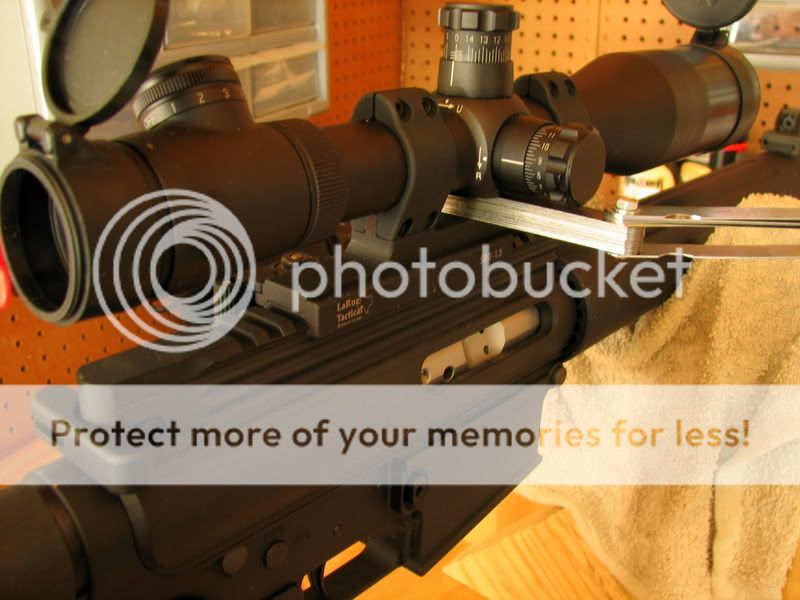
I fin it's a simple method of squaring your scope to the base it's mounted on.
As mentioned though, this won't work with certain setups, such as if you're using two piece bases.
If the method won't work because the optics setup won't doesn't have a flat base to which you can align the scope, I just eyeball it. Put the rifle in a rest, make sure It's perfectly vertical, mount the scope in the rings and have a vertical or horizontal spot on the wall as a point of reference. Remember though, the crosshair will be on a slight cant. This has to do with manufacturing tolerances, and 99% of the time, will not be noticeable to most shooters.
I fin it's a simple method of squaring your scope to the base it's mounted on.
As mentioned though, this won't work with certain setups, such as if you're using two piece bases.
If the method won't work because the optics setup won't doesn't have a flat base to which you can align the scope, I just eyeball it. Put the rifle in a rest, make sure It's perfectly vertical, mount the scope in the rings and have a vertical or horizontal spot on the wall as a point of reference. Remember though, the crosshair will be on a slight cant. This has to do with manufacturing tolerances, and 99% of the time, will not be noticeable to most shooters.

You basically use a set of feeler gauges to ensure the flat portion of the scope (opposite the elevation turret) is perfectly square to a picatinny/weaver rail or one piece mount/base. Basically like this (not my rifle):
I fin it's a simple method of squaring your scope to the base it's mounted on.
As mentioned though, this won't work with certain setups, such as if you're using two piece bases.
If the method won't work because the optics setup won't doesn't have a flat base to which you can align the scope, I just eyeball it. Put the rifle in a rest, make sure It's perfectly vertical, mount the scope in the rings and have a vertical or horizontal spot on the wall as a point of reference. Remember though, the crosshair will be on a slight cant. This has to do with manufacturing tolerances, and 99% of the time, will not be noticeable to most shooters.
now I have to go find a feeler gauge. that's a brillant idea, I'm ashamed I never thought of it.
having someone who is slightly ocd around helps as well.
make sure you are able to view the corsshair in an open field or at a distance, lining things up in your basement with no reference points DOES NOT work well. haha.

You basically use a set of feeler gauges to ensure the flat portion of the scope (opposite the elevation turret) is perfectly square to a picatinny/weaver rail or one piece mount/base. Basically like this (not my rifle):
I fin it's a simple method of squaring your scope to the base it's mounted on.
As mentioned though, this won't work with certain setups, such as if you're using two piece bases.
If the method won't work because the optics setup won't doesn't have a flat base to which you can align the scope, I just eyeball it. Put the rifle in a rest, make sure It's perfectly vertical, mount the scope in the rings and have a vertical or horizontal spot on the wall as a point of reference. Remember though, the crosshair will be on a slight cant. This has to do with manufacturing tolerances, and 99% of the time, will not be noticeable to most shooters.
Remember this system will only work if your reticle is perfectly square to the frame of the scope. Surprisingly this is not always the case. Even high optics can have the reticle off a degree or two. This is a good place to start but the very best way is experience. We use a close in reference(big cross on the floor) and a farther reference point (window or doorway). By doing this you ensure the reticle and not the scope body is square to the bore and frame of rifle. Phil.

Ar180shooter
CGN Ultra frequent flyer
- Location
- Ottawa, ON
Remember this system will only work if your reticle is perfectly square to the frame of the scope. Surprisingly this is not always the case. Even high optics can have the reticle off a degree or two. This is a good place to start but the very best way is experience. We use a close in reference(big cross on the floor) and a farther reference point (window or doorway). By doing this you ensure the reticle and not the scope body is square to the bore and frame of rifle. Phil.
Yes, you may need adjust it slightly and should always check to make sure, but it gets you very close, very quickly. At the very least, it is an easy way for people who don't have a lot of scope mounting experience to get their scope reasonably straight and functional (and trust me, I've seen some really poorly set up scopes, lol). Naturally, I'd use other methods and be much more meticulous if setting up an expensive scope on someones target rifle, but if I have a dozen cheap rifle/scope combos to set up, if I can save 5 minutes/rifle by using the feeler gauge method, I will.
- Location
- Invermere, BC
Cool, some good ideas here! 

canadaman30
CGN Ultra frequent flyer
- Location
- Far from the City
Magnetic roof truss dial at CT works well.

ultimate_monkey
CGN Ultra frequent flyer
- Location
- victoria BC
Just eye ball it, having your x-hair perfectly square to the rifle doesn't matter. What matters is that your x-hair is perfectly level/plumb when your shooting. And unless your some kind of shooting god you will probably hold your rifle canted more then you think you do, due to ergonomics

- Location
- Fort Mcmurray
Hey Guys I watch this long video while at work one day but had soem great info at about minute 54 they show a great way to verify scope alignment,
http://www.youtube.com/watch?v=dxqIKiBMqmg
http://www.youtube.com/watch?v=dxqIKiBMqmg

Just eye ball it, having your x-hair perfectly square to the rifle doesn't matter. What matters is that your x-hair is perfectly level/plumb when your shooting. And unless your some kind of shooting god you will probably hold your rifle canted more then you think you do, due to ergonomics
Yes, and no. You can also have misalignment between the reticle and the erector assembly (adjustment mechanisms). Its the erector assembly that needs to be running square, not the scope body or the reticle.
Adjusting a scope so that it runs square to gravity when your bubble level is centered only tells you that your erector assembly is squared. You will not be able to detect cant between the scope body and the rifle or the crosshairs and the rifle unless they're quite large. Leveling your cross hairs just ensure that the cant is consistent.

After doing the in house adjustments then go out on the range to prove. At 100m set up your target with a plum vertical line (plumbob or level). Then with your accurate load 0 the rifle.
Then run a group +6 and -6 inches below or more if you have a large target. Do not re-0 the scope when at + or - 6". If you see a pattern, ie +6 is 2" left and -6 is 2" right then your scope is not aligned. You loosten the rings and move the scope in the direction of the group, ie move the vertical cross hair towards the group.
Retest and see if your +/- group is centered on your plum line. Done.
Cheers.
Elky....
Then run a group +6 and -6 inches below or more if you have a large target. Do not re-0 the scope when at + or - 6". If you see a pattern, ie +6 is 2" left and -6 is 2" right then your scope is not aligned. You loosten the rings and move the scope in the direction of the group, ie move the vertical cross hair towards the group.
Retest and see if your +/- group is centered on your plum line. Done.
Cheers.
Elky....






















