Am I over-pressured?

AShorvath

Member
Rating - 100%
7   0   0
300WSM, Norma brass, H4350 and 175gr LRX

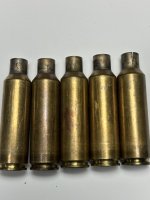
I worked up a load for the 175gr and followed the recommended starting and max load for h4350. I ended up with 66.8gr which was a pretty solid group (3 touching at 100yrd) but I noticed my brass had a little crack in it after an elk hunt. I never used this Norma brass with my previous load so not sure if that is the issue or if I am in fact overpressure even though I am under the Barnes 'Max'. I dropped the load down to 66.6gr to see if the cracks would go away and they are still present in some of the spent cases. The bolt is easy to lift up and I can't see any other signs of overpressure. Also the cracks only appear in 1 of every 3-5 shots.

My average vel is 3074fps but that is from a cheaper chrono and not a garmin.

thoughts?
 

Attachments

  • IMG_6273.jpg
    IMG_6273.jpg
    79.5 KB · Views: 178
  • IMG_6274.jpg
    IMG_6274.jpg
    81.4 KB · Views: 179
In my opinion you're probably 100, even 200 fps over max with 4350

Barnes data used Remington brass, possibly having considerable larger case capacity than the Norma you're using

Quickload chart for 300 wsm 175 LRX @ 65k PSI

Cartridge : .300 WSM
Bullet : .308, 175, Barnes 'LRX'BT 30318
Useable Case Capaci: 67.762 grain H2O = 4.400 cm³
Cartridge O.A.L. L6: 2.860 inch = 72.64 mm
Barrel Length : 24.0 inch = 609.6 mm

Predicted Data for Indicated Charges of the Following Powders.
Matching Maximum Pressure: 65000 psi, or 448 MPa
or a maximum loading ratio or filling of 104 %
These calculations refer to your specified settings in QuickLOAD 'Cartridge Dimensions' window.
C A U T I O N : any load listed can result in a powder charge that falls below minimum suggested
loads or exceeds maximum suggested loads as presented in current handloading manuals. Understand
that all of the listed powders can be unsuitable for the given combination of cartridge, bullet
and gun. Actual load order can vary, depending upon lot-to-lot powder and component variations.
USE ONLY FOR COMPARISON !

36 loads produced a Loading Ratio below user-defined minimum of 80%. These powders have been skipped.
Powder type Filling/Loading Ratio Charge Charge Vel. Prop.Burnt P max P muzz B_Time
% Grains Gramm fps % psi psi ms
--------------------------------- -----------------------------------------------------------------
Alliant Reloder-26 101.8 68.4 4.43 3055 100.0 65000 10649 1.102 !DANGEROUS LOAD-DO NOT USE!
Norma MRP 102.7 67.0 4.34 3020 99.6 65000 10795 1.107 !DANGEROUS LOAD-DO NOT USE!
IMR 7828SSC 103.2 66.2 4.29 2989 97.6 65000 10622 1.101 !DANGEROUS LOAD-DO NOT USE!
Vihtavuori N560 104.0 66.4 4.30 2987 97.0 63920 10933 1.114 ! Near Maximum !
Alliant Reloder-17 92.2 60.4 3.91 2975 100.0 65000 9520 1.115 !DANGEROUS LOAD-DO NOT USE!
Alliant Reloder-16 97.4 59.2 3.84 2971 100.0 65000 9543 1.110 !DANGEROUS LOAD-DO NOT USE!
Accurate MAGPRO 104.0 69.1 4.47 2964 95.4 63611 10915 1.121 ! Near Maximum !
Alliant Reloder-22 104.0 65.7 4.26 2963 98.5 63651 10555 1.123 ! Near Maximum !
Ramshot Magnum 104.0 70.8 4.58 2948 99.0 64101 10091 1.111 ! Near Maximum !
Vihtavuori N555 102.7 62.9 4.08 2945 100.0 65000 9607 1.136 !DANGEROUS LOAD-DO NOT USE!
Alliant Reloder-19 101.5 63.4 4.11 2937 98.5 65000 10122 1.121 !DANGEROUS LOAD-DO NOT USE!
Ramshot Hunter 96.9 62.5 4.05 2935 99.8 65000 9826 1.126 !DANGEROUS LOAD-DO NOT USE!
Winchester StaBALL 6.5 Bartell Tune 94.3 63.4 4.11 2933 99.9 65000 9738 1.127 !DANGEROUS LOAD-DO NOT USE!
Hodgdon H414 91.5 60.5 3.92 2930 99.5 65000 9851 1.128 !DANGEROUS LOAD-DO NOT USE!
Winchester 760 91.5 60.5 3.92 2930 99.5 65000 9851 1.128 !DANGEROUS LOAD-DO NOT USE!
Vihtavuori N550 93.7 59.8 3.87 2917 100.0 65000 9537 1.136 !DANGEROUS LOAD-DO NOT USE!
Norma URP 96.4 59.5 3.86 2917 100.0 65000 9402 1.133 !DANGEROUS LOAD-DO NOT USE!
Hodgdon CFE223 87.4 59.5 3.86 2913 100.0 65000 9323 1.132 !DANGEROUS LOAD-DO NOT USE!
Hodgdon Leverevolution 94.1 58.8 3.81 2913 100.0 65000 9408 1.130 !DANGEROUS LOAD-DO NOT USE!
Alliant Reloder-23 104.0 63.6 4.12 2909 100.0 60465 9387 1.145 ! Near Maximum !
Norma 204 96.3 62.1 4.02 2909 98.3 65000 9854 1.125 !DANGEROUS LOAD-DO NOT USE!
Hodgdon H4831SC 102.8 64.9 4.21 2906 96.7 65000 9928 1.119 !DANGEROUS LOAD-DO NOT USE!
Accurate 4350 95.1 59.4 3.85 2903 100.0 65000 9321 1.143 !DANGEROUS LOAD-DO NOT USE!
IMR 4831 101.0 60.4 3.91 2895 100.0 65000 9179 1.140 !DANGEROUS LOAD-DO NOT USE!
Ramshot BigGame 87.3 58.1 3.77 2893 100.0 65000 8958 1.136 !DANGEROUS LOAD-DO NOT USE!
IMR 4895 87.3 54.5 3.53 2891 100.0 65000 9011 1.143 !DANGEROUS LOAD-DO NOT USE!
Alliant Reloder-15 88.2 55.1 3.57 2884 100.0 65000 8995 1.143 !DANGEROUS LOAD-DO NOT USE!
Norma 203B 88.5 55.3 3.58 2880 100.0 65000 8911 1.145 !DANGEROUS LOAD-DO NOT USE!
Hodgdon Hybrid 100V 98.9 59.8 3.87 2877 100.0 65000 8626 1.135 !DANGEROUS LOAD-DO NOT USE!
Shooters World SW4350 96.5 59.6 3.86 2875 99.6 65000 9412 1.145 !DANGEROUS LOAD-DO NOT USE!
Hodgdon H4350 99.2 60.6 3.93 2875 99.1 65000 9362 1.134 !DANGEROUS LOAD-DO NOT USE!
 
Last edited:
On the second picture there is a primer missing, was that from being resized, or did it come out when fired?

How do these primers look compared to your previous cases? Are these more flat? Do you have ejector marks on the brass heads? It’s hard to tell on the pic.
 
Cracks in the neck are not from over pressure. Those cracks suggest the brass has been over used and needs to be annealed.

The primers are a little flat and the missing primer suggests that one fell out, which is def a pressure sign.

As someone mentioned above, that load seems a little hot. Prob not dangerous but its gonna damage the brass and limit its lifespan.
 
Listen to the advice OP your brass is work hardened, and your load is hot.

I think you may have been mislead about how often those cases were fired.

That empty primer pocket means the base of the case has expanded to the point it will no longer hold the primer, and likely fell out when you ejected the empty case.

The loads in the manuals are "suggested," not written in stone.

Your load is too hot, with the bullets, primers, and powder combination you're using in your specific rifle.

Norma brass is pretty forgiving, but the 300WSM generates around 65K psi with that load, maybe more.

Most cases don't stand up to a steady diet of such high pressures for more than 3 reloads, in my experience.

I'll bet if you drop the load back at least 3 grains, and reanneal your cases, the groups will be almost identical and velocities will be so close, there isn't an Elk or Moose that will know any better.
 
If you owned all the manuals and read all the available online data you’d know the Barnes load data showing a compressed charge is an error.
Did you know Barnes has had to correct more over pressure load data than anyone on the planet?
Lot to lot variations need to be accounted for as well. Sierra and Hogdon are 2.7 grains different with Sierra 175’s. Be careful.
 
Last edited:
Without reading it anywhere, I have formed the opinion that reloading manuals report the results that they got, with their gear and their components. Chances are really low that they used your rifle for their velocity testing. It is not likely that you are using the same lot of primers, cases, powder and bullets that they used - so, there are many ways your results can be different than theirs. If you can not understand or afford to Start Low and work up to pressure signs with your components in your gear, perhaps reloading is not something that you should play with. I believe most bullet and powder companies (that publish modern reloading manuals in the past 25 years or so) use pressure testing devices to test their loads for the breech pressure that they develop - with the components that they used - primer, case, bullet and powder - I do not own pressure testing equipment, and do not know any hand loaders that do - all of us "make do" with surrogates for pressure - perhaps velocity, perhaps case expansion, perhaps primer condition - but none of that will say that the pressure was ##### psi. Too many people on CGN apparently believe that a Reloading Manual will give you a "safe" maximum - I believe their published loads are safe - in their gear, using their components. When you swap components - different primer, powder, brass or bullet, I think you are on your own.
 
  • Like
Reactions: DGY
OK, perfect! I appreciate all the advice and will rework the load this winter.

Also the missing primer is from resizing, that is when I noticed that crack.

I will start at about 63gr as gatehouse recommends and go from there.

Now is the brass that I have used with this load trash? I have about 30-40 cases that 'might' have been fired with this current load but don't show cracks. Unfortunately I loaded this last year and didn't keep track of what brass was fired with 66+ gr
 
OK, perfect! I appreciate all the advice and will rework the load this winter.

Also the missing primer is from resizing, that is when I noticed that crack.

I will start at about 63gr as gatehouse recommends and go from there.

Now is the brass that I have used with this load trash? I have about 30-40 cases that 'might' have been fired with this current load but don't show cracks. Unfortunately I loaded this last year and didn't keep track of what brass was fired with 66+ gr
being that you bought this brass from someone else, you truely don't know the round count. I would suggest annealing the brass and load a few and see what happens, your best bet is to get into brass that you know that it hasn't been shot out.
 
The loads in the manuals are "suggested," not written in stone.

Your load is too hot, with the bullets, primers, and powder combination you're using in your specific rifle.
Yep. I've had book loads end up well below max as well as some where I couldn't get anywhere near the book load.


Now is the brass that I have used with this load trash?
No. Brass is only trash when the primer pocket opens up too far and the primers seat with hardly any resistance at all. Even then, as long as the primer stays in the pocket, the case is OK for one last firing. I mark those rounds with a sharpie X on the bottom and chuck them after firing.
 
OK, perfect! I appreciate all the advice and will rework the load this winter.

Also the missing primer is from resizing, that is when I noticed that crack.

I will start at about 63gr as ######XX recommends and go from there.

Now is the brass that I have used with this load trash? I have about 30-40 cases that 'might' have been fired with this current load but don't show cracks. Unfortunately I loaded this last year and didn't keep track of what brass was fired with 66+ gr
PSA for the day ....
Why would you take the word on where to start from someone who is not in the manufacturing business of reloading components is not a published writer nor a supplier of reloading components etc... ?
Have you not read any of the recommendations or warnings in any of the Books that Reloading Component companies have spent millions on to provide you with documented information ?
Taking the recommendations of one individual is a recipe for disaster and from your pictures that event is not far off imo.
Others have offered advice based on what they have learned from reading manuals and from practice.
 
Regarding annealing - I never used to do that - back around 2002 or so, I got a Ruger #1A in 7x57 - usually I would get new Remington bulk brass - like 50 or 100 cases per bag - I probably reloaded some of them a few times, but I did not keep good records and really do not know what I did, then. My reloading records show that I used RL-19 powder under 150 grain Nosler Partition bullets - several hundred of them. Those fired brass were put in bags to anneal "one day". Fast forward to a few years ago - another 7x57 rifle - first time to resize circa 80 cases, I must have had 20 of them crack the neck when FLS sizing. So, I bought a Salt Bath Annealing kit - the principle of that seller is apparently a metallurgist from Western Canada. I annealed a pile of those brass following the user instructions in that kit - I got perhaps 10 cracked necks out of another 75 or so cases - so the "annealing" helped, but did not eliminate the cracked necks. I have not reloaded any of those cases yet - the ones that did not crack necks when resized. I believe now that I was seeing "stress corrosion cracking" on brass that was close to 20 years old - although I have certainly read of others who have re-sized 50 year old brass without issue.

A next-door neighbour brought over a box full of mixed up 22-250 cases - various head stamps - RP, W-W, Barnes, PMC, etc. - I believe all were from factory ammo that had been fired once. During sorting for head stamp. I found four cracked necks on W-W cases - the shooter in question probably did not know which or when the case necks cracked. I FLS circa 120 of those W-W cases and never found another cracked neck. However, I bought a Red Label bag of W-W 22-250 brass - from the bag, probably half dozen would not even chamber in my rifle - the necks and case mouths were so deformed - I FLS and trimmed to length the rest of that bag of "new" brass - as if W-W changed brass subcontractors from the days they sold "Blue Label" bags of brass - which I have had no problems with, at all.
 
As others have said your load is a BIT HOT 🥵 The cracked necks are from TOO many firings . Different brands of brass vary in hardness so there is no - how many loads can I get before they crack . All brass should be annealed every time for best Life and Neck tension . Your brass is JUNK throw it away . Not all brass is the same in hardness or in capacity so start with min load and work up especially when changing brands sometimes even with just different lots .
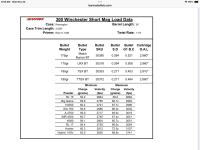
I would go to a slower burn rate powder too . But there are others powders that work well in the 300 Whizzum too as in Bartells load data in post # 2. 👍

I have supplied Barnes load data .
 

Attachments

  • IMG_2961.png
    IMG_2961.png
    139.7 KB · Views: 10
Back
Top Bottom