Annealing Newbie

daroccot

Regular
Rating - 100%
34   0   0
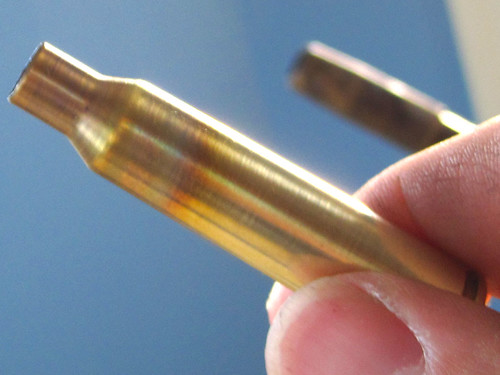
I'm curious about annealing to increase the longevity of my brass, so I watched some videos on youtube and read some stuff on 6mmBR.com. This is what I am comming up with, after about 13 seconds in the drill and socket method:

4756308391_41252112af.jpg


and a video...

[youtube]fhcry0mw0bc[/youtube]
 
Last edited:
did you do it in a dark room
too hot will ruin brass
you might have to resize after
if you do for too long or go down too much you can soften the shoulder and when you go to seat a bullet you will ruin brass (shoulder bulges/buckles)
 
Looks pretty good to me, I do the same method with my 243 brass, having a drill turn at slow speed with a holder I built to hold the case. I think I'm around 9 to 10 seconds then I drop them in water. I have fired them numinous times and things look good so fare.

Cheers
Bucky:sniper:
 
So 13 seconds is probably too long and it looks like I've gone a bit too far down the case wall? I might also need to change my torch, it's a braising tip I think might need more of a finer point to concentrate the heat more?

Thanks
 
Please reduce the size of your pictures.
Heat the brass until it changes colour and quench. Red hot is too hot.
That giant case needs trimming and chamfering and deburring.
 
I use a torch in my bathroom in the dark. Hold the cases in my fingers. Rotate in the flame until my fingers get hot ( dull red ) and drop in a bucket of water.

Before annealing: too much spring back during neck sizing; could pull bullets out with my fingers. Also a distinct ringing when the necks were struck

After annealing: necks size properly, no more ringing.
 
The only way to know for sure is to measure the brass temp - colour change is not a good indicator.

750 to 800F is where you want to be. tempilac paint is what you want get from your local welding supply store. The paint is easy to apply but a royal PITA to remove. The crayon leaves no residue but you can only use this by inference.

I am going to set up a combo of both so that I can get a true indicator vs time.

Different alloys and degrees of work hardening will affect your time in flame. Go over 800f and the necks will turn to taffy. Under and it has done nothing much. have different amounts with each case and you have a world of hurt.

I have a chance to test some of my annealed brass for ductility and my method still requires a whole bunch of improvement.

Process is so easy, it is hard to do it precisely.

I will be looking at the new Frankford Arsenal set up when it is offered later this year. Supposed to be a much lower cost unit vs the small manf rigs.

If it works, I will carry it as I feel annealing is so very critical to LR accuracy.

But doing it with any degree of variability is worse then not doing it at all. A couple of seconds and you may have a pile of junk.

Jerry
 
I could also use oxi-acetylene with a finer tip flame to really concentrate the heat. Would this be better then a propane setup? Thanks for the read cyan1de, I had already saw the 6mmbr one, that induction annealer looked cool, I could probably build one of those too. However I don't really have that many cases couple hundred I guess. Is the pic size better sun? I'm used to really big monitors!
 
As already noted the article on 6mmBR is a very good review.

I use tempilaq to get my neck temperatures to 700-750, so far I have had good results, both from accuracy changes, and using the semi-quantitaitve method outlined in 6mmbr. What is really needed is a good and reproducible method to assess the changes in ductility of the necks. I hope to get around to making one of these after the summer shooting season is over.

I have attached pics and a video of the rotary annealing system that I use. As far as I know it is the only CANADIAN made rotary annealer that I know of.


GrizzAnneal1.jpg


GrizzAnneal2.jpg


GrizzAnneal3.jpg


[youtube]7n6_w3bwq_I[/youtube]
[youtube]Kl1amCv3xo8[/youtube]
 
I did 50 myself yesterday, same method, same tools, but in a dark room, with a bit cooler torch setting, and for only 10 seconds. I have a much tighter fit, so there's almost no wobbling. I also take care to have the flame edge on the shoulder, and at 90 degrees to the case, so the neck is heated only by induction, not by direct flame contact. The neck is much smaller than the shoulder, and for the heat to be consistent through the neck/shoulder area, the larger shoulder area needs more heat applied. I do not heat long enough for any discernable redness to appear even in the dark. Very consistent (the main objective), and produces good results in the field.

I'd just as soon refine and share the simple, inexpensive and effective method demonstrated by the OP, than shoot it down and post pictures of elaborate and inaccessible machines. Sure it shows the "Gold Standard", but there isn't one reloader (who anneals) in 1000 who would or could buy that kind of apparatus (myself included) and while those machines would be much quicker, I'm not convinced that they would do a measurably better job than I can with my setup and my experience with it.

 
The annealing machines are slick, however much too costly for an individual. One is well suited for club use, with all the associated headaches that come with shared equipment. My buddy is annealing brass as we speak, we used some scrap 9mm brass and noticed heating till it is just blue and quenching was enough to make it noticably softer. Did the same with 270, annealed a few and sized them compared to non anneal and got a noticeable difference by feel on the press handle. We are using the drill/torch/quench method.


 
X2.....who makes em, how much are they and what is the contact info?

:D

This was a project that I worked on with Jeff at GRIZZLY GUNWORKS in Hamilton. Jeff is a machinest and gunsmith. He is also my brother-inlaw. We worked on this together with the goal of producing an affordable, rotary annealing system that can anneal cases for multiple bolt faces, the one in the pictue can do 4 different bolt faces. We are almost finished with prototypes, since Jeff is not a CGN dealer and I am, I have posted these images. Please PM me for specific details
 
This was a project that I worked on with Jeff at GRIZZLY GUNWORKS in Hamilton. Jeff is a machinest and gunsmith. He is also my brother-inlaw. We worked on this together with the goal of producing an affordable, rotary annealing system that can anneal cases for multiple bolt faces, the one in the pictue can do 4 different bolt faces. We are almost finished with prototypes, since Jeff is not a CGN dealer and I am, I have posted these images. Please PM me for specific details

Looks like a BBQ rotisserie motor? Yes?
 
I would love to have an automated annealer and the one Mark has shown is incredible.

Necessity being the mother of invention (or the de-bunker of many sacred isms) I undertook to see if I could salvage brass from the trash due to work-hardened necks.

I simply put them on a glass-topped patio table and apply the heat of two (I started with one) propane torches. I simply kept going until the case looked like a new Lapua case. The neck does flash a dim orange about the time it is "cooked".

No rotating, no quenching.

The results were dramatic, and salvaged hundreds of otherwise useless 6BR cases.

Along the way, I could not resist pushing things just to see where it took me, and I had a few that glowed bright red and to which I applied heat for 30 seconds.

These did not end up so soft they could be damaged with fingers, and they held together with a normal load with no signs of failure. I came to the conclusion that brass has a fairly forgiving structure, and all the fear about over-annealing, while valid if you actually DO that, is - from my experience - largely unjustified.

I also think it is entirely possible to do a great job of annealing with simple tools, although one of them fancy schmancy annealers would have its nuts worked-off in my shop.
 
Back
Top Bottom