












































Another interesting Enfield find.

Sasquatch807

Regular
Super GunNutz
Rating - 100%
506   0   0
I've been away for work for a couple of months and couldn't wait to get back and share this find with you Enfield nutz. A retired smith who had sold me a bunch of Enfield parts last winter called me back and offered me his Enfield gages and tools. I purchased them so here's a pic.

From left to right.

Top row: Oiler, crowning tool (not sure about this), firing pin protrusion gage.

Middle row: Go/No-go chamber gages, bore gauges, bore condemnation and throat erosion gages.

Bottom row: Body & barrel assembly gages, home made barrel wrench and barrel vise sleeves.

Note: Some of the tools are marked with the C broad arrow, others have a company names (C.Oxweld ?, Canadian Arsenals) and some have part numbers stamped or electro-penciled on them. As for the crowning cutter, does anyone here know how the armourer aligned it with the bore ? There is no "pilot" system on this tool, was there another part that fit over the barrel and aligned the bore ?
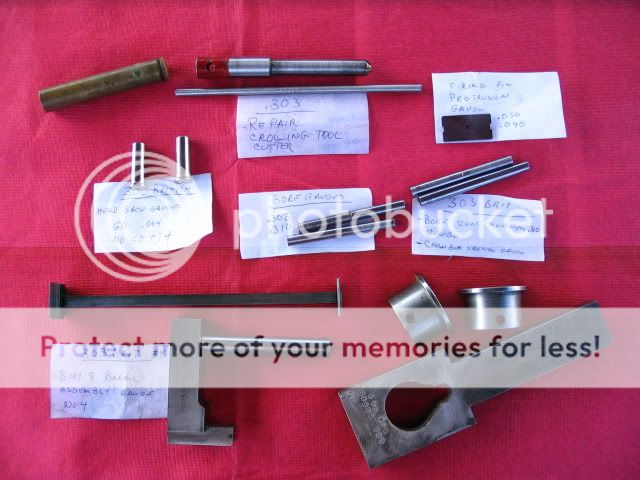

Enfieldtools002.jpg
 
Last edited:

Sasquatch807

I have a ton of Enfield manuals and I can find no reference to the crown repair cutter as such.

In the U.S. military we have three levels of maintenance, field, intermediate and depot. The base/field level armourers would not be allowed to re-crown a barrel as this was done at a higher level of maintenance. My guess is the crowning tool was used at depot/overhaul level and I do not have any Enfield manuals that deal in that level of repair.

The inspection standards below would have been used at base/field level and if the rifle failed these inspections it was sent higher up the repair/overhaul ladder.

gauge_file_Page_01.jpg
 
Sasquatch807

I have a ton of Enfield manuals and I can find no reference to the crown repair cutter as such.

In the U.S. military we have three levels of maintenance, field, intermediate and depot. The base/field level armourers would not be allowed to re-crown a barrel as this was done at a higher level of maintenance. My guess is the crowning tool was used at depot/overhaul level and I do not have any Enfield manuals that deal in that level of repair.

The inspection standards below would have been used at base/field level and if the rifle failed these inspections it was sent higher up the repair/overhaul ladder.

Thanks bigedp51 for the info.

The crowning tool is marked "C. OXWELD - NUMBER SEVEN", but like I said, there is no provision for a pilot and I am not personnally convinced it even is a crowning tool as it would leave a concave-type of cut the likes i've never seen on a barrel before.

So far, i've been able to successfully use the GO/NO-GO gauges, the firing pin protrusion gauge, the chamber erosion gauge and the barrel to body assembly gauge. However, I have yet to figure out how to use the bore gauges and the bore condemnation gauge. The scant instructions I got for these from the seller didn't make sense to me. Do you have anything on the use of these gauges in your manuals ?
 
IIRC, the bore gauges: the large one shouldn't pass through the bore. The small one should slide down the full length without any interference. But I may be totally off the track.

Lou
 
IIRC, the bore gauges: the large one shouldn't pass through the bore. The small one should slide down the full length without any interference. But I may be totally off the track.

Lou

Hi Lou, that is exactly what I was told but it doesn't seem to work. The larger one measures .310 and the smaller is .308. Neither fit down any bores I have and that is normal as a .303 brit. barrel should be about .303" across the bore and .311" across the grooves. So how could a .308" steel dowel ever fit freely down the barrel ?
 
Hi Enzo,

Certainly an interesting package from a gunsmith who did a lot of Enfield work.

With reference to CF manuals I have, specifically C-71-111, and my experience doing Enfield restoration here's what I tell you;

There are 5 No Go and 1 Go bore size/staightness plain cyclindrical guages; .3009" Go
and .304", .306", 307", .308" and .310" No Go's. The .308" is also use for a chamber and muzzle check. Manual states " .308 to not enter more than 1/4" at the muzzle and not complely enter the chamber. Looks like you have some of the No Guages. Should any of these pass through the bore then you can tell the varying degree of wear. Are these threaded at one end? Some are for attachment to a cleaning rod.

The crowning tool is not military. What is the diameter of the solid pilot?

If there are #'s on any of the tools. I'll look them up for you when I have a chance.

Hope this helps,

Ron
 
Sasquatch807

You have five, four and two groove barrels, and these barrels were made in Britain, Canada, USA and Australia.

You also have the story of the "Enfield inch" when the the U.S. company Pratt & Whitney set the up Lithgow Enfield factory in Australia for rifle production.

The problem started back in England when an inch was equal to so many kernels of corn, so many grains of barley, so many grains of wheat etc.

Once the Americans figured out what a British inch was equal to from the many drawings they had a standard that was set to manufacture the Australian Lithgow Enfield rifle.

NOTE: My Canadian made bore gauges do not fit British made barrels and you are discovering the Canadian Enfield inch story. :D

Canadian grown wheat has larger grains than British wheat and therefore the Canadian bore specifications are slightly different than the British. ;)

wheat-stem-and-grain.jpg


The height of the lands or rifling is different between the type of rifling and where the barrel was made.

NOTE: depth of rifling .005 to .008 thousandths and variations even occur with this British standard.

303borejpg.jpg
 
Last edited:

gauge_file_Page_01.jpg


My Canadian bore gauge is .303 and only fits my Long Branch Enfield, and in the British manual below there is NO .303 bore gauge. Below the .301 gauge is to run the length of the bore and the .307 and .308 must not enter more the 1/4 inch. on the "FIVE" groove British barrel. ;)

gauge_file_Page_29.jpg


gauge_file_Page_30.jpg
 
Thanks for sharing your knowledge bigedp51.

I guess my gauges are best used on Canadian made rifles.

I tried the No-Go (.074") gauge on my rifles and I can close the bolt on one of my # 5's but just barely, the last 1/4" of downward bolt handle travel requiring slight pressure. My understanding is that it should be impossible to close the bolt on a rifle within the correct headspace range. This rifle has a "0" bolt head, would you suggest fitting another bolthead to correct this ? This rifle shoots reasonnably, spent cases show no primer protrusion, bulged sides or other anomalies other than some "frosting" and dimples from chamber wall imperfections due to past neglect.
 
Sasquatch807

The only way to check your headspace when its that close is to dissemble the bolt. If you can feel resistance its so close to the correct measurement that it doesn't matter.

Now for the hard part to understand, headspace is governed by the cartridge cases you are shooting and not the rifle.

Example: British headspace limits of .064 to .074 are set for cartridge cases made to military standards. Civilian commercial standards are less because these cases are made thinner and lighter than military.(.064 to .067)

If you do not reload and your cases are not having case head separations on the first firing then don't worry about it. Winchester cases are the lightest and thinnest and would be the weakest link in the .303 Enfield chamber. Commercial factory loaded ammunition for the .303 British is loaded to pressures BELOW 43,000 cup and military ammo was loaded to 45,000 cup or 49,000 psi.

I reload and no longer bother to go looking for longer bolt heads, because a Canadian taught me a trick to fooling the Enfield rifle into thinking the rims were thicker. ;)

Below, a larger o-ring is pictured just as an example and normally the o-ring will be half the diameter or smaller depending on headspace. Lube the locking lugs when fire forming this way to prevent lug wear.

IMGP5098.jpg


headspacestretch_frame_0001.jpg


IMGP5096.jpg


With the o-ring around the case I fire form the cases with a pistol bullet and a light reduced load.

IMGP4691.jpg
 
Sasquatch, I'm pretty sure you have a "1" bolt head in your parts bin :) Swap it, and test with the gauges, see if it's not too tight. It probably will be a better fit.

Lou
 
Hey Bigedp51- Appreciate the info you post, some good stuff there that might have been forgotten about if not brought up from past days.


Sasquatch807

The only way to check your headspace when its that close is to dissemble the bolt. If you can feel resistance its so close to the correct measurement that it doesn't matter.

Now for the hard part to understand, headspace is governed by the cartridge cases you are shooting and not the rifle.

Example: British headspace limits of .064 to .074 are set for cartridge cases made to military standards. Civilian commercial standards are less because these cases are made thinner and lighter than military.(.064 to .067)

If you do not reload and your cases are not having case head separations on the first firing then don't worry about it. Winchester cases are the lightest and thinnest and would be the weakest link in the .303 Enfield chamber. Commercial factory loaded ammunition for the .303 British is loaded to pressures BELOW 43,000 cup and military ammo was loaded to 45,000 cup or 49,000 psi.

I reload and no longer bother to go looking for longer bolt heads, because a Canadian taught me a trick to fooling the Enfield rifle into thinking the rims were thicker. ;)

Below, a larger o-ring is pictured just as an example and normally the o-ring will be half the diameter or smaller depending on headspace. Lube the locking lugs when fire forming this way to prevent lug wear.

IMGP5098.jpg


headspacestretch_frame_0001.jpg


IMGP5096.jpg


With the o-ring around the case I fire form the cases with a pistol bullet and a light reduced load.

IMGP4691.jpg
 
Back
Top Bottom




















