












































You are using an out of date browser. It may not display this or other websites correctly.
You should upgrade or use an alternative browser.
You should upgrade or use an alternative browser.
Another Tobin Arms SxS sees the light of day!
- Thread starter ninepointer
- Start date


decrease of value was not really a concern of mine...what was happening was, when you put in modern shells, they would not go in all the way. They would sit about 1/8th proud and you kinda had to slam the gun to get it to close. I figured it was harder on the gun slamming it shut than just lengthening the cones. The chokes were miked at very full and full and it was already getting done at the chambers so the choke job made sense at the time too...it patterns really nice with .5 and .15 thou constriction.

ninepointer
CGN frequent flyer
- Location
- Central Ontario
Modern 2 3/4" shells easily go in all the way in my Tobin. I know that the previous owner shot 2 3/4" through it. My smith checked the chambers with a gauge today and he said the chambers come up a bit longer than most 2 5/8" chambers, but a hair short of modern 2 3/4". He felt that light loads would be fine through it as is, but that opening up the chambers could easily be done and doubted it would negatively impact the value. Having said that, my experience with with most gun "improvements" is that you don't recoup your money on resale.

MauserMike
CGN Ultra frequent flyer
- Location
- SW Ontario
Whoa. Modern 2-3/4" shells should chamber fine, even in a 2-1/2" gun. (not safe to shoot though)
Remember, the length of the shell is measured with the crimp open.
Remember, the length of the shell is measured with the crimp open.
Mike, it was weird...old papers would slide right in wiith no problem but new shells were like described. The gunsmith who looked at it laughed and said the chamber was like the guy who worked on it didn't quite finish it off. Apparently, lots of these guns were bought out the back door of the factory, so maybe it was a Friday afternoon. Regardless, the work done was well within the safe limits and the gun is much nicer now to shoot. On another note, all the other Tobins I have seen have no trouble chambering modern shells.
ninepointer
CGN frequent flyer
- Location
- Central Ontario
This shotgun is in very good condition considering the age. S.N. 18976 to 19526 are Crandall guns and were manufactured after 1922 .
Thanks for the info
 I recently spoke to Tobin aficionado in Woodstock who informed me its a Tobin-made (pre-Crandall) gun, based on certain physical features. This is supported by your serial# data since the gun I'm holding has a serial# of 184XX (pre-Crandall). I'm finding this whole thing tremendously interesting and I hope that Sharptail is back on-line soon so that I can pick his brain.
 Unfortunately, the last thing I need right now is another 12 ga. shotgun, so I've put the gun on the EE forum. But before this Tobin leaves my hands I think I just might round up my beagle and take the gun for a gentlemanly cottontail hunt, just so that I can forever say that I've had the privilege of hunting with a Tobin

Ninepointer, here is what I can tell you about your gun:
From the lack of engraving, and no trace of of the pyro - oxidized finish found on the next grade up, we can surmise that it is a model #40, Standard Grade gun. Based upon the serial number and the lack of border engraving, we can place the date of manufacture between 1916 and 1921. Definitely pre - Crandall. Sorry I can not pin it down any closer, but Tobin serial numbers were not released in exact numerical order. The lack of border engraving would indicate later manufacture (closer to 1921 than 1916). Tobin was struggling after 1916 and removing the border engraving would have been an economy measure. I have no idea when the border engraving on the model 40 was actually dropped.
The model #40 was the same gun as the higher grade Tobins (based on the Wollam patent), but offered without the options available on the higher grades. For instance, only the pistol grip stock was offered on the model 40, whereas the model 70 (Trap Grade) and higher models offered the choice of a straight grip stock. The model 40 was only offered with Trojan steel barrels while the higher grades could have Krupp or De Moya steel.
The barrels were offered in 28, 30 and 32 inch lengths on a 12 gauge #40, and the chambers should be 2 3/4" in length. Chokes were of the tapered variety, and Tobin provided Full (0.030 to 0.040") and Modified (0.015 to 0.020") as standard, but individuals could order guns choked to their specifications, "Provided such changes do not in our opinion prevent making a satisfactory article". Tobin guaranteed his patterns and furnished a test target with each gun.
The LOP of the Standard Grade stock was set at 14 1/8th inches, and drop could be specified between 2 1/2 to 3 1/8th inches (higher grades gave more latitude in these measurements, and offered fancier wood). Depending on configuration, the 12 gauge Standard Grade gun could weigh between 6 3/4 to 8 lbs.
In 1915, the catalogue price of the #40 Standard Grade was $25.00, a Trap Grade was set at $45, but ordering the single trigger OR the ejectors would raise the price to $65, ordering both put the price at $85. Neither ejectors nor the single trigger option were offered on the model 40. A top of the line Regal Grade #250 with both single trigger and ejectors brought $210, a fortune at the time.
All of these guns were built on the same action, a hybrid half sidelock which placed part of the locks on the frame, part on the lock plates. Because off this design, a good deal of wood has to be removed from the head of the stock. Because of this, it is NOT recommended that modern, high pressure loads be used in the Tobin - the risk of cracking the stock at it's head is too great. In addition, some American users have noted that the frame itself can bend under the stress of the high pressure shells. I recommend the use of GameBore "Pure Gold" shells (available from Kent dealers in Canada). These low pressure, 2 1/2" loads seem to work well in the Tobin, assuming that it is still sound and tight. It is up to the shooter to select appropriate loads for his or her gun!
Tobin was a brave entrepreneur who chose to compete in an established market. In the process he built Canada's first proper shotgun factory. His product had much merit but in the end was done in by changing times and tastes. He should be fondly remembered and his remaining guns should be cherished.
Sharptail
From the lack of engraving, and no trace of of the pyro - oxidized finish found on the next grade up, we can surmise that it is a model #40, Standard Grade gun. Based upon the serial number and the lack of border engraving, we can place the date of manufacture between 1916 and 1921. Definitely pre - Crandall. Sorry I can not pin it down any closer, but Tobin serial numbers were not released in exact numerical order. The lack of border engraving would indicate later manufacture (closer to 1921 than 1916). Tobin was struggling after 1916 and removing the border engraving would have been an economy measure. I have no idea when the border engraving on the model 40 was actually dropped.
The model #40 was the same gun as the higher grade Tobins (based on the Wollam patent), but offered without the options available on the higher grades. For instance, only the pistol grip stock was offered on the model 40, whereas the model 70 (Trap Grade) and higher models offered the choice of a straight grip stock. The model 40 was only offered with Trojan steel barrels while the higher grades could have Krupp or De Moya steel.
The barrels were offered in 28, 30 and 32 inch lengths on a 12 gauge #40, and the chambers should be 2 3/4" in length. Chokes were of the tapered variety, and Tobin provided Full (0.030 to 0.040") and Modified (0.015 to 0.020") as standard, but individuals could order guns choked to their specifications, "Provided such changes do not in our opinion prevent making a satisfactory article". Tobin guaranteed his patterns and furnished a test target with each gun.
The LOP of the Standard Grade stock was set at 14 1/8th inches, and drop could be specified between 2 1/2 to 3 1/8th inches (higher grades gave more latitude in these measurements, and offered fancier wood). Depending on configuration, the 12 gauge Standard Grade gun could weigh between 6 3/4 to 8 lbs.
In 1915, the catalogue price of the #40 Standard Grade was $25.00, a Trap Grade was set at $45, but ordering the single trigger OR the ejectors would raise the price to $65, ordering both put the price at $85. Neither ejectors nor the single trigger option were offered on the model 40. A top of the line Regal Grade #250 with both single trigger and ejectors brought $210, a fortune at the time.
All of these guns were built on the same action, a hybrid half sidelock which placed part of the locks on the frame, part on the lock plates. Because off this design, a good deal of wood has to be removed from the head of the stock. Because of this, it is NOT recommended that modern, high pressure loads be used in the Tobin - the risk of cracking the stock at it's head is too great. In addition, some American users have noted that the frame itself can bend under the stress of the high pressure shells. I recommend the use of GameBore "Pure Gold" shells (available from Kent dealers in Canada). These low pressure, 2 1/2" loads seem to work well in the Tobin, assuming that it is still sound and tight. It is up to the shooter to select appropriate loads for his or her gun!
Tobin was a brave entrepreneur who chose to compete in an established market. In the process he built Canada's first proper shotgun factory. His product had much merit but in the end was done in by changing times and tastes. He should be fondly remembered and his remaining guns should be cherished.
Sharptail
ninepointer
CGN frequent flyer
- Location
- Central Ontario
Sharptail,
You are AWESOME! Thanks for the info, most interesting. I really appreciate you sharing your knowledge and the time you spent writing up your detailed description. Thanks again
You are AWESOME
! Thanks for the info, most interesting. I really appreciate you sharing your knowledge and the time you spent writing up your detailed description. Thanks again
As Re-Animator is one of my favourite stories (and movies) I keep re-animating these old threads.
I'm still puzzled after reading an article by David Noreen
How do you tell models apart? How do you estimate DOM?
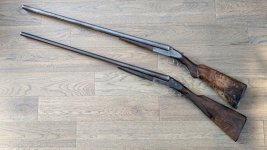
Top one is 185xx
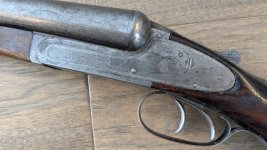
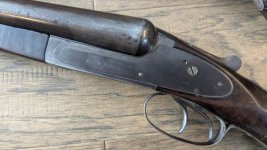
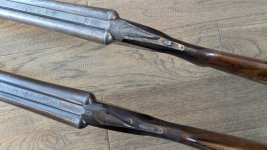
Bottom one with straight stock, De Moya Fluid Steel, has one set of serials on WB, FE and barrel 195xx and another serial 157xx on trigger guard - replaced? assembled like this? This is Grednall gun?
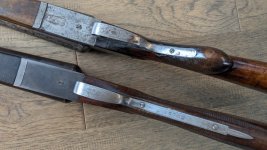
I'm still puzzled after reading an article by David Noreen
How do you tell models apart? How do you estimate DOM?
Top one is 185xx
Bottom one with straight stock, De Moya Fluid Steel, has one set of serials on WB, FE and barrel 195xx and another serial 157xx on trigger guard - replaced? assembled like this? This is Grednall gun?

I'm still puzzled after reading an article by David Noreen
Dave Noreen posts on a number of US forums and is incredibly knowledgeable. If you still have questions you might consider going to DoubleGun forums and asking Dave directly. His name over there is Researcher. Kinda apt name.
I messed up many years ago. a buddy gave me his Fathers Tobin 16 gauge and I sold it to a buddy . told him if he was ever going to get rid of it let me know. he tragically passed away and his brother ended up getting his toys . I won't say how much I sold it for. it was a basic model no frills. still regret selling it.





















