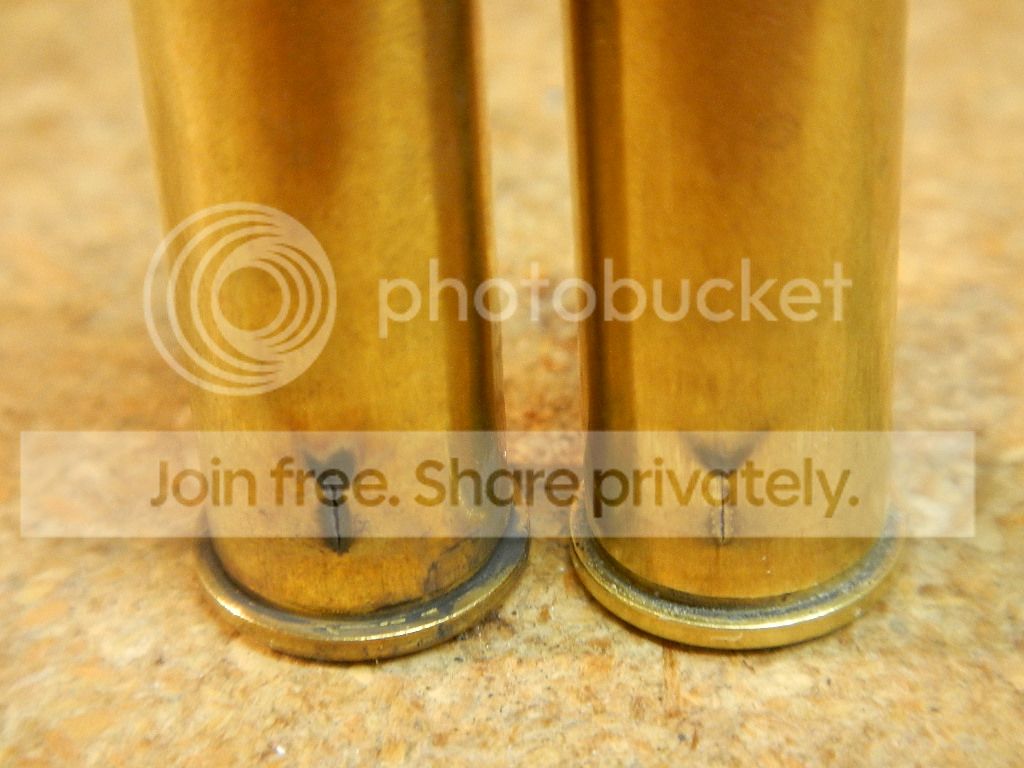
Any Idea What Caused This?

trky chsr

CGN Regular
Rating - 100%
50   0   0
Location
Ontario
These were shot in a S&W M29. They are 44mag handloaded with 7gr of Unique under a 240gr lead bullet. I keep track of my cases and they have been loaded about 7 times. One of these was from my latest loading the other from a previous loading. TC

44Brass002_zpsa2c05550.jpg
 
I would tend to agree that it's simply brittle brass that let go.

They only other thing I can think of is the rounds were fired out of battery. But since they were fired from a revolver id say that isn't the case here.
 
These were shot in a S&W M29. They are 44mag handloaded with 7gr of Unique under a 240gr lead bullet. I keep track of my cases and they have been loaded about 7 times. One of these was from my latest loading the other from a previous loading. TC

44Brass002_zpsa2c05550.jpg

Unique is a good powder for 44 mag --- 7 g should be a nice target load
7 loading -- not bad but not great
could be a flaw in brass
could be work hardening or a oversize chamber
hole is so low that you can't aneal the rest of the brass to make it last longer

I would not worry about it

just shoot it till they all split or till a percentage has split and toss the rest
 
That's a very strange place for a case to fail. It pretty much has to be a bad chamber or defective brass. Unless this revolver does something similar with every case fired (in at least one chamber), then it most likely is the brass.
 
It looks like you were using carbide dies, if so you over worked the brass by over sizing the base of the case. Raise the die and don't size down the case so far.
 
I didn't mention that it's not old brass, they are brand new R-P never sized or primed. I like the tip for the carbide dies, I will give that a try. I generally load 100 at a time and I keep using the same brass until something like this happens. Usually they split at the top from the constant case mouth expanding but I've never seen them split at the base before. TC

 
The splits look rather uniformly positioned. Check the chamber for a burr or other defect that might be scoring the brass at the point where the splits occur. Similarly, check your dies for burrs or other problems.
 
I am going to go with the brass was shot too many times, did you try to anneal the brass? I have the same load in the same gun and have had worse cracks than that. Maybe it is a defect in the brass, maybe something in the gun, but it does happen to me. I do not have the equipment to anneal the brass and I don’t keep good track of how often the brass is reloaded or if I shot it out of the rifle but around 7 times reloaded some start to go.
 
My target load is 6.5g of Unique under the 240 SWC. I use a hodge podge of brass, that has been loaded many times. never seen a case split at the base like that. get a few at the mouth.

i full length size with carbide dies, so ammo drops right into the chamber.

My guess would be a bad batch of brass with a seam in it. Some of the cases will fail early.
 
It looks like you were using carbide dies, if so you over worked the brass by over sizing the base of the case. Raise the die and don't size down the case so far.


I'm sorry but this suggestion makes no sense. As long as the dies are within spec (and there's no reason to believe they aren't) carbide dies won't overwork brass any more than steel dies. If this information was accurate people would be splitting cases like crazy because every die manufacturer says to screw the dies in till they touch the shellholder which gives maximum resizing and I don't know a single person who reloads with steel dies anymore. Everyone full length resizing with carbide dies should have this problem.Plus not fully sizing the cases is just asking for trouble chambering the rounds.

If the brass is sound mild reloads like these should be good for 15-20 reloads minimum. As most others have said this is either faulty brass or a cylinder flaw.
 
Using 8 gr. of Unique ahead of the 240 429421 Lyman ( "Keith SWC") I've fired literally hundreds of rounds out of my Mod. 29 without
ever having seen such a case split.

I would suggest either a bum batch of brass ... or oversize chamber(s) ... Do the splits all come from a particular chamber ... or from any ?
 
Mic your brass after firing. Keep track of which chamber each comes from. This will eliminate chamber problems if all come out within spec. I suspect the gun will be fine. Then Ganderite has your answer. Mark
 
Measure the base of the case just above the rim, now measure just above where the carbide ring stopped. If the upper measurement is smaller than the base diameter you are over sizing the brass when using carbide pistol dies. In the photos I can "SEE" the case was over resized and the case is smaller in diameter where the carbide ring stopped.

Using a pistol case gauge helps when making die adjustments, the gauge diameter is minimum SAAMI chamber diameter. A carbide die should be adjusted so the case fully enters the case gauge without binding. Any more downward adjustment will over work the brass, and if you notice the case cracked and failed just above where the carbide ring stopped. The brass was over compressed and caused a hairline fracture where the brass is the hardest in the base. Meaning the brass cracked from being squeezed too much.

Below, from the Sierra reloading manual, Hornady and Redding.
(for slicknova and ted_dent to read and grasp) "When all else fails read the manual".


Carbide Sizers

Carbide sizing dies have become tremendously popular in the past ten to fifteen years, and for good reason. As we have already seen, carbide dies do away with the necessity of lubricating cases prior to the resizing process. They do require some attention to how they are set up, to avoid damage to the die, and obtain best results. The often repeated advice to screw the die body down until it contacts the shell holder, will give poor results with a carbide die and may even result in cracking the carbide insert. NEVER adjust the die body down so far that it will contact the shell holder. Carbide dies for straight-wall cases are not designed to full-length resize, and are frequently adjusted to give what amounts to excessive resizing. This often results in an undesirable bulge slightly above the extractor groove. Often called the “Coke bottle” effect, this will cause the brass to be worked excessively and can lead to reduced case life. The only portion of the case that needs to be resized is the area that is expanded by firing. For use in revolvers especially, the case need only be sized enough to allow the case to chamber freely again. Often, this may involve sizing only half the length of the case body and is in effect, neck sizing. If this is enough to allow the case to be chambered easily, then the die is adjusted down far enough.

This will avoid overworking the brass, and will eliminate the so-called Coke-bottle effect.


Hornady Die FAQ

Question: My Titanium Carbide Resizing Die is leaving a ring on the bottom of my case, is there something wrong with my Die?

Answer: The size of the carbide ring inside a Titanium Carbide Sizing Die must be small enough to allow the case to accept a bullet with adequate neck tension. Thus, the bottom of a case may be sized a little more than it has to be. Usually, backing the Die away from the Shellholder to size approximately ½ of the case or enough of the case to hold the bullet will rectify the problem.


Dual Ring Carbide Sizing Dies

Redding has solved the problem that has plagued ordinary carbide dies since their invention. The little ring in a standard carbide die had to do double duty. It sized the top of the case to properly hold the bullet but then continued to size the whole body of the case as well. Unfortunately, these two areas need to be sized at different diameters, so carbide dies of the past have always been a compromise.

Redding's solution to this problem is a unique (patent pending) design, incorporating two carbide rings within one sizing die. The upper ring is positioned to size only the bullet retention portion of the case while the other is located to properly size the case body without overworking the brass. Sized cases will not only look and function better but brass life will increase.


reddingII_zpsd4315e68.jpg
 
Last edited:
Back
Top Bottom































































