






























You are using an out of date browser. It may not display this or other websites correctly.
You should upgrade or use an alternative browser.
You should upgrade or use an alternative browser.
Anyone here sell stronger mainsprings for princess auto airguns?
- Thread starter savagefan
- Start date


Bought the cheapy years ago, shoots well but weak, lots of room to go bigger spring coil before bind. Anyone replaced their spring or shimmed the stock one? TIA.
D&L airguns
McMaster Carr has a large selection. A canuck needs a business name to order from them.
https://www.mcmaster.com/compression-springs/
https://www.mcmaster.com/compression-springs/
Last edited:
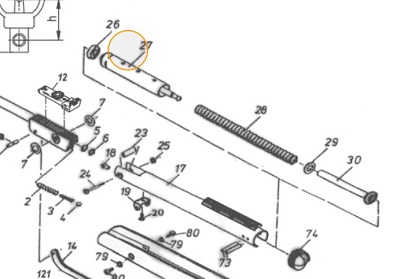
Changed the spring today, bigger od than the original and had to cut 1 coil to get it out of bind. My trusty F1 Chrony says 410fps average on a 10 shot string. Gamo "Magnum" pellets which weigh 7.5 gr on my Lyman beam scale. Judging by the increased cocking effort and noise I'm sure the original spring was only half that. So much for the advertised 495fps, that must have been achieved with pellets made from spider farts. Very happy with dlair. This season when a squirrel starts nattering at me in my treestand, look out!


Increase piston weight. Plug any pistol holes if they are there.
Wouldn't that reduce mv?

- Location
- SE corner Sk
Wouldn't that reduce mv?
No, by plugging holes no air can exscape and with a heavier weight hit the pellit harder?
No, by plugging holes no air can exscape and with a heavier weight hit the pellit harder?
What???
Are you suggesting the piston in anyway contacts the pellet?
Most piston driven air guns that use a main spring achieve higher fps by composition of main spring material.
Not size or length, as the spring will be fully compressed under load. (bigger/longer main spring will bind in the holding tube)
Although on some Canadian multi pump compressed air rifle do run a relief vlv or relief hole to sneak under our 500fps or muzzle energy greater than 5.7 joules.
Last edited:
There are no holes to plug and a heavier piston would be slower to react, and thus reduce mv I would think. No?No, by plugging holes no air can exscape and with a heavier weight hit the pellit harder?
There are no holes to plug and a heavier piston would be slower to react, and thus reduce mv I would think. No?
Official answer. It can vary.
The idea is to tune the impulse of the piston slamming home at the front of the chamber (which it should not actually hit, as it 'should' be slamming into a cushion of compressed air) so that it transfers the most of it's energy to the pellet in the barrel.
Too light a piston/spring, and the piston can bounce off the cushion of air, and reduce power transferred. Too much, and it drives the pellet out without adequately transferring the energy over. Balancing act.
Another tactic, is to use heavy grease or 'tar' on the spring and guide, to reduce the amount of rattling and vibrations. I got some Moly and some heavy and light Tar from Maccarri, Stateside a fair few years ago, when I was on a bit of an airgun kick. Ever see one of those slow motion shots of a gun being fired, with all the stuff you thought was rigid, flexing like it was jello? The idea is to minimize the shaking, without slowing down the piston too much. A fitted rear guide can help in this respect too.
You pretty much have to do a case by case search, to see what the makers did to 'Canada-proof' their various models. Some used de-rated springs, some used a different piston (longer piston=Shorter stroke providing power), some barely did anything that isn't reversible and others did a lot of changes.
if you want substantially more fps then a longer stroke is what you want so in that case maybe look at getting a different rifle. (diana 34 for instance or a chinese clone)
With a short stroke springer there is only so much you can achieve.
With a short stroke springer there is only so much you can achieve.

OkayShooter
CGN Ultra frequent flyer
- Location
- Nova Scotia
Changed the spring today, bigger od than the original and had to cut 1 coil to get it out of bind. My trusty F1 Chrony says 410fps average on a 10 shot string. Gamo "Magnum" pellets which weigh 7.5 gr on my Lyman beam scale. Judging by the increased cocking effort and noise I'm sure the original spring was only half that. So much for the advertised 495fps, that must have been achieved with pellets made from spider farts. Very happy with dlair. This season when a squirrel starts nattering at me in my treestand, look out!
No airguns really shoot what they're advertised as. As they use light weight pellets to boost the numbers up. Speed sells. But alot of these cheap airguns have damaged piston seals, or faulty breech seals.
You do the tissue test? Piece of tissue over the breech and see if it blows off indicating a leak?
Lots to think about here guys, thanks. I bought this thing on a whim as did a friend and it's just one of those things you just feel can be beefed up for grins. I have a Diana 350 Magnum in .22 which is a heavy beast, deadly accurate too. I have a Crosman P1322? that i was using for squirrels that were chirping me in the treestand. This P auto pellet gun will take its place now as it's light/portable and fairly accurate. Now this has me thinking, I seem to remember mods to beef up the Crosman pump. Hmmm. Gonna do that tissue test right now OkayShooter.
Just trust me on the piston weight thing.
The spring puts most of its force out when it's mostly compressed. Once it starts to decompress the force is less. The heavier your piston the more energy it has when it's completing it's stroke. And this is when the air forces the projectile out.
To test beach seal, cover breach with baby powder and shoot it. You should see minimal baby powder being put into the air by leaking compression
The spring puts most of its force out when it's mostly compressed. Once it starts to decompress the force is less. The heavier your piston the more energy it has when it's completing it's stroke. And this is when the air forces the projectile out.
To test beach seal, cover breach with baby powder and shoot it. You should see minimal baby powder being put into the air by leaking compression