












































You are using an out of date browser. It may not display this or other websites correctly.
You should upgrade or use an alternative browser.
You should upgrade or use an alternative browser.
Anyone reload 7.62x39?
- Thread starter joebanana
- Start date

- Location
- The Conservative part of Ontario
While the cartridge itself is a natural for cast bullets, if your shooting it in a gas operated semi, you probably should not use cast, it may plug the gas mechanism, if you don't maintain it.
Here's an article:
CAST BULLETS IN THE SKS
Paul Brasky
Brief History and Variants
The SKS or more properly the 7.62 Simonov System Self-Loading Carbine, Model 1945, was designed by Sergei Gavrilovich Simonov, a Senior Master Gunsmith whose specialty was semi-automatic weapons using the 7.62 x 39mm (M 43) cartridge. In the Soviet Union, the AK-47 replaced the SKS as the primary military arm in the 1950’s, but Russia continued to produce the latter for export until the late 1960’s. Some of the major differences between SKS 45 variants are summarized below:
Albania: Produced approximately 17,000 rifles between the1960’s and 1979 at the Umgramsh Arsenal. However, as many as 2/3 were destroyed or given away over the years. These differed from the Model 1945 in that milled steel components were used. The stock was lengthened, as was the handguard, which is also distinguished by three vents on the bottom. Other differences include an AK-47 style bolt knob, a butt plate with two “doors,” a rear sling swivel located on the left side of the stock rather than the bottom, a different magazine profile as well as a spike bayonet.
China: The Type 56 SKS was developed in the mid-1950’s and manufactured on Soviet-supplied equipment in China until 1971. Those with serial numbers of 9,000,000 and higher had spike bayonets; lower serial numbered rifles have blade bayonets. Barrels are pinned rather than threaded.
Romania: Produced between 1956 and 1962 in Cugir, Romania and distinguished by shallow cut-outs on the handguard and a blade bayonet.
Yugoslavia: The SKS M 59 and 66A1 was manufactured by the Zastava Ordnance/Red Banner Works between 1967 and 1970. The M 59 and M 59/66 were clones of the Type 45. Most had beechwood stocks, but those exported to Africa had teakwood stocks. Nevertheless, there were significant differences between the Yugoslav products and those made in the Soviet Union. To wit, the former didn’t have chrome-lined barrels as there was no chromium in Yugoslavia and it was difficult to obtain from Russia given the political differences between the two nations. The M 59’s and 66’s also had stronger, heavier actions since Yugoslavian M 43 ammunition was loaded to a higher pressure than its Soviet counterpart. In addition, the A1 was fitted with tritium sights, both front and rear. Lastly, Yugoslavian made rifles have a gas cut-off valve at the front of the gas tube, whereas other SKS variants do not.
Ballistics and the 7.62 x 39mm (M 43) Cartridge
There is some debate as to what the 7.62 x 39mm cartridge is capable of. Can it be safely loaded to equal the ballistics of the venerable .30-30 Winchester for example? Let’s look at what various reloading manuals have to say about this controversy. The fourth edition of Hornady’s “Handbook of Cartridge Reloading, Vol. 1 (1996)” states, “In factory or military form, it offers a 123gr. FMJ bullet at 2,300fps. Reloaders can easily equal this, but it is difficult to substantially surpass due to limited powder capacity.” (p. 379) Hodgdon’s “Data Manual #26 (1993)” says substantially the same thing (p. 383). The late Frank C. Barnes in Cartridges of the World 7th Edition,” added somewhat confusingly, “…the M 43 can be loaded to nearly duplicate the .30-30 with most bullet weights up to about 150 grains. However this is only possible in a strong single shot or bolt-action rifle. Semi-auto (sic) rifles must stick to the original ballistics, which are marginal at best for deer-size animals.” (p. 272, italics mine). To reiterate Barnes’statement, the SKS wasn’t designed to handle the pressure of the .30-30Win. For safety’s sake, don’t even think about making yours into something it’s not!
Reloading
Reloading for the 7.62 x 39mm is straightforward and full-length resizing dies are available from all of the major manufacturers as are shellholders (#6, Hornady; #12, Lee; #3 Lyman; #12 Redding and #32, RCBS). Be advised that FL die sets come with two expander balls, one for .308” bullets and one for .311” bullets. If you’re loading cast bullets, use the .311” expander. You’ll also need some means of flaring the case mouth so those cast bullets can be seated without shaving lead, which isn’t conducive to accuracy. The Lyman M-die, specifically M 1 C 91, works perfectly and won’t overwork your case mouths when properly adjusted.
Cast Bullets and the SKS
One of the myths surrounding cast bullets is that they can’t be used successfully in semi-automatic rifles because they are inaccurate, will leave lead in the bore or will render the gas operating system inoperative because of lead fouling there. While it’s true that you must not exceed the port pressure for a gas-operated semi-automatic rifle with jacketed or cast bullets, that doesn’t mean you can’t obtain excellent results with the latter. Certainly one of the main determinants of cast bullet accuracy is how well the bullet fits the bore and throat of the rifle. (Barrel quality and condition are also important.) Bullet fit is at least as important as bullet design (shape), perhaps more so, since poorly fitted bullets are notoriously inaccurate. On the other hand, properly fitted [cast] bullets are likely to be accurate ones. These principles apply to single shot, bolt-action as well as gas-operated rifles and carbines, including the SKS.
When you consider that the SKS was produced by at least five nations over a period of thirty-four years, variations in bore dimensions will come as no surprise. Therefore, before you purchase a particular bullet mold hoping that it will fit your SKS, slug your bore, breech and muzzle (i.e., two slugs). Both should measure about the same, with a slightly larger breech slug being ideal. This will tell you the minimum dimension a cast bullet must be to fit the bore. Generally the cast bullet is sized from .001” to .003” larger than that minimum. Once you’ve done this, you’ll be in a better position to determine which mold and/or bullet design will fit your rifle (carbine). Unfortunately there aren’t a plethora of mold choices available, which, to view it in a more positive light, eases the burden of choosing the “right” mold. However, the SKS tolerates a wide variety of cast bullet designs and weights, so long as they fit the bore and throat and can be loaded so that they can feed from the magazine. On the other hand, very long cast bullets and overall lengths necessitate single loading: Simply place them in the follower and release the bolt.
A personal example may help illustrate the above. I purchased my Type 56 around the time C.E. Harris developed and published his cast bullet design for the SKS in the pages of “The American Rifleman.” Lee Precision, Lyman, and LBT later produced it. After slugging my bore and studying the published dimensions of the Lee and Lyman molds (.312”), I knew that neither would fit my rifle. Somewhat reluctantly (because of the price, not the quality or service) I sent those slugs to Veral Smith/Lead Bullets Technology so that he could cut a mold whose bullets would fit my SKS. In brief, they do (sized to .314”) and shoot into 2 minutes of angle from an “as issued” Type 56 purchased new.
Which cast bullets are appropriate for the SKS? So long as you achieve a proper fit in both bore and throat, many cast bullet designs will suffice if not excel. Don’t overlook the following molds: Lee’s C.E. Harris-designed C312-155-2R or CTL312-160-2R (tumble lube) or Lyman‘s #311410. Also, if you have Lyman #311291 or #311041 and if they cast large enough, try them by all means. If you don’t mind single loading (because the OAL exceeds the length of the magazine), Lyman #314299 will give 3 to 4 minutes of angle accuracy. Lastly, even the very old Lyman #321232, a plain-base, flat-nosed, tapered Loverin (tapers from .319” on forward band to .322” at the rear), which was made for an entirely different rifle (.32-20 I think), shoots surprising well from the SKS because it can be sized to fit the rifle.
Maintenance
Making sure the rifle is unloaded; I remove the bolt cover, spring and bolt assembly every time I fire my SKS, not because such maintenance is required, but so that I can clean the barrel from the breech rather than the muzzle. I also check the gas piston for lead, which will be deposited on its face. While you may not be able to entirely prevent lead deposition, you can make any accumulation easier remove by coating the piston rod, especially its face, with white lithium grease. Clean and regrease the bolt assembly and put things back together in reverse order and you’re ready for another session. Cycle the action manually to make sure all is correct.
Powders
Consult several reloading manuals for appropriate powders and powder charges. Lyman’s “Reloading Handbook, 48th Edition” (2002) is recommended because of the variety of cast bullet loading combinations it contains. Having written this, I must confess to having tried only a few powders, mostly because I was rewarded with immediate success when using them. I must also say that I use my SKS strictly for informal target shooting so I have no need for high pressure/high velocity loads. With the C.E. Harris-designed, but LBT produced, bullet mold (145gr. gas check bullet) I’ve basically used only two powders, namely Alliant 2400 and military surplus WC 820 (burning rate similar to Accurate Arms #9, but different lots may be faster or slower than AA #9). In either instance, 14gr. gives excellent accuracy, reasonably clean burning and reliable ejection. Velocity hovers around 1,550fps. Incidentally, Alliant 2400 burns
much cleaner in rifles than it does in revolvers and no crimp is needed either.
Chronograph Data
I used my Shooting Chrony Model F-1 to test the LBT 145gr. cast bullet as well as the venerable Lyman #321232 (175gr.). The load was 14gr. of WC 820 in once-fired Winchester brass atop Winchester Large Rifle primers. Ambient temperature was 25 degrees [Fahrenheit] and the chronograph was 15 feet from the muzzle.
Velocity Standard Dev. Extreme Spread
LBT Bullet, OAL = 2.125” 1,514fps 40fps 137fps
Lyman #321232, OAL = 2.19” 1,473fps 29fps 107fps
Targets
Conclusion
The SKS is a robust, fast-handling rifle, which can shoot cast bullets to a high degree of accuracy if the owner takes the time to assess its requirements. Happily, those are few and easily mastered. Primary among them is fitting the cast bullet to its throat and bore and not trying to turn it into a “short magnum” variant of the .30-30 Winchester. Keeping an eye on the gas piston and removing any lead deposits that accumulate there and in the barrel will go along way to insure that your SKS remains trouble-free and a joy to shoot.
REFERENCES
Frank C. Barnes, Cartridges of the World, 7th Edition. Edited by Mike Bussard.
DBI Books, 1993.
Hodgdon Data Manual No. 26, Tom Shepherd, Editor. Hodgdon Powder Company, 1993.
Hornady Handbook of Cartridge Reloading, Vol. 1, Todd Georgi, Editor.
Hornady Manufacturing Company, Inc., 1996.
Michael E. Kreka, “7.62 Simonov Self-Loading Carbine, Model 1945” at Jamie Mangrum’s site, http://www.surplusrifle.com
Lyman Reloading Handbook, 48th Edition, Thomas J. Griffin, Editor.
Lyman Products Corporation, 2002.
Here's an article:
CAST BULLETS IN THE SKS
Paul Brasky
The SKS or more properly the 7.62 Simonov System Self-Loading Carbine, Model 1945, was designed by Sergei Gavrilovich Simonov, a Senior Master Gunsmith whose specialty was semi-automatic weapons using the 7.62 x 39mm (M 43) cartridge. In the Soviet Union, the AK-47 replaced the SKS as the primary military arm in the 1950’s, but Russia continued to produce the latter for export until the late 1960’s. Some of the major differences between SKS 45 variants are summarized below:
Albania: Produced approximately 17,000 rifles between the1960’s and 1979 at the Umgramsh Arsenal. However, as many as 2/3 were destroyed or given away over the years. These differed from the Model 1945 in that milled steel components were used. The stock was lengthened, as was the handguard, which is also distinguished by three vents on the bottom. Other differences include an AK-47 style bolt knob, a butt plate with two “doors,” a rear sling swivel located on the left side of the stock rather than the bottom, a different magazine profile as well as a spike bayonet.
China: The Type 56 SKS was developed in the mid-1950’s and manufactured on Soviet-supplied equipment in China until 1971. Those with serial numbers of 9,000,000 and higher had spike bayonets; lower serial numbered rifles have blade bayonets. Barrels are pinned rather than threaded.
Romania: Produced between 1956 and 1962 in Cugir, Romania and distinguished by shallow cut-outs on the handguard and a blade bayonet.
Yugoslavia: The SKS M 59 and 66A1 was manufactured by the Zastava Ordnance/Red Banner Works between 1967 and 1970. The M 59 and M 59/66 were clones of the Type 45. Most had beechwood stocks, but those exported to Africa had teakwood stocks. Nevertheless, there were significant differences between the Yugoslav products and those made in the Soviet Union. To wit, the former didn’t have chrome-lined barrels as there was no chromium in Yugoslavia and it was difficult to obtain from Russia given the political differences between the two nations. The M 59’s and 66’s also had stronger, heavier actions since Yugoslavian M 43 ammunition was loaded to a higher pressure than its Soviet counterpart. In addition, the A1 was fitted with tritium sights, both front and rear. Lastly, Yugoslavian made rifles have a gas cut-off valve at the front of the gas tube, whereas other SKS variants do not.
Ballistics and the 7.62 x 39mm (M 43) Cartridge
There is some debate as to what the 7.62 x 39mm cartridge is capable of. Can it be safely loaded to equal the ballistics of the venerable .30-30 Winchester for example? Let’s look at what various reloading manuals have to say about this controversy. The fourth edition of Hornady’s “Handbook of Cartridge Reloading, Vol. 1 (1996)” states, “In factory or military form, it offers a 123gr. FMJ bullet at 2,300fps. Reloaders can easily equal this, but it is difficult to substantially surpass due to limited powder capacity.” (p. 379) Hodgdon’s “Data Manual #26 (1993)” says substantially the same thing (p. 383). The late Frank C. Barnes in Cartridges of the World 7th Edition,” added somewhat confusingly, “…the M 43 can be loaded to nearly duplicate the .30-30 with most bullet weights up to about 150 grains. However this is only possible in a strong single shot or bolt-action rifle. Semi-auto (sic) rifles must stick to the original ballistics, which are marginal at best for deer-size animals.” (p. 272, italics mine). To reiterate Barnes’statement, the SKS wasn’t designed to handle the pressure of the .30-30Win. For safety’s sake, don’t even think about making yours into something it’s not!
Reloading
Reloading for the 7.62 x 39mm is straightforward and full-length resizing dies are available from all of the major manufacturers as are shellholders (#6, Hornady; #12, Lee; #3 Lyman; #12 Redding and #32, RCBS). Be advised that FL die sets come with two expander balls, one for .308” bullets and one for .311” bullets. If you’re loading cast bullets, use the .311” expander. You’ll also need some means of flaring the case mouth so those cast bullets can be seated without shaving lead, which isn’t conducive to accuracy. The Lyman M-die, specifically M 1 C 91, works perfectly and won’t overwork your case mouths when properly adjusted.
Cast Bullets and the SKS
One of the myths surrounding cast bullets is that they can’t be used successfully in semi-automatic rifles because they are inaccurate, will leave lead in the bore or will render the gas operating system inoperative because of lead fouling there. While it’s true that you must not exceed the port pressure for a gas-operated semi-automatic rifle with jacketed or cast bullets, that doesn’t mean you can’t obtain excellent results with the latter. Certainly one of the main determinants of cast bullet accuracy is how well the bullet fits the bore and throat of the rifle. (Barrel quality and condition are also important.) Bullet fit is at least as important as bullet design (shape), perhaps more so, since poorly fitted bullets are notoriously inaccurate. On the other hand, properly fitted [cast] bullets are likely to be accurate ones. These principles apply to single shot, bolt-action as well as gas-operated rifles and carbines, including the SKS.
When you consider that the SKS was produced by at least five nations over a period of thirty-four years, variations in bore dimensions will come as no surprise. Therefore, before you purchase a particular bullet mold hoping that it will fit your SKS, slug your bore, breech and muzzle (i.e., two slugs). Both should measure about the same, with a slightly larger breech slug being ideal. This will tell you the minimum dimension a cast bullet must be to fit the bore. Generally the cast bullet is sized from .001” to .003” larger than that minimum. Once you’ve done this, you’ll be in a better position to determine which mold and/or bullet design will fit your rifle (carbine). Unfortunately there aren’t a plethora of mold choices available, which, to view it in a more positive light, eases the burden of choosing the “right” mold. However, the SKS tolerates a wide variety of cast bullet designs and weights, so long as they fit the bore and throat and can be loaded so that they can feed from the magazine. On the other hand, very long cast bullets and overall lengths necessitate single loading: Simply place them in the follower and release the bolt.
A personal example may help illustrate the above. I purchased my Type 56 around the time C.E. Harris developed and published his cast bullet design for the SKS in the pages of “The American Rifleman.” Lee Precision, Lyman, and LBT later produced it. After slugging my bore and studying the published dimensions of the Lee and Lyman molds (.312”), I knew that neither would fit my rifle. Somewhat reluctantly (because of the price, not the quality or service) I sent those slugs to Veral Smith/Lead Bullets Technology so that he could cut a mold whose bullets would fit my SKS. In brief, they do (sized to .314”) and shoot into 2 minutes of angle from an “as issued” Type 56 purchased new.
Which cast bullets are appropriate for the SKS? So long as you achieve a proper fit in both bore and throat, many cast bullet designs will suffice if not excel. Don’t overlook the following molds: Lee’s C.E. Harris-designed C312-155-2R or CTL312-160-2R (tumble lube) or Lyman‘s #311410. Also, if you have Lyman #311291 or #311041 and if they cast large enough, try them by all means. If you don’t mind single loading (because the OAL exceeds the length of the magazine), Lyman #314299 will give 3 to 4 minutes of angle accuracy. Lastly, even the very old Lyman #321232, a plain-base, flat-nosed, tapered Loverin (tapers from .319” on forward band to .322” at the rear), which was made for an entirely different rifle (.32-20 I think), shoots surprising well from the SKS because it can be sized to fit the rifle.
Maintenance
Making sure the rifle is unloaded; I remove the bolt cover, spring and bolt assembly every time I fire my SKS, not because such maintenance is required, but so that I can clean the barrel from the breech rather than the muzzle. I also check the gas piston for lead, which will be deposited on its face. While you may not be able to entirely prevent lead deposition, you can make any accumulation easier remove by coating the piston rod, especially its face, with white lithium grease. Clean and regrease the bolt assembly and put things back together in reverse order and you’re ready for another session. Cycle the action manually to make sure all is correct.
Powders
Consult several reloading manuals for appropriate powders and powder charges. Lyman’s “Reloading Handbook, 48th Edition” (2002) is recommended because of the variety of cast bullet loading combinations it contains. Having written this, I must confess to having tried only a few powders, mostly because I was rewarded with immediate success when using them. I must also say that I use my SKS strictly for informal target shooting so I have no need for high pressure/high velocity loads. With the C.E. Harris-designed, but LBT produced, bullet mold (145gr. gas check bullet) I’ve basically used only two powders, namely Alliant 2400 and military surplus WC 820 (burning rate similar to Accurate Arms #9, but different lots may be faster or slower than AA #9). In either instance, 14gr. gives excellent accuracy, reasonably clean burning and reliable ejection. Velocity hovers around 1,550fps. Incidentally, Alliant 2400 burns
much cleaner in rifles than it does in revolvers and no crimp is needed either.
Chronograph Data
I used my Shooting Chrony Model F-1 to test the LBT 145gr. cast bullet as well as the venerable Lyman #321232 (175gr.). The load was 14gr. of WC 820 in once-fired Winchester brass atop Winchester Large Rifle primers. Ambient temperature was 25 degrees [Fahrenheit] and the chronograph was 15 feet from the muzzle.
Velocity Standard Dev. Extreme Spread
LBT Bullet, OAL = 2.125” 1,514fps 40fps 137fps
Lyman #321232, OAL = 2.19” 1,473fps 29fps 107fps
Targets
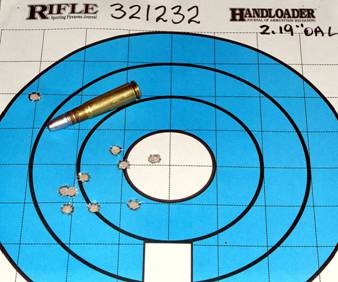
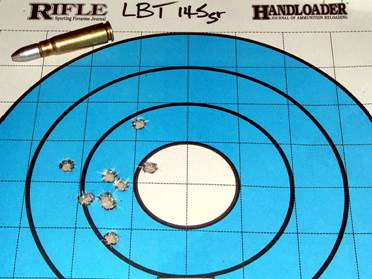
10 shot groups at 50 yards
Top: Lyman’s 321232
Bottom: LBT 145 grain
Conclusion
The SKS is a robust, fast-handling rifle, which can shoot cast bullets to a high degree of accuracy if the owner takes the time to assess its requirements. Happily, those are few and easily mastered. Primary among them is fitting the cast bullet to its throat and bore and not trying to turn it into a “short magnum” variant of the .30-30 Winchester. Keeping an eye on the gas piston and removing any lead deposits that accumulate there and in the barrel will go along way to insure that your SKS remains trouble-free and a joy to shoot.
DBI Books, 1993.
Hodgdon Data Manual No. 26, Tom Shepherd, Editor. Hodgdon Powder Company, 1993.
Hornady Handbook of Cartridge Reloading, Vol. 1, Todd Georgi, Editor.
Hornady Manufacturing Company, Inc., 1996.
Michael E. Kreka, “7.62 Simonov Self-Loading Carbine, Model 1945” at Jamie Mangrum’s site, http://www.surplusrifle.com
Lyman Reloading Handbook, 48th Edition, Thomas J. Griffin, Editor.
Lyman Products Corporation, 2002.
- Location
- The Conservative part of Ontario
By the way, Ellwood Epps, one of the site sponsors lists 7.62X39 in stock on their website. Others likely do as well.

Henry Nierychlo
CGN frequent flyer
- Location
- Surrey, B.C.
I have some New Winchester 7.62X39 brass in stock.
Check out my WTS Post link below for pricing on bullets & brass.
Regards, Henry
Check out my WTS Post link below for pricing on bullets & brass.
Regards, Henry

I've reloaded for the 7.62 x 39 in a couple of SKS rifles for the past several years,mainly to produce more accurate,cleaner ammo as well as not being tied down to commercial prices or ammo imports restrictions or lack of availability. A year or so ago when there was no X39 ammo to be had I never had to stop shooting.
I've developed loads for 123,125,150 gr. commercial jacketed bullets and 147 and 187 gr. surplus FMJ bullets. I also shoot cast bullets in both the Chinese and Yugo SKS.


I use Winchester and Prvi Partizan brass mainly although I have a few coffee cans full of Lapua berdan primed brass I use for loading hunting ammo so I don't have to worry about loosing it in the field.
For primer my Chinese & Yugo SKS with free floating firing pins works fine with CCI#34,Wolf LR or LRM primers all three are Mil-Spec quality. My Chinese shoots the Winchester LR fine also no dimples on the primers at all.
My favorite powders for jacketed bullets are AA1680,Reloader #7 or H or IMR 4198 they give me the best bang for the buck compared to other powders. AA1680 is not readily available and once my stash is used up I probably drop it,Reloader#7 is my main powder and 4198 is my backup powder I have loads worked up for my rifles with each powder.
For my cast bullet loads I use the Lee .312 tumble lube bullet I cast them for straight WW alloy and water quench,lube once with my Lee Alox/JPW lube apply the gas check with a Lee .314 push through sizer so as not to size the bullet any,it drops from the mold around .313.5 dia. @ 165 grs.
My Chinese SKS cycles the bolt with 12.5 grs of Alliant 2400 dropping the brass right by my shooting position MV runs around 1500 fps. a load of 14.5 grs. of 2400 throws the brass about the same distance as Russian factory ammo although MV is a bit lower at around 1900 fps.
My Yugo M59/66A1 want cycle the 12.5 gr. load but will the 14.5 it also like 18.0 grs. of Reloader #7. I get no leading with either loads in the bore or gas tube,I just clean as normal.

First 5 shot test targets with cast loads no sight adjustments were made on the Chinese,I adjust the Yugo sight up to 400 meters and it shot high so I have to bring that down some evidently the Yugo shoots a bit flatter than the Chinese.


I've developed loads for 123,125,150 gr. commercial jacketed bullets and 147 and 187 gr. surplus FMJ bullets. I also shoot cast bullets in both the Chinese and Yugo SKS.
I use Winchester and Prvi Partizan brass mainly although I have a few coffee cans full of Lapua berdan primed brass I use for loading hunting ammo so I don't have to worry about loosing it in the field.
For primer my Chinese & Yugo SKS with free floating firing pins works fine with CCI#34,Wolf LR or LRM primers all three are Mil-Spec quality. My Chinese shoots the Winchester LR fine also no dimples on the primers at all.
My favorite powders for jacketed bullets are AA1680,Reloader #7 or H or IMR 4198 they give me the best bang for the buck compared to other powders. AA1680 is not readily available and once my stash is used up I probably drop it,Reloader#7 is my main powder and 4198 is my backup powder I have loads worked up for my rifles with each powder.
For my cast bullet loads I use the Lee .312 tumble lube bullet I cast them for straight WW alloy and water quench,lube once with my Lee Alox/JPW lube apply the gas check with a Lee .314 push through sizer so as not to size the bullet any,it drops from the mold around .313.5 dia. @ 165 grs.
My Chinese SKS cycles the bolt with 12.5 grs of Alliant 2400 dropping the brass right by my shooting position MV runs around 1500 fps. a load of 14.5 grs. of 2400 throws the brass about the same distance as Russian factory ammo although MV is a bit lower at around 1900 fps.
My Yugo M59/66A1 want cycle the 12.5 gr. load but will the 14.5 it also like 18.0 grs. of Reloader #7. I get no leading with either loads in the bore or gas tube,I just clean as normal.
First 5 shot test targets with cast loads no sight adjustments were made on the Chinese,I adjust the Yugo sight up to 400 meters and it shot high so I have to bring that down some evidently the Yugo shoots a bit flatter than the Chinese.

I've made loads that cycle with 32 cal hornady pistol bullets. I used unique and got it to cycle.
...i have done this as well...not the most accurate load but it works good-enough...
...i reload .312 hornady's (which are now impossible to find because i bought them all!)...
...and i reload cast, which i power with unique (for giggles and grins)...185 grain Lees, #C312 - 185 grain - 1R, paper patch, 7.5 grains Unique, WW primer, 1255 fps...shoot all day for a couple of cents per shot...and they penetrate a 6" poplar at 20 yards no problem...anything above 7.5 and I get flattened primers and sticking brass...they do not recycle, ever...
I have some New Winchester 7.62X39 brass in stock.
Check out my WTS Post link below for pricing on bullets & brass.
Regards, Henry
...i will be contacting you tomorrow...


- Location
- Vancouver Island BC Canada
I've been thinking about looking into this in the event of an ammo shortage. Once you have the equipment, is it much cheaper to reload than to buy a crate?

I've been thinking about looking into this in the event of an ammo shortage. Once you have the equipment, is it much cheaper to reload than to buy a crate?
You can't reload x39 cheaper than buying. Surplus is ~$0.18/round. Reloads will be near double that.
- Location
- Vancouver Island BC Canada
You can't reload x39 cheaper than buying. Surplus is ~$0.18/round. Reloads will be near double that.
What about in comparison to buying non-corrosive x39? About the same? Still better to buy those?
with free lead or near free lead you can reload cheaper then surplus, but for the amount of time involved even with nice press i would just buy the surplus for general plinking. for hunting or trying to get the most accuracy from the gun then i would hand load.

If you're casting you can reload for probably around the same as surplus ($.18 to $.20/round). That's a $.05 primer, $.03 gas check, and $.10 worth of powder. That's assuming free lead. If you make your own gas checks you might be able to do it for cheaper than surplus but not significantly.
Non-corrosive steel cased can be had for $.45/round from Tulammo Canada.
Non-corrosive brass cased reloadable is more like $.70/round at a minimum.
Non-corrosive steel cased can be had for $.45/round from Tulammo Canada.
Non-corrosive brass cased reloadable is more like $.70/round at a minimum.
If you're casting you can reload for probably around the same as surplus ($.18 to $.20/round). That's a $.05 primer, $.03 gas check, and $.10 worth of powder. That's assuming free lead. If you make your own gas checks you might be able to do it for cheaper than surplus but not significantly.
Non-corrosive steel cased can be had for $.45/round from Tulammo Canada.
Non-corrosive brass cased reloadable is more like $.70/round at a minimum.
Use 3 cent primers, and powder coat the bullets which should be less then 1 cent for the amount of powder used.

Anyone reload 7.62x39
I reload for my 7.62x39 Rugers. My experience is that the quality of the ammunition makes a huge difference in the accuracy as measured by group size at 100 yards.
My best load is: Winchester brass, WLR primer, 125 grn Sierra SPT (Pro Hunter #2250) and 25.2 grn of IMR 4198.
Shooting from my Ruger 77, Mark 2 stainless (the boat paddle stock model), I can get .75 inch at 100 yards. The same gun shoots Norinco hardpoint to 2.0 inches and Norinco softpoint to 4.0 inches at 100 yards. One test with American Eagle hardpoint shot 1.5-2.0 inches.
The groups from my Mini 30 showed a similar difference among ammo types but all groups were larger.
Note that my Rugers have a 308 barrel. Persons using SKS type rifles would probably have better results with the Sierra .311 125 grn bullets. Sierra reports that both bullets will perform OK in both types of rifles.
I reload for my 7.62x39 Rugers. My experience is that the quality of the ammunition makes a huge difference in the accuracy as measured by group size at 100 yards.
My best load is: Winchester brass, WLR primer, 125 grn Sierra SPT (Pro Hunter #2250) and 25.2 grn of IMR 4198.
Shooting from my Ruger 77, Mark 2 stainless (the boat paddle stock model), I can get .75 inch at 100 yards. The same gun shoots Norinco hardpoint to 2.0 inches and Norinco softpoint to 4.0 inches at 100 yards. One test with American Eagle hardpoint shot 1.5-2.0 inches.
The groups from my Mini 30 showed a similar difference among ammo types but all groups were larger.
Note that my Rugers have a 308 barrel. Persons using SKS type rifles would probably have better results with the Sierra .311 125 grn bullets. Sierra reports that both bullets will perform OK in both types of rifles.
I just can't see how reloading at this point in time is worth a person's time. With corrosive surplus, there is no way and some non corrosive is quite reasonably priced right now. At most, mexican match with soft points is as close to reloading as I think I would go.

I just can't see how reloading at this point in time is worth a person's time. With corrosive surplus, there is no way and some non corrosive is quite reasonably priced right now. At most, mexican match with soft points is as close to reloading as I think I would go.
Purely in a financial sense, I don't see how any shooting hobby is actually "worth a person's time". But we do it any way.























