












































You are using an out of date browser. It may not display this or other websites correctly.
You should upgrade or use an alternative browser.
You should upgrade or use an alternative browser.
AR 500 gongs
- Thread starter redmist25
- Start date

canucklehead
CGN Ultra frequent flyer
- Location
- Calgary, AB
TAG
Will it be ok for 223 at 15yards? What about 7.62x39 ?
In for 2
You won't punch through 1/2" AR500 with any of those. High speed (like 4000fps) rounds will leave a small crater if it's under 100 yards.
I would NOT be shooting steel with ANY calibre at 15 yards. Not even handgun. Personally, I think the risk of getting hit with 'splatter' is too high.
I only shoot steel with rifles at 75 yards minimum.

Unregistered_
Regular
- Location
- Edmonton, AB
15 yards?
If it wasn't for the restrictions on me for 10 yard minimum distance, I'd have steel at 7 for my IPSC stage designs.
If it wasn't for the restrictions on me for 10 yard minimum distance, I'd have steel at 7 for my IPSC stage designs.
you won't punch through 1/2" ar500 with any of those. High speed (like 4000fps) rounds will leave a small crater if it's under 100 yards.
I would not be shooting steel with any calibre at 15 yards. Not even handgun. Personally, i think the risk of getting hit with 'splatter' is too high.
I only shoot steel with rifles at 75 yards minimum.
x2!!

You won't punch through 1/2" AR500 with any of those. High speed (like 4000fps) rounds will leave a small crater if it's under 100 yards.
I would NOT be shooting steel with ANY calibre at 15 yards. Not even handgun. Personally, I think the risk of getting hit with 'splatter' is too high.
I only shoot steel with rifles at 75 yards minimum.
You may not punch through, but steel core will cause cratering. Cratering on steel can be the riskiest. I would freely shoot steel at 7-10 yards with handgun or shotgun, but as you said, never less than 75 yards, (100 is better) with rifle.

You may not punch through, but steel core will cause cratering.
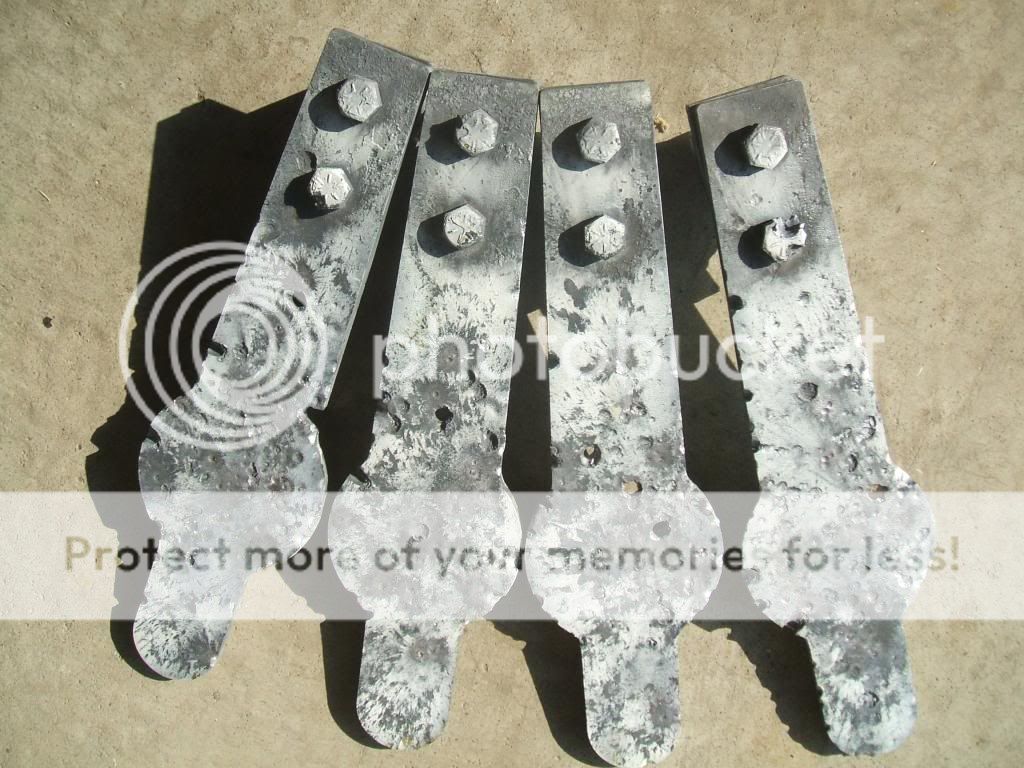
Oh you'll punch through alright... LoL
'Courtesy of someone who wasn't listening to the match briefing when I said "No Steel Core Ammo Please"

canucklehead
CGN Ultra frequent flyer
- Location
- Calgary, AB
Steel cored ammo ain't getting through 1/2" AR500. Crater maybe - clean hole? I have my doubts.
Steel cored ammo ain't getting through 1/2" AR500. Crater maybe - clean hole? I have my doubts.
IMO, its best to stop using steel whens its cratered....I have seen some crazy riccochets off of cratered steel
I was talking about 223....those holes seem quite a bit bigger?
Yes... I suspect, no.... I'm sure these holes resulted from 7.62x39 "surplus".
- Location
- Lac Pelletier Sask
I am looking at getting a bunch of AR 500 gongs cut if I get enough interest to use up a sheet. Check out the thread below if your interested.
http://www.canadiangunnutz.com/forum/showthread.php?892661-AR-500-Gongs
What would the cost as describe for one? and approx. shipping?
And do you have enough interest to get started?
I'd really like one.
Info from MGM site
How close can I shoot steel?
MGM strongly discourages shooting ANY steel closer than 15 yards. Period. Shooters AND spectators (especially children) should always wear ear AND eye protection, regardless of target composition (steel or paper). Any closer than 15 yards presents a significant risk of the shooter or spectators being hit by bullet fragments. Generally speaking, MGM targets will easily handle hits from any traditional defense caliber handgun without significant marking.
Regarding bullet fragments hitting shooters and/or onlookers, ANYTIME you are shooting steel, this is a possibility. I don't know anybody who has shot steel, that hasn't been hit by a fragment hard enough for it to draw blood. It is usually so insignificant that it doesn't even require a BAND-AID®, but I suppose that it could be much worse.
The MAIN reason bullet fragments hit people is because the surface of the target is damaged. Damage is usually the result of 1) the target was shot with a rifle (or shotgun slug, or .44 Mag -or larger-), or 2) the steel was too soft to be a satisfactory target, in which case, traditional pistol rounds could have damaged it, or 3) any combination of the above. If the target face is smooth, bullets hit it and splatter like an egg thrown against a wall. If it is dimpled or cratered, bullets hit it and ricochet out of the craters in any direction. I personally know of bullet fragments from a high powered rifle that flew back over 200 yards, to then hit the wall behind the shooter. (That was NOT an MGM target!!) Damaged steel should not be used, even with extreme caution, regardless of the distance the shooter is from the target.
Back to the top
Can I shoot my rifle at your targets?
Of course, that is what many of them are designed for! MGM targets can withstand an incredible amount of wear, but even Armor plate can be abused. Every shot from a centerfire rifle at 100 yards is going to put a visible mark on the target. We recommend shooting the target at this distance a couple of times so you can determine if the mark is acceptable to you before moving it closer. These small marks are what cause the bullet frags to come back...
* MGM 3/8" AR500 targets can be shot with pistols from 15 yards or more. Closer range risks increased incidents of fragment bounce-back.
* MGM 3/8" AR500 targets can be shot with rifle ammunition up to 2800fps and 175gr., non steel core, non bi-metal, non multi core bullets, at distances of 150 yards or more. The MGM TAC BCCZone target can be shot at 50 yards or more.
* For long range firearms using high velocity ammunition - over 2800 fps, non steel core, non bi-metal, non multi core bullets, MGM recommends shooting at distances reasonable for the rifle and ammunition, 200 yards or more. In this case, The MGM TAC BCCZone target can be shot at 100 yards or more.
PLEASE NOTE: DO NOT SHOOT STEEL TARGETS WITH 'XM-193' AMMUNITION. SUCH AMMUNITION IS INTENDED TO PENETRATE STEEL AND WILL CAUSE SEVERE DAMAGE TO TARGETS, INCREASING THE LIKELYHOOD OF FAILURE AND PERSONAL INJURY. DAMAGE TO TARGETS RESULTING FROM THE USE OF 'XM-193' WILL NOT BE COVERED BY THE WARRANTY.
* MGM 3/16" AR400 reactive targets can be shot with rim fire ammo at range of 15 yards or more.
Shotgun slugs will also significantly mark the steel, and are not recommended at distances less than 50 yards. Steel shot should NEVER be used with steel targets. Buck shot of any size will not damage the steel, any more than twelve .38 caliber pistol bullets fired individually will. 00 Buck is fine.
Back to the top
Why Steel Targets Live or Die...
We don't have the time or space to address every conceivable factor impacting the life (and death) of steel targets. Nor will we deal with the highly technical side of bullets impacting steel, such as how deep did each bullet penetrate a specific type of steel. I don't care how deep one bullet penetrated a piece of steel. I want to know what thousands of rounds will do to it! Hopefully the following information will simplify this target business, and eliminate some of the "mystery metal" characteristics that tend to surround targets today.
Hardness is of course the single most critical element affecting target life. The hardness of steel is most typically measured on one of two scales. Brinell or Rockwell. Rockwell is used primarily in machine shops. Brinell would most commonly be used in a welding or heavy equipment repair shop. There are conversion tables available, but we have not included them here.
To put hardness into perspective, please consider the following:
Mild Steel (like I-beams, angle iron, channel, pipe is 112-163 Brinell.
T-1 (ASTM A514) which has been the target steel of choice for years, has a Brinell hardness of 235-293. All our standard targets are 500 Brinell (460-540). This converts to roughly a 52 on the Rockwell scale.
ARMOR PLATE is 500 Brinell, and has been Ballistically tested and certified.
You will notice that each material has a range of hardness that is acceptable to the manufacturer and the ASTM (American Society for Testing Materials). I suspect that, with the exception of the Armor plate, this is because each material is designed for a particular application or purpose. The hardness will affect that application, but hardness is not the primary design criteria. It is easy to see that the harder material is, the better it will stand up in a target application, as long it is not brittle. Some steel (like tungsten carbide) is harder, but you can break it with a hammer. Target steel has to have the right amount of hardness, coupled with the necessary chemical properties to make it tough, and able to stand up to the impact and vibration a target is subjected to.
Two other major factors to consider in target design are weight and movement. Physics: An object at rest tends to stay at rest. If your target is too heavy for the bullet to move, or is designed to not move, the target face has to absorb 100% of the bullet energy, and is consequently going to sustain more damage than a target that can fall down, or is spring loaded. The same is true for a stationary target. We have seen penetration much deeper on a 3/4" 500 Brinell immobile target, than on a 3/8" target of the same hardness, that could move. There are some applications where you have to go thicker, simply because the bullet carries enough energy to penetrate the target plate.
Check out our section on target repairs, and how heat affects the hardness of target steel.
How close can I shoot steel?
MGM strongly discourages shooting ANY steel closer than 15 yards. Period. Shooters AND spectators (especially children) should always wear ear AND eye protection, regardless of target composition (steel or paper). Any closer than 15 yards presents a significant risk of the shooter or spectators being hit by bullet fragments. Generally speaking, MGM targets will easily handle hits from any traditional defense caliber handgun without significant marking.
Regarding bullet fragments hitting shooters and/or onlookers, ANYTIME you are shooting steel, this is a possibility. I don't know anybody who has shot steel, that hasn't been hit by a fragment hard enough for it to draw blood. It is usually so insignificant that it doesn't even require a BAND-AID®, but I suppose that it could be much worse.
The MAIN reason bullet fragments hit people is because the surface of the target is damaged. Damage is usually the result of 1) the target was shot with a rifle (or shotgun slug, or .44 Mag -or larger-), or 2) the steel was too soft to be a satisfactory target, in which case, traditional pistol rounds could have damaged it, or 3) any combination of the above. If the target face is smooth, bullets hit it and splatter like an egg thrown against a wall. If it is dimpled or cratered, bullets hit it and ricochet out of the craters in any direction. I personally know of bullet fragments from a high powered rifle that flew back over 200 yards, to then hit the wall behind the shooter. (That was NOT an MGM target!!) Damaged steel should not be used, even with extreme caution, regardless of the distance the shooter is from the target.
Back to the top
Can I shoot my rifle at your targets?
Of course, that is what many of them are designed for! MGM targets can withstand an incredible amount of wear, but even Armor plate can be abused. Every shot from a centerfire rifle at 100 yards is going to put a visible mark on the target. We recommend shooting the target at this distance a couple of times so you can determine if the mark is acceptable to you before moving it closer. These small marks are what cause the bullet frags to come back...
* MGM 3/8" AR500 targets can be shot with pistols from 15 yards or more. Closer range risks increased incidents of fragment bounce-back.
* MGM 3/8" AR500 targets can be shot with rifle ammunition up to 2800fps and 175gr., non steel core, non bi-metal, non multi core bullets, at distances of 150 yards or more. The MGM TAC BCCZone target can be shot at 50 yards or more.
* For long range firearms using high velocity ammunition - over 2800 fps, non steel core, non bi-metal, non multi core bullets, MGM recommends shooting at distances reasonable for the rifle and ammunition, 200 yards or more. In this case, The MGM TAC BCCZone target can be shot at 100 yards or more.
PLEASE NOTE: DO NOT SHOOT STEEL TARGETS WITH 'XM-193' AMMUNITION. SUCH AMMUNITION IS INTENDED TO PENETRATE STEEL AND WILL CAUSE SEVERE DAMAGE TO TARGETS, INCREASING THE LIKELYHOOD OF FAILURE AND PERSONAL INJURY. DAMAGE TO TARGETS RESULTING FROM THE USE OF 'XM-193' WILL NOT BE COVERED BY THE WARRANTY.
* MGM 3/16" AR400 reactive targets can be shot with rim fire ammo at range of 15 yards or more.
Shotgun slugs will also significantly mark the steel, and are not recommended at distances less than 50 yards. Steel shot should NEVER be used with steel targets. Buck shot of any size will not damage the steel, any more than twelve .38 caliber pistol bullets fired individually will. 00 Buck is fine.
Back to the top
Why Steel Targets Live or Die...
We don't have the time or space to address every conceivable factor impacting the life (and death) of steel targets. Nor will we deal with the highly technical side of bullets impacting steel, such as how deep did each bullet penetrate a specific type of steel. I don't care how deep one bullet penetrated a piece of steel. I want to know what thousands of rounds will do to it! Hopefully the following information will simplify this target business, and eliminate some of the "mystery metal" characteristics that tend to surround targets today.
Hardness is of course the single most critical element affecting target life. The hardness of steel is most typically measured on one of two scales. Brinell or Rockwell. Rockwell is used primarily in machine shops. Brinell would most commonly be used in a welding or heavy equipment repair shop. There are conversion tables available, but we have not included them here.
To put hardness into perspective, please consider the following:
Mild Steel (like I-beams, angle iron, channel, pipe is 112-163 Brinell.
T-1 (ASTM A514) which has been the target steel of choice for years, has a Brinell hardness of 235-293. All our standard targets are 500 Brinell (460-540). This converts to roughly a 52 on the Rockwell scale.
ARMOR PLATE is 500 Brinell, and has been Ballistically tested and certified.
You will notice that each material has a range of hardness that is acceptable to the manufacturer and the ASTM (American Society for Testing Materials). I suspect that, with the exception of the Armor plate, this is because each material is designed for a particular application or purpose. The hardness will affect that application, but hardness is not the primary design criteria. It is easy to see that the harder material is, the better it will stand up in a target application, as long it is not brittle. Some steel (like tungsten carbide) is harder, but you can break it with a hammer. Target steel has to have the right amount of hardness, coupled with the necessary chemical properties to make it tough, and able to stand up to the impact and vibration a target is subjected to.
Two other major factors to consider in target design are weight and movement. Physics: An object at rest tends to stay at rest. If your target is too heavy for the bullet to move, or is designed to not move, the target face has to absorb 100% of the bullet energy, and is consequently going to sustain more damage than a target that can fall down, or is spring loaded. The same is true for a stationary target. We have seen penetration much deeper on a 3/4" 500 Brinell immobile target, than on a 3/8" target of the same hardness, that could move. There are some applications where you have to go thicker, simply because the bullet carries enough energy to penetrate the target plate.
Check out our section on target repairs, and how heat affects the hardness of target steel.
There is a fair bit of interest so far. We will start cutting as soon as we have enough orders. We will accept orders until April 7th and inform everyone if we have enough interest to proceed.
Please drop me a PM if you have questions or would like to order.
see the WTS thread here: http://www.canadiangunnutz.com/forum/showthread.php?892661-AR-500-Gongs
Please drop me a PM if you have questions or would like to order.
see the WTS thread here: http://www.canadiangunnutz.com/forum/showthread.php?892661-AR-500-Gongs






















