












































At Wit's End - Sell the Whole Lot!!!

sobo4303

CGN frequent flyer
Rating - 100%
37   0   0
I have been trying for the past few months to develop a load to shoot cast bullets for silhouette in my 30-30, to no avail.

the bullets are 0.309" OD 165 gr from the bullet barn. I mic'd them and they are very consistent.

Here's the deal, both rifles were brand new. First bought a Marlin with the micro-groove. At lower velocities (Unique, Trail Boss) the bullets keyhole, even at 1,100 fps. I have seen the evidence at 100 yards and as close as 25 yards. At higher velocities (1,500 to 1,600), the group is very unpredictable and wide. At 25 yards (RL-7, Win 748, IMR 3031) I have average spreads of over 15". No way I can even hope to hit a chicken at that range.
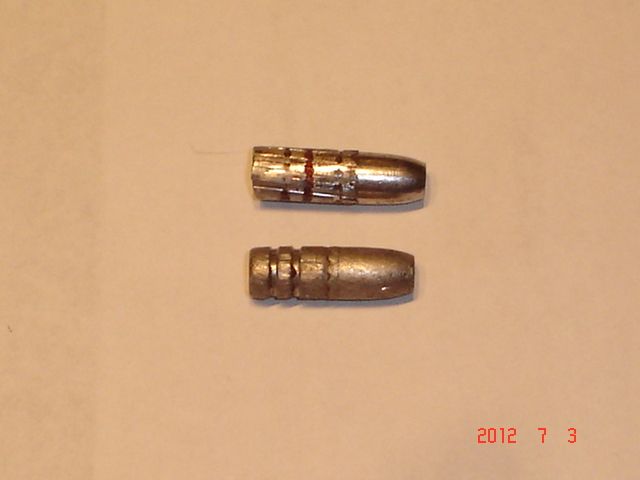
Bullet.jpg


Thinking it had to be the micro-grooving and after finding a bullet (above), I sold the rifle and bought a rifled Henry. Same results.

Here's the kicker, both those rifles could shoot quarter sized groups and under with factory jacketed ammo, particularly the 125 gr stuff. They are both phenomenal shooters of the 100 gr Hornady bullets too.

Without getting into the actual process of making my own bullets, any ideas on other suppliers of 0.310 or 0.311 bullets? Either that, or I'll sell off the stuff - pretty frustrating here.
 
Sobo - you may want to spend some time looking around the castboolits website, lot's of experience with cast bullets & micro-groove Marlins to be found there.
 
If you've gone to the trouble of selling off a rifle and buying another - casting your own bullets doesn't seem like much of big deal.

I bought a Lee mold for a 170 gr flat nose gas check bullet. I used wheel weight lead and dropped the bullets into water from the mold. I used the Lee sizer/lubricator kit. Bullets sized to .309.

With 26 grs of H4895 or 28 grs of BL (C) 2 I was getting 4" groups at 100 yds from a rest (with a 'scope). Not the greatest but not too shabby either for not spending much time/money on the project.

Rifle was a Winchester M94 .30-30 Angle Eject XTR.
 
Could be the bullet is too long for the twist at under 1400 or so, could also be the alloy hardness is not enough for 15-1600, or far too hard. 170gr 311041 in my 32-30Rem is keyholing a bit at 200, but shoots very well, 13 or 14" twist ( I forget which). 165 LBT shoots beautifully at 100, not at 200. They are dropping at .311, 1/20 mix. Both run at about 1400.
 
You require a gas check designed bullet, with gas checks.
The size of your bullets are likely just fine. But as you have been told, at your slow velocities they are not stablizing and at higher velocity they are leaking gas.
With a good gas check bullet in the 165-180 weight range in the 30-30, you should have good accuracy at the same speed you would drive a jacketed bullet.
Use the same loading data, powder and charge, as you would for the same weight in a jacketed bullet. Maybe 30 grains of 3031.
If the groups are a bit large, you may have to come down a grain or two on powder.
 
Could be the bullet is too long for the twist at under 1400 or so, could also be the alloy hardness is not enough for 15-1600, or far too hard. 170gr 311041 in my 32-30Rem is keyholing a bit at 200, but shoots very well, 13 or 14" twist ( I forget which). 165 LBT shoots beautifully at 100, not at 200. They are dropping at .311, 1/20 mix. Both run at about 1400.

The twist rate on the Henry is 1:16". The Marlin 336C was 1:10". The bullets have a brinnell of 25, they are hard little puppies. In speaking with the Bullet Barn, 1,600 is max velocity. I went with book rating of 1,100 to 1,600. The Marlin was better at grouping at the lower velocities with Unique (7.5 gr) but could not get anything reasonable (less than 18" at 100) as the load approached 9.0 grains. The Henry did not fare any better. I have not been able to get them on target at 100 yards very well.

Maybe the bullets are too hard, never contemplated that. Any ideas as to how to resolve? I have no experience casting my own, so therein lies my reluctance.
 
You require a gas check designed bullet, with gas checks.
The size of your bullets are likely just fine. But as you have been told, at your slow velocities they are not stablizing and at higher velocity they are leaking gas.
With a good gas check bullet in the 165-180 weight range in the 30-30, you should have good accuracy at the same speed you would drive a jacketed bullet.
Use the same loading data, powder and charge, as you would for the same weight in a jacketed bullet. Maybe 30 grains of 3031.
If the groups are a bit large, you may have to come down a grain or two on powder.

Good info...any idea as to where to get the commercial GC bullets? Or how would I GC the commercially cast bullets?
 
Funny, because I was using those Bullet barn bullets in the Marlin 336 with microgroove barrel, with I believe up to 10 grains of unique without issue.

Mine were mostly just plinking with irons at the cottage or camping and load testing was only done at 50m, but groups were impressive.
 
Funny, because I was using those Bullet barn bullets in the Marlin 336 with microgroove barrel, with I believe up to 10 grains of unique without issue.

Mine were mostly just plinking with irons at the cottage or camping and load testing was only done at 50m, but groups were impressive.

According to my notes and memory, I had consistent groups at 8.5 and at 9.5 they started opening up radically. Everything I read on Castboolits and elsewhere indicated that the 9-10 grains should be fine. My goal was to shoot silhouette at longer ranges, hence my stubborn insistence for the longer distance observations. The picture I posted was from one of my long shots (likely bounced off the grass) at 9.7 gr Unique. Folks experienced in these things commented that the load may have been too hot. I noted the glorious absence of defined rifling (mircro-groove) in this case. This is one reason I am pulling hair out, it does not seem to make sense, although I never though that the Henry rifle may have too slow a twist (that was a d'oh moment for me today).

I'm not that fond of the modern looks of the Henry rifle and would have to paint over the white front sight stripe for use in the cowboy action anyways, so I'll sell and look for another decent Marlin or Winny.
 
The rifling imprints on those bullets look pretty shallow, almost incomplete on one of them. I'm wondering what you are using for a crimp die and alternately a case neck expander (diameter). Possibly too much neck tension, shaving of bullet during seating, taper crimp die reducing bullet size? Are you flaring the case mouth? You should be able to get 1400 to 1600 without a gas check if the fit is good and the lube is good. I'd certainly try a larger bullet such as .310 or .311 as with a bullet that hard you aren't going to get any bump up. A softer bullet may actually work better for you at that velocity range. You need a bullet designed for a gas check to install a gas check. Those are not so designed.
 
.309 is to small for most .30 cal. throats except the 7.5 Swiss. .311 or .312 will work much better for you. Bore diameter is not the critical measurement in cast boolit shooting, it is throat diameter.
 
The rifling imprints on those bullets look pretty shallow, almost incomplete on one of them. I'm wondering what you are using for a crimp die and alternately a case neck expander (diameter). Possibly too much neck tension, shaving of bullet during seating, taper crimp die reducing bullet size? Are you flaring the case mouth? You should be able to get 1400 to 1600 without a gas check if the fit is good and the lube is good. I'd certainly try a larger bullet such as .310 or .311 as with a bullet that hard you aren't going to get any bump up. A softer bullet may actually work better for you at that velocity range. You need a bullet designed for a gas check to install a gas check. Those are not so designed.

I use a RCBS 30-30 dies set, swage the neck and use the roll crimp in the die set. I thought that could be the problem initially. I mic'd the cast (0.309") and seated a couple). I pulled them and they also mic'd at 0.309". There was really no change in the overall diameter of the bullet. These bullets are pretty hard, so with softer and larger diameter bullets, I would think I would have to use a different setup in terms of the dies I use. These comments have really got me thinking though.
 
I have no experience casting my own, so therein lies my reluctance.

There is no big deal in casting your own bullets. I started doing it as a teenager.

If you live in an apartment I can see that as a limitation but maybe you'd have family/friends with a house?

Millions of bullets have been cast over open fires in the past (and not so past).

I started out using a Coleman camp stove in my Dad's garage.

Lee moulds ($26) and lead casting furnaces ($48 - $75) are not very expensive.
 
And just so you are aware Bullet Barn will size them differently if you ask. Not sure what the minimum order or cost would be though.

That said I just used the standard size, and wish I had my notes from those days so I could tell you exactly what I was shooting.

It may have been lower charges like 7 or 8 grains as you suggest though.

I eventually switched to Berry's plated 30-30 that Henry of Budget Shooter Supply sells. I was able to push them a lot harder with no leading/smoke issues, and they cost about the same.

Not sure if that is an option for Cowboy Action, or Silhoette.
 
Try taking a dozen of your bullets, boil to remove the lube, lay them on a cookie sheet. Heat your oven to 450 degrees and put the sheet in for an hour. Then, shut the oven off and let them cool for a couple hours in the oven. If the bullets had been hardened by quench dropping or other heat/quench treatment they will return to their original metal hardness in a day or two. That may be about BHN 12+/_ as a guess from their hardened state. Try shooting them after re-lubeing. For a few bullets it is easy enough to apply the lube by hand or by melting the lube and pouring it around the upright bullets in a small can to cover the lube grooves. Cut the head off a fired cartridge and use it cookie cutter style to cut the bulllets from the congealed lube.
 
Back
Top Bottom






















