Barnes and the .270 win

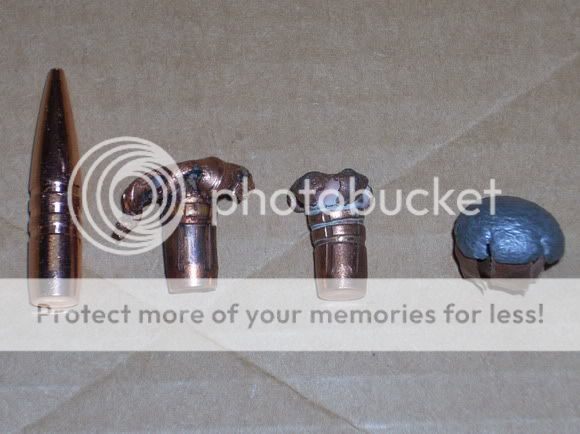
Spent about 30 min looking for a 150 gr TSX last night , ended up rooting through the box of my truck with flashlight . I found 1 TSX that I had recovered out of a pine backstop .

All 150 grn
From Left to right
TSX , Partition , SST , Speer Fb

dscf0003xm.jpg


The best group best Ive ever shot , were those partitions out of my 1 in 10 twist , factory barreled m 700 . About .23 or .24

Maybe with different powder ? I spent enough $$ trying to get them to work . If I want a heavier Barnes I'd go with a 140 , for my personal rifle . You'r experiences may differ .
 
What I really like about the new monometal bullets (esp the Barnes TSX / TTSX) is that they make the 270 even more capable than it was back in Jack O'C's day. The combination of lighter weight + devastating terminal performance is especially beneficial for cartridges like the 270, 25-06, 257 Bob, etc. Now you've got a bullet that flies like a light soft point and penetrates / wounds like a much heavier Nosler Partition. I also like the fact that the Barnes bullets don't leave lead fragments in my dinner.

My Parker Hale throws the 110 TTSX sub MOA, and I'm hoping it'll like the 140 TSX as well. Last season I had two deer DRT with the 130 TSX (factory ammo) - just folded 'em up like they'd been hit with lightning. Now that I'm handloading I'm hoping to have "one gun, two bullets" - the 110 TTSX for deer, and the 140 TSX for moose and bears.

Does anyone know if Barnes is planning to make a .277 140gr TTSX? I'd try that in a heartbeat.
 
Interesting feed back from Barnes on the TTSX/TSX comparison.

Will be doing my elk hunting here on with 130 TSX for my .300 WM, handloaded for me by a friend.

The one elk I took with the 130 TTSX convinced me it's all I need.

Lots of members here are taking elk with 25.06s! If a 25.06 can get the job done (although I wouldn't recommend it myself), certainly 130 gr TSX/TTSX from a .270 Win or WSM will sufficiently plant elk...and moose, too.
 
Lots of members here are taking elk with 25.06s! If a 25.06 can get the job done (although I wouldn't recommend it myself), certainly 130 gr TSX/TTSX from a .270 Win or WSM will sufficiently plant elk...and moose, too.

Ya, if I can't get the 140 TSX to shoot I'll probably drop down to the 130 TTSX. In reality, either probably won't make a dime's worth of real-world difference on a moose or a black bear.

Or, for that matter, maybe I should just stick with the 110 TTSX @ ~3300 fps for everything short of grizzlies (which I don't intend to hunt anyway).
 
Ya, if I can't get the 140 TSX to shoot I'll probably drop down to the 130 TTSX. In reality, either probably won't make a dime's worth of real-world difference on a moose or a black bear.

Or, for that matter, maybe I should just stick with the 110 TTSX @ ~3300 fps for everything short of grizzlies (which I don't intend to hunt anyway).

IMHO, while the 110 gr would be just about perfect for deer of any size, probably pushing the envelope a tad on elk and moose. Would be no better than the 25.06.

I think 130 gr fills the bill just about perfect from .270 through to .300 WM/WSM.

What I really like is how much flatter they shoot out to 300 - 350 yds. Considerable advantage in extending maximum point blank range...if one is inclined at all to take shots at such distance.
 
IMHO, while the 110 gr would be just about perfect for deer of any size, probably pushing the envelope a tad on elk and moose. Would be no better than the 25.06.

I think 130 gr fills the bill just about perfect from .270 through to .300 WM/WSM.

What I really like is how much flatter they shoot out to 300 - 350 yds. Considerable advantage in extending maximum point blank range...if one is inclined at all to take shots at such distance.

Yep - except for a 270 the 110 is the "flatter shooting bullet" since the "usual" weight is 130gr.

With the 110 TTSX @ 3300 fps, sighted in at 1.5 in high at 125 yrds, I'm about 1.5 inches low at 250 yards, and the bullet is never more than +/- 1.5 inches from the line of sight. At 300 yrds, it's about 5 inches low. Starts to make the 130gr feel like a "rainbow" trajectory... :)
 
The thing one has to remember about lighter weight bullets, is that although they can be started faster, they shed their velocity much quicker because of their lighter weight. Consequently, there is very little difference in trajectoy.

At very long range, the heavier bullets often shoot flatter than light ones from the same cartridge.

Ted
 
The thing one has to remember about lighter weight bullets, is that although they can be started faster, they shed their velocity much quicker because of their lighter weight. Consequently, there is very little difference in trajectoy.

At very long range, the heavier bullets often shoot flatter than light ones from the same cartridge.

Ted

Absolutely correct.

However, out to 400 yards the 130 TTSX in .300 WM holds up pretty impressively...

http://www.federalpremium.com/products/details/rifle.aspx?id=750

Same for 110 TTSX in .270 Win...

http://www.federalpremium.com/products/details/rifle.aspx?id=752

Inside the ranges from 200 to 400, when using these lighter bullets, the thing to be more conscious of than one might be with 150s to 180s is wind deflection...although, unless wind is relatively severe, shouldn't be hard to manage.

If one is into shots beyond 400 yds, then such lightweight bullets clearly are not a good option.
 
In changing over to Barnes in a few calibers, for the 308 Norma Magnum I picked two weights to work with. The 168gr TTSX and the 180gr TTSX. In my Husqvarna 30-06 which has a 1:12 twist I thought I'd go with 150gr TTSX but with that twist I thought I'd also try something lighter yet, 130gr TTSX. The first ones I ended up trying out in the '06 were the 130's and I like the results so far.

TTSXloadtestresults-1.jpg
 
Absolutely correct.

However, out to 400 yards the 130 TTSX in .300 WM holds up pretty impressively...

http://www.federalpremium.com/products/details/rifle.aspx?id=750

Same for 110 TTSX in .270 Win...

http://www.federalpremium.com/products/details/rifle.aspx?id=752

Inside the ranges from 200 to 400, when using these lighter bullets, the thing to be more conscious of than one might be with 150s to 180s is wind deflection...although, unless wind is relatively severe, shouldn't be hard to manage.

If one is into shots beyond 400 yds, then such lightweight bullets clearly are not a good option.

Yep. Like for any cartridge/bullet/gun system, you need to do your homework, know its limitations, know your own limitations, and practice, practice, practice. I know for myself that shots beyond 400 yards are not in the cards. In perfect conditions, with an animal standing broadside and completely unalarmed, with a good rest and ample time, perhaps 300 - 350. So, the 110 TTSX has plenty of jam for deer over the type of ranges I'm comfortable with.
 
I have been a fan of the .270 Win for years & have taken many game animals over the years. I just started using barnes 130gr tsx bullets & I have been very satisfied with their performance on deer. The 4 deer I have shot with this bullet have dropped on the spot. I only recovered one of the bullets from a deer that I shot quartering toward me. I recovered the bullet after 28" of penetration on the opposite side hip! That bullet is 2nd from the left in the picture below. IMHO you can't go wrong with a .270 Win. :D

George

TSX357bullets141.jpg
 
270cal - 130gr tsx vs ttsx

130gr tsx has a B.C. of .431

130gr ttsx has B.C. of .392

Below is a email I sent and the response I received from Barnes concerning expansion, their response would seem to validate Chuck's statement if the 270cal has the same results (can't see why it wouldn't).

Personally, unless he 130gr tsx don't shoot well out of your firearm I can't see any reason to use anything else.


Wed, June 30, 2010 9:28:44 AMBarnes Bullets
From: Ty Herring <tyh@barnesbullets.com>Add to Contacts
To: burpeefox@yahoo.ca


--------------------------------------------------------------------------------

Hi Todd,


We test primarily in water and in some cases we have found that tissue may actually cause the bullets to expand at lower impact velocities. Especially with regard to the TTSX bullet design. The .308 cal 130gr TSX is tested at 1800fps and the TTSX version at 2000fps. The 7mm 120gr TSX is tested at 1800fps and the TTSX at 2000fps.


Thanks,

Ty Herring | Customer Service Lead Tech

Barnes Bullets, LLC

38 North Frontage Road, PO Box 620, Mona, UT 84645
Phone: 435-856-1000 | Direct Line: 435-856-1105 | Fax: 435-856-1040

Freedom Group Family of Companies

Remington | Bushmaster Firearms | DPMS / Panther Arms | Marlin | H&R | Dakota Arms
Parker Gun | L.C. Smith | EOTAC | INTC | Advanced Armament Corp | Barnes Bullets

Confidentiality/Proprietary Note: This e-mail and any files transmitted with it are intended solely for the use of the individual or entity to which they are addressed. If you are not the intended recipient or the person responsible for delivering the e-mail to the intended recipient, be advised that you have received this e-mail in error and that any use, dissemination, forwarding, printing or copying of this e-mail is strictly prohibited. If you have received this e-mail in error, please reply back to sender advising that you have received the e-mail in error and delete this e-mail from your system. Thank you.


From: Todd Bailey [mailto:burpeefox@yahoo.ca]
Sent: Friday, June 25, 2010 10:09 AM
To: email@barnesbullets.com
Subject: Minimum Velocity for reliable expansion?


Hi


I use your products TSX & TTSX for all my big game hunting. I am handloading some reduced loads for a new hunter and was wondering what the minimum velocity (fps) was for reliable expansion? I will be loading for either a 308win (130gr) or a 7mm-08Rem (120gr).


Keep making the great products.


Regards


Todd


I was always a fan of Nosler Partitions ( I still like them ) but it seem that more and more people are making the switch to barns. The performance of their bullets really help people who shoot some of the fast flat rounds such as 25-06 , .270 and the 7MM offerings take large game with the confidence that their rounds will hold up. The .270 has always been a great performer...with a lerge following and when teamed up with a quality bullet is a great choice for black bear , deer or moose.
 
A bullet's minimum expansion velocity does not necessarily determine wound channel characteristics. Testing on water is not a consistent way to get results from the two bullets. The hp on the TSX will allow hydraulic compression to work in favour of expansion, while the TTSX has a very pointy tip which would sooner cut through the water than be forced rearward into the hp cavity.

Just to show the hp cavity characteristics between the two bullets. The two on the left are TTSX, the one on the right is a TSX...
images


A more direct way to compare the TSX vs. TTSX would be to ask Barnes which bullet opens easier and wider.

 
A bullet's minimum expansion velocity does not necessarily determine wound channel characteristics. Testing on water is not a consistent way to get results from the two bullets. The hp on the TSX will allow hydraulic compression to work in favour of expansion, while the TTSX has a very pointy tip which would sooner cut through the water than be forced rearward into the hp cavity.

Just to show the hp cavity characteristics between the two bullets. The two on the left are TTSX, the one on the right is a TSX...
images


A more direct way to compare the TSX vs. TTSX would be to ask Barnes which bullet opens easier and wider.

One of the reasons I opted for the TTSX where possible instead of the TSX is partly because of a statement they make concerning that question in their discription of the Tipped TSX in their number 4 manual.

"The tip and re-engineered nose cavity provide even faster expansion".
 
I sold a great light .270 last year with some 130 grain TTSX handloads I made for it. That things was superaccurate with these bullets and the fellow who bought it shot two very nice bucks with it. Both bang flops.
 
Last edited:
Back
Top Bottom