












































You are using an out of date browser. It may not display this or other websites correctly.
You should upgrade or use an alternative browser.
You should upgrade or use an alternative browser.
Barnes TSX - Performance on deer
- Thread starter blasted_saber
- Start date

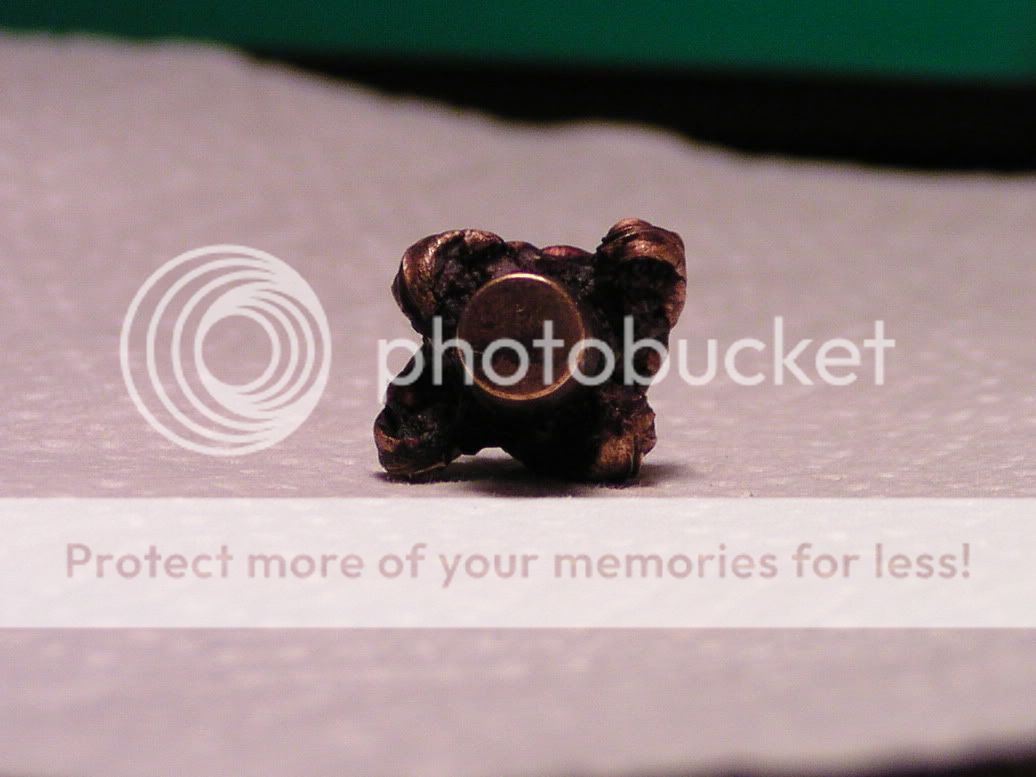
Ok, here's some meat expanded TSX. These are the only two TSX I've recovered from game.
160gr from a 7mm Rem Mag in a moose.

and a 225gr from a .35 Whelen in a moose, the petals brokesbut it was over 1.5x before they broke off. Finisher shot, frontal head shot, bullet found in the spine.

160gr from a 7mm Rem Mag in a moose.
and a 225gr from a .35 Whelen in a moose, the petals brokesbut it was over 1.5x before they broke off. Finisher shot, frontal head shot, bullet found in the spine.
Last edited:

A friend recovered two (bad angle) 30 cal tsx bullets from a moose this year. Both had gone through heavy muscle and bone, hence their recovery. Both opened up just like the ones shot into wet newspaper and retained all petals. Measuring petal to petal, the expansion was probably 2X. On the other hand, nobody can say what expansion is on a real world 'proper' lung shot!
RG
<><
RG
<><

His opinion is based on shooting ONE deer with a 7mmRM and a TSX, that ran a bit, IIRC.
Funny how all the deer I've shot with TSX or TTSX died pretty quick...
I have shot the TSX into wet and dry newsprint as well as wet clay and cooked rice. I have shot one deer myself and have now witnessed (gutted) 3 others that were shot with 30 cal TSX. All testing and animals had smaller wound channels (less internal damage) than "normal" bullets. My assessment of Internal damage is based off the notion of material that is permanently blown away. Temporary wound cavities, cutting or slicing does not rate as highly to me as permanent wound cavities do.
The cost of increased penetration is reduced wound diameter plain and simple. IF you can provide evidence to the contrary please do so.... The TSX is not a "magic" bullet that can deliver the best of both, If it were I would call it the JFK and then post about the magic bullet on the Internet.
Something that pisses me off. The TSX does NOT have the same frontal area as other bullets. You cannot simply measure the outside of the petals and call 1.5x expansion "Frontal Area" See those gaps between the X pattern?? Those gaps REDUCE the frontal area (and potentially reduce wound diameter) so you can get INCRESED penetration. That's how and why it works so well for penetration.
I do take back what I said about the TSX being the worst choice for deer, that award belongs to the FAIL safe. But it is gone now so The TSX must take it's place. At any rate choosing the smallest and longest wound diameter bullet on the market to shoot through 8" of deer is why I consider it a bad choice.
In conclusion: I guess if you are hunting elephants on Monday's with your 270 the TSX would be a good choice, it gives you the rest of the week to follow the blood trail.

Jordan Smith
CGN Ultra frequent flyer
- Location
- Calgary, AB
You can sit there with your 1 deer and pout about the TSX, but of the dozens and dozens that I've killed and seen killed with the bullet, 90%+ go straight down at the shot. TSX bullets may not provide the best of both worlds when it comes to penetration and internal damage, and they may create a smaller wound cavity than some bullets, but it seems to me that they create "enough" internal damage to be effective, but only when they hit the right place on the animal.
Chuck Nelson has got it exactly right. Although I've seen a heck of a lot of game shot with the TSX, and I have yet to see a failure to open. He must be one of the unlucky ones to get the 1 bullet out of 100 that didn't expand.
Chuck Nelson has got it exactly right. Although I've seen a heck of a lot of game shot with the TSX, and I have yet to see a failure to open. He must be one of the unlucky ones to get the 1 bullet out of 100 that didn't expand.

The original post was about deer, not Cape Buffalo.... Any bullet will kill a deer if it is placed right. Especially out of a 270WSM.
Confidence in your ability to place the bullet in the right spot is far more important than construction.
Confidence in your ability to place the bullet in the right spot is far more important than construction.

Both opened up just like the ones shot into wet newspaper and retained all petals. Measuring petal to petal, the expansion was probably 2X. On the other hand, nobody can say what expansion is on a real world 'proper' lung shot!
Well just to compare, i got a good double lung/heart in on a moose at about 250 yards (gps'd) out of a 30-06 using a 168 grain (sure, a little 'pointier than some but still) and recovered my bullet on the far side hide. Clipped a rib on the way out, but nothing heavy.
Doing a quick measurement now - it looks like it's about .64 at the widest point, a hair less at the thinnest (one petal bent a little more than the others. ) So that's better than 2 times.
And at that distance the speeds wouldn't have been terribly high or anything. maybe 2200 - 2300 fps.
Damage inside was significant. Well - obviously, he died faster than dion's last speech.
I don't know about this business of 'not opening at lower speeds'.
Never recovered any out of the deer i shot with that load, but they all died very fast.
Something that pisses me off. The TSX does NOT have the same frontal area as other bullets. You cannot simply measure the outside of the petals and call 1.5x expansion "Frontal Area" See those gaps between the X pattern?? Those gaps REDUCE the frontal area (and potentially reduce wound diameter) so you can get INCRESED penetration. That's how and why it works so well for penetration.
I think you'll find any tissue that passes between the 'x' is pretty completely disrupted.
And 'cutting' damage is pretty lethal - ask any bowhunter
There is no doubt in my mind that you're correct that a controlled expansion round like the barnes X will not expand as much as a less controlled round such as a hornady interloc for example.
But three things come to mind.
1 - 1.5 - 2 times expansion is fine, especially in something like a 30 cal or better. Worrying about it too much is silly. If we were to follow the logic that it wasn't enough or was some how 'less lethal', then 6.5's would be pretty harmless compared to a mighty 30 cal - and 45's would be able to kill much much faster.
2 - Consistancy is in many ways better than dramatic results. I've seen two very similar sized deer from very similar distances and angles, one with a triple shock and the other with a interbond. (Different guns - i shot one, someone else shot the other). The interbond broke up. The deer died, but had it been a larger animal or different circumstances that might not have happened.
I'd rather have a strong, consistant, long wound channel than a bullet that doesn't always perform the way i expect.
3 - You're hearing from numerous hunters here who actually use the thing to take everything from small deer to large animals, and with consistent success. I don't know - but i'd bet of those who've talked to you about it here, they probably represent 40 or 50 dead deer. Which is a reasonable number to judge performance. Does that not perhaps give you some reason to pause and reflect on your belief it may not be a great bullet for deer? Seems to me like your newspaper test, while interesting, isn't really telling you the full story on the lethality of this bullet properly loaded. Or at least, it should call your analysis of the data into SOME question, shouldn't it?


- Location
- Somewhere on the Hudson Bay Coast
Something that pisses me off. The TSX does NOT have the same frontal area as other bullets. You cannot simply measure the outside of the petals and call 1.5x expansion "Frontal Area" See those gaps between the X pattern?? Those gaps REDUCE the frontal area (and potentially reduce wound diameter) so you can get INCRESED penetration. That's how and why it works so well for penetration.
This assessment completely disregards the rotational velocity of the bullet. The speed of rotation is diminished only slightly during the bullet's time of flight. If your rifle has a 1:12 twist and the bullet exits the muzzle at 3000 fps, but the bullet has a rotational speed of 36000 revolutions per second. If you have a fast twist barrel, the rotational velocity could be as much as 61714 ###, if your barrel has a 1:7 twist. Given the rotational speed, the air space between the petals would for all practical purposes not exist until the rotational speed had slowed to nearly a stop. The faster the spin, the deeper the bullet penetrates because less velocity is lost through precession, which is the yaw a bullet experiences when it hits a barrier of different density, such as a game animal. The faster the rotational velocity, the faster the yaw is corrected. This has been proven in tests comparing bullets fired from fast and slow twist barrels, resulting in consistently deeper penetration with identical bullets fired from the faster twist barrels. Precession occurs twice during the bullet's flight, first when it exits the barrel into the open air (this is what target shooters refer to as "going to sleep", which is seen as a bullet being more accurate down range, once it has "gone to sleep" than it is at close range) then the bullet precesses again when it impacts the target.
If the theory of supercavitation is correct, and I think it is, when a bullet passes through a fluid target medium, a shock wave moves ahead and off the sides of the expanded area of the super sonic bullet. We can see the shock-waves that we see come off a bullet in flight when captured by a high speed camera. Except now during the penetration of the target, the nose of the bullet has expanded, and the shape of the shock wave has changed from the way it appeared in the high speed photo. Now it projects a concentrated shock-wave a small distance ahead of the bullet's flat nose, comes off the edges of the expanded nose of the bullet, and neither the tail of the bullet nor the shank produce a shock-wave. The only tissue not effected by the shock-wave is the hide and bone, all fluid bearing tissue is crushed and displaced while the bullet's passage is supersonic. The only material the bullet actually touches inside the body is bone, so those razor sharp petals don't even come into play until the velocity is reduced to subsonic. When a frangible bullet goes to pieces inside the game animal, I will admit I have no idea of how the mechanics of the wound volume occur, but in extreme circumstances the wound volume can be very broad if shallow. Small bore high velocity varmint bullets provide the best example, and there is no doubt that if this can be arranged to happen within the chest of a big game animal it goes down pretty quickly.
I observed a huge wound volume when I first tested the 380 gr Rhino bullet fired from my .375. That bullet expanded to nearly an inch with an impact velocity of 2300 fps, 500 fps slower than a 270 gr bullet, and 300 fps slower than a 300 gr bullet. Due to the heavy weight of the 380 gr slug and the high velocity of the 270 and 300 gr bullets, penetration was dead even at 32", and the ballon shaped part of the wound that is created by the supersonic passage of the bullets was also equal in length, showing that the lighter bullets gave up velocity at a faster rate than did the heavier bullet. But the wound volume of the 380 gr bullet was larger by a multiple of 3, which is a guess because it caused the container holding the test material to fail. That is the difference between a bullet that expands to .73 and one that expands to .93 despite a large difference in velocity.
Game animals are not a homogenous test medium. They are a complex blend of tough elastic skin, suspended organs, air filled spaces, and a variety of bones of different sizes and densities. A game bullet has much to overcome, and hunters over time acquire a preference for how a bullet should perform. I like to see bullets exit. If the shot is not immediately fatal, two holes let out more blood and make tracking easier. I prefer bullets that shed little of their original weight, because to my way of thinking, you might not always get that text book broadside shot that favors the frangible bullet, and in those circumstances penetration trumps a shallow wound cavity. In my experience the game is more often than not quartering to me, and the number of times I've had the picture perfect broadside shot is about even with the number of times I've had a head on shot or a going away shot (which I will only take on a wounded animal or in a dangerous bear scenario where the bear has to be stopped immediately).


Johnn Peterson
CGN Ultra frequent flyer
- Location
- Chemainus B.C.
Good indepth info Boomer. Great actually.
Jordan Smith
CGN Ultra frequent flyer
- Location
- Calgary, AB
Good post, Boomer.
The only thing that I want to point out, is that frangible bullets rotating faster sometimes penetrate less than those rotating slower, due to the greater expansion (and consequently, greater drag) caused by the greater centrifugal force of faster rotation.
Varmint hunters have long noticed that faster twist barrels give a greater "splat" factor for just that reason.
The only thing that I want to point out, is that frangible bullets rotating faster sometimes penetrate less than those rotating slower, due to the greater expansion (and consequently, greater drag) caused by the greater centrifugal force of faster rotation.
Varmint hunters have long noticed that faster twist barrels give a greater "splat" factor for just that reason.
If the theory of supercavitation is correct, and I think it is, when a bullet passes through a fluid target medium, a shock wave moves ahead and off the sides of the expanded area of the super sonic bullet. We can see the shock-waves that we see come off a bullet in flight when captured by a high speed camera. Except now during the penetration of the target, the nose of the bullet has expanded, and the shape of the shock wave has changed from the way it appeared in the high speed photo. Now it projects a concentrated shock-wave a small distance ahead of the bullet's flat nose, comes off the edges of the expanded nose of the bullet, and neither the tail of the bullet nor the shank produce a shock-wave. The only tissue not effected by the shock-wave is the hide and bone, all fluid bearing tissue is crushed and displaced while the bullet's passage is supersonic.
Even with just regular cavication when the bullet slows down, the idea that a temporary cavity does no damage is highly questionable.
Those who doubt this can test it fast enough - get someone to punch you as hard as they can in the gut, or kick you in the nards. That's a 'temporary cavitation', yet you will notice it does have some effect on you
Temporary cavication still causes massive bruising in soft tissue like lungs, which can destroy their ability to function. It messes with the central nervous system of the animal, which can and often does anchor the animal while it bleeds out (and the test for that is get kicked in the nards, then run 100 meters. good luck with that.)
It also disrupts and destroys blood carrying vessles such as arteries, and frequently leads to blood clots that go to the brain and can kill all by themselves.
The deformation and cavity may be 'temporary' - but the damage it causes can be quite permanent and disabling.
- Location
- Somewhere on the Hudson Bay Coast
Good post, Boomer.
The only thing that I want to point out, is that frangible bullets rotating faster sometimes penetrate less than those rotating slower, due to the greater expansion (and consequently, greater drag) caused by the greater centrifugal force of faster rotation.
Varmint hunters have long noticed that faster twist barrels give a greater "splat" factor for just that reason.
Good point, and I know that from shooting a 1:7 .222 with light skinned bullets.
Thanx boomer I knew you would come up with a big long post.
For me the simple facts are X bullets give a smaller diameter wound channel. I like a bigger one. A .280 SD and higher Hornady in popular calibers at 2900 down to 2300 Fps impact have always given me both adequate penetration and wound channels on every deer I have shot. At the upper velocity's I can penetrate from last rib forwards through to far shoulder with 7 and 30 cals, in the lower velocity ranges I have penetrated nearly full length on some of the smaller whitetails. That is more than enough penetration for me.
The whole inadequate penetration boogie man that started on the Internet 12+ years ago came from guys shooting African game. I bought into it for a while shooing really heavy for caliber bullets with heavy construction on deer untill I realized they did not do the job as well as some of my old standards. I had been a light for cal at high velocity guy before and now have settled more towards that end and the middle. I find the best results for deer are from higher velocities, middle of the road bullet construction and high SD.
I have stated what I believe to produce border line or unsatisfactory results in the wound diameter department. (X bullets especially from small cals) I would love to hear from you guys what you feel to be border line in the penetration department. (without quoting some kind of John Barsness's "standard cup and core under 2800fps" mantras that eveyone seems to be regurgitating without thought).
For me the simple facts are X bullets give a smaller diameter wound channel. I like a bigger one. A .280 SD and higher Hornady in popular calibers at 2900 down to 2300 Fps impact have always given me both adequate penetration and wound channels on every deer I have shot. At the upper velocity's I can penetrate from last rib forwards through to far shoulder with 7 and 30 cals, in the lower velocity ranges I have penetrated nearly full length on some of the smaller whitetails. That is more than enough penetration for me.
The whole inadequate penetration boogie man that started on the Internet 12+ years ago came from guys shooting African game. I bought into it for a while shooing really heavy for caliber bullets with heavy construction on deer untill I realized they did not do the job as well as some of my old standards. I had been a light for cal at high velocity guy before and now have settled more towards that end and the middle. I find the best results for deer are from higher velocities, middle of the road bullet construction and high SD.
I have stated what I believe to produce border line or unsatisfactory results in the wound diameter department. (X bullets especially from small cals) I would love to hear from you guys what you feel to be border line in the penetration department. (without quoting some kind of John Barsness's "standard cup and core under 2800fps" mantras that eveyone seems to be regurgitating without thought).

I have stated what I believe to produce border line or unsatisfactory results in the wound diameter department. (X bullets especially from small cals) I would love to hear from you guys what you feel to be border line in the penetration department. (without quoting some kind of John Barsness's "standard cup and core under 2800fps" mantras that eveyone seems to be regurgitating without thought).
I wouldn't call this "borderline" more like outright failure- But I've twice seen lightly constructed bullets blow up on the outside of deer shoulders from 7RM at close range. Both required a couple of follow up shots.
I'd much rather have the deer drop at the shot or shortly thereafter, which is the performance I see on deer from TSX or TTSX bullets. From .22 caliber right up to .375 caliber and everything in between.






















