
Thru the barrel is the most productive way of getting rid of the heat in a rifleStrongly suspect external fan blowing over the gun is the way to go in this scenario.















































Thru the barrel is the most productive way of getting rid of the heat in a rifleStrongly suspect external fan blowing over the gun is the way to go in this scenario.
I'm impressed with the amount of airflow. Looks like the one he suggested can do car tires tooSaw this so I thought I would pass it along


I have this one and used quite a bit. Used the Duracell Lithium battery. Over 2 summers on the one battery.I saw a guy using this on the range yesterday. It is a little noisy, but not bad. He says it does a great job, but I see it uses CR123 batteries that could end up being expensive. Maybe not too bad if you get rechargeable CR123 batteries.
https://magnetospeed.com/products-riflekuhl
This is a case of overthinking the issue. Moving a smallish volume of air down the bore that has a small surface area, is counter intuitive. Move a larger volume of air over the larger surface area of the exterior of the barrel.
Convection is completely irrelevant, a fan will blow air with significantly more force to overcome any convection slightly warm air might have. Convection flow for air touching outer surface will only be relevant in a still air.One thing you also need to consider is that external cooling is a 3D solution whereas the bore cooling is 2D. External cooling may only be exposed to the exterior 50%, but there will be some degree of convection of heat increasing that number. Thermal dynamics again, where heat will migrate internally in the barrel, which moves very quickly. Grid something on a bench grinder 2" away from your hand and it gets hot, fast where you hold it, depending on mass.
The 3D affect of a large volume of ambient air hitting the barrel creating a large temperature differential, and extraction of heat. The 2D situation in the barrel, where the air entering is heated up quickly, and as it travels the barrel will be ambient to the bore at some point, and can't carry away as much heat, not so much the surface area, but the volume of air.
External cooling, say the air hits the barrel at 20*C and is 25*C when it leaves the surface. Internal cooling, lets say the barrel surface is 120*C, air entering is 20*C and by the time it has moved down half of the barrel, it's at 50*C. The lower volume of air, which is now hotter, doesn't have the shear temperature differential to extract heat as efficiently.
There's a lot more at play than area here, there's volume of air. How many CFM are internal air pumps? I know there is a lot of air from a fan that doesn't hit the barrel, but the massive amount of air hitting at ambient. The Dewalt fan I use is 650 CFM, and having it angled and hitting the whole surface leads to a lot of heat extraction.
Edit to add, earlier someone posted an air pump from amazon of 450 L/min, that works out to about 15 CFM.
Cheap !Hmmm - Using forced convection (fan) inside the barrel or outside the barrel will increase the heat transfer coefficient over free convection (no fan).Convection is completely irrelevant, a fan will blow air with significantly more force to overcome any convection slightly warm air might have. Convection flow for air touching outer surface will only be relevant in a still air.
Second, speed of air through the barrel is again completely irrelevant to the question we are trying to evaluate. Energy taken from barrel by passing air is air mass * delta T. There is more energy taken out from the system with N air leaving at 50 degrees than 3 * N air leaving at 25 with ambient at 20. Ambient temp of air is the same in both cases, inside and outside because you are pulling ambient air outside the system so I fail to see any 3D vs 2D you were talking about.
As I said before - this is not such an obvious situation to solve it just by looking at it. It needs numbers.
Thanks for sharing that! Great idea.If you have a 3D printer, this one is easy to make and uses a cheap USB fan
https://www.thingiverse.com/thing:5351868
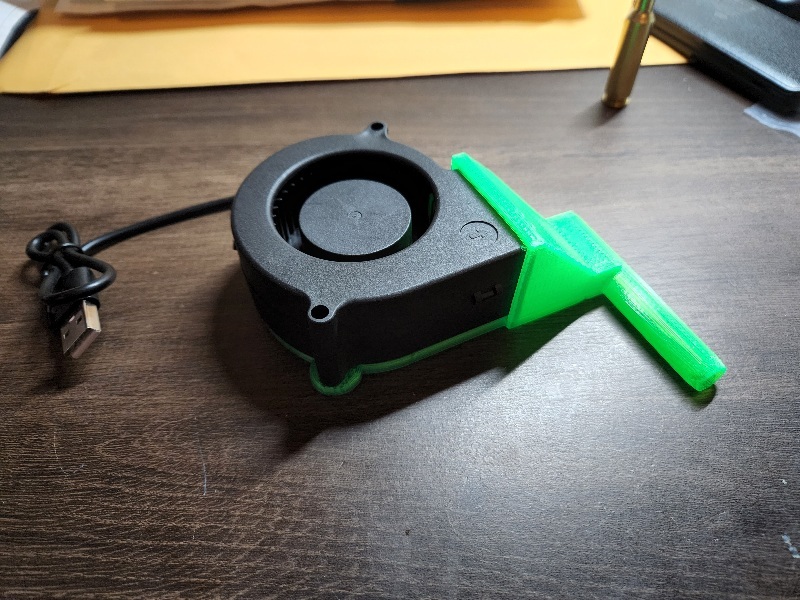
The fan is $15 on Amazon
https://www.amazon.ca/Wathai-Turbine-Centrifugal-Blower-Cooling/dp/B07Z7PVJH8/ref=sr_1_4?crid=DDY78CIVULCA&dib=eyJ2IjoiMSJ9.xBtv1YCcdqrr5DN-XjQ2UiUaI7wsgGka9xD18kAI39JX23AhdTVjoRDMlKaOT0UImBWfySq4HbSU2cCpTh8U5nxJuV9rR2fi83s2nJsM8OsIDiq6nMR5rKiLBAQqXXBPJdsq4kdmjPK8wzWrQcddCbet0BUXCvtoJS2o4mD3KCOAMBNMn1zFtg0gfIn8tpMY-GpaWIp_KxH9Y5qnvqrz8Qlhkq_WHf7K898ZhGcWd9qDkezC5vAuu6m3WWCC0t0P5PcvHAyDL7fPQCPna1RWsy2rxCxJz8TC9Xh0I_QCTvI.c3SMHZNjQ7C10snlnCw1M21VzBBqjMa3obAs3O9jjFs&dib_tag=se&keywords=75mm+x+30mm+USB+cooler+fan&qid=1756051176&sprefix=75mm+x+30mm+usb+cooler+fan,aps,661&sr=8-4&th=1
1) Temperature difference between air and barrel has nothing to do with an amount of air pushed through. Ambient air temp is the only temperature you will have unless you are doing air compression/decompression cycle.Hmmm - Using forced convection (fan) inside the barrel or outside the barrel will increase the heat transfer coefficient over free convection (no fan).
1) Pushing increasing amounts of air through the bore will always increase the rate of heat transfer as you are increasing the heat transfer coefficient, and increasing the temperature difference between air and barrel.
2) Free convection on the barrel surface has a much lower heat transfer coefficient, and is dependent upon geometry and orientation of the surface. Where the barrel sits inside the stock, heat transfer will be marginal, possibly resulting in temperature gradients within the barrel and slight warping. Using a fan offers the same risk.
3) A fella can easily exploit the "stack effect" by orienting the rifle with the muzzle pointing up and the bolt open. This will draw cool air into the breech. As it heats, bouyancy will cause the air to rise through the bore. This results in a "natural convection" system, with a good heat transfer coefficient, approaching forced convection.
I use method 3) - its quite effective. If I wanted to speed things up, I would opt for option 1)


























