Battleship Powder Burn Rate?

Bullwhip

Regular
Rating - 100%
29   0   0
My Google-fu was not strong with this so I could not find an answer.

Where in the spectrum of rifle powders (including black powder) would "modern" battleship powders have fit?

No plans to reload for the USS Iowa, just curious, lol.
 
The Americans don't use smokeless powder in naval rifle, iirc. The Brits used Cordite, but confusing terminology in many sources imply the USA still uses a nitre/charcoal/sulphur propellant. Look on youtube and compare the firing of US guns with those of British capital ships. I'm no expert, I just have an opinion.
 
The Americans don't use smokeless powder in naval rifle, iirc. The Brits used Cordite, but confusing terminology in many sources imply the USA still uses a nitre/charcoal/sulphur propellant. Look on youtube and compare the firing of US guns with those of British capital ships. I'm no expert, I just have an opinion.

Nitre + charcoal + sulphur = black powder. That's Civil War technology.


http://www.navweaps.com/Weapons/WNUS_16-50_mk7.htm gives extensive detail on the 16" rifles.

Propellant types are listed as SPD, SPDN, SPCG, D839, D840 and D845.

http://www.navweaps.com/index_tech/tech-100.htm discussed naval propellants.

Another source says one type had grains 0.545" in diameter and about one inch long. They were pierced longitudinally with seven holes. That last is common enough in large propellant grains as it keeps the surface area approximately the same as the grain burns (the outside gets smaller as it burns away, but the holes down the centre get larger to compensate).

Another says, "The D839 propellant grain used for full charges issued for this gun was 2 inches long (5.08 cm), 1 inch in diameter (2.54 cm) and had seven perforations, each 0.060 inches in diameter (0.152 cm) with a web thickness range of 0.193 to 0.197 inches (0.490 to 0.500 cm) between the perforations and the grain diameter."

Bottom line? Very big grains, very slow burning, smokeless.
 
i can tell you for a fact that the NEW JERSEY uses BLACK- bags of the stuff, , i have pictures of the powder magazine, shell room, projectile room, and other parts- each of the 16 inch rifles has it's own rooms- i've seen 4(105) inch come the way that rifle rounds do- loaded with projectile, powder, case, and primer, and 6 inch(155)can come either fixed or loose, but anything above that comes still as loose, afaik
 
Battleship powder I've seen on the net for 16" IOWA-style naval rifles appear to be 3" long and 1" diameter cylinders. For a +2000# shell, apparently muzzle velocities are in the slow 30-06 category. Pressures are near those generated in a 30-06.

Haven't done the math, but it looks like the big guns are scaled up from the small rifles.
 
I thought they used a black powder primer charge followed by the main charge of smokeless for the big 16" from the Iowa?
 
love the capitol ships, just finished a book on the life and times of the HMS Hood, came to vancouver bc years and years ago, long before me. The big guns are awsome

on that theme check out this

http://www.youtube.com/watch?v=BxuW8gG8Hfg

80cm bore, would launch a 4800 kg shell at 820m/s or a 7100 kg at 720 m/s
used a ton of powder, literally
here is wiki
http://en.wikipedia.org/wiki/Dora_gun
it was not that practical, but cool
 
I thought they used a black powder primer charge followed by the main charge of smokeless for the big 16" from the Iowa?

The New York Times coverage of the USS Iowa turret explosion mentions that each (Korean-war vintage) bag had a pad of black powder on one end.

Black powder is still used in a wide number of munitions. It's a useful low explosive with easy ignition and violent burning. Its use as an igniter would make sense as the smokeless propellant they were using was rather hard to ignite.

There was in addition a primer, fired either electrically or by percussion. Although I haven't details on this, it's very likely it looked like a round of small arms ammo, similar to those used in current army artillery. Once the projectile and the propellant bags had been rammed into place and the breech closed, the primer would have been inserted from the outside.

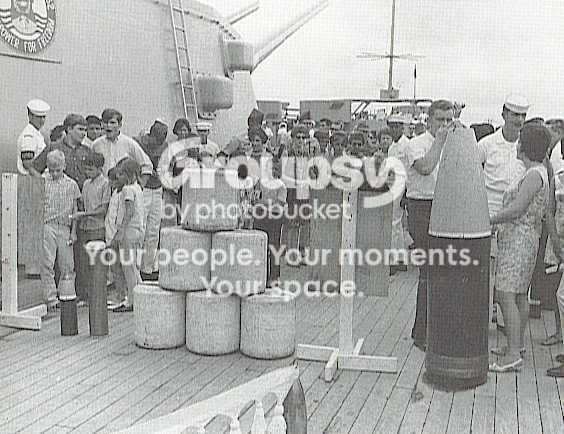
To put this all into scale, consider the 1968 photo taken on board USS New Jersey showing ammo for the 16"/50 Mk 7 rifle as well as for the 5" gun. The 'oil drums' in the centre are the propellant bags.

WNUS_16-50_mk7_Korea_powder_bag.jpg
 
Last edited:
love the capitol ships, just finished a book on the life and times of the HMS Hood, came to vancouver bc years and years ago, long before me. The big guns are awsome

on that theme check out this

http://www.youtube.com/watch?v=BxuW8gG8Hfg

80cm bore, would launch a 4800 kg shell at 820m/s or a 7100 kg at 720 m/s
used a ton of powder, literally
here is wiki
http://en.wikipedia.org/wiki/Dora_gun
it was not that practical, but cool


Wrote a blog post on the Hood visit
http://denofzeus.########.com/2011/02/hms-hood-enters-vancouver.html
 
In addition to the large grains, I read where Gerold Bull used wooden "disks" between his bags of propellant, to create a travelling charge, delaying the start of burning of part of the powder charge. This was done to keep pressure at a high level, further along the combustion cycle.

He used tons of "surplus" battleship powders, 2 cannon barrels welded together, to achieve incredible some incredible velocities/ranges.

There are a few threads about Gerold Bull here on CGN.

http://www.canadiangunnutz.com/forum/showthread.php?t=503912&highlight=bull+harp

http://www.canadiangunnutz.com/forum/showthread.php?t=494622&highlight=bull+harp
 
Back
Top Bottom