
Click here to go to the BC Wildlife & Habitat site.













































You are using an out of date browser. It may not display this or other websites correctly.
You should upgrade or use an alternative browser.
You should upgrade or use an alternative browser.
BC Hunting Regulations 2014-2016 now on-line
- Thread starter 'Boo
- Start date
- Location
- Kelowna, BC
For the lazy:
Major regulation Changes for 2014-2016
Summary
Region 1
- Liberalized black bear hunting seasons in the Thompson, Okanagan, Skeena and Omineca Regions.
- Coordinated and shortened spike-fork moose seasons in the Okanagan Region and portions of the Thompson Region.
- Harmonized restricted Mule Deer Seasons in the Kootenay Region and portions of the Okanagan Region.
- New Initiation Licence allows a person 18 years or older who has never previously held a hunting licence in B.C. to try hunting without having to complete CORE.
- Youth Licence expanded to ages 10 - 17.
Region 2
- Expansion of the shotgun/bow only restriction area and special antlerless deer seasons in the vicinity of Nanaimo.
- Expansion of special antlerless deer seasons to the Saanich Peninsula.
- No Closed Season and No Bag Limit for Fallow Deer in MU 1-1. Deer species license requirements for Fallow Deer are under review; check for in-season regulations change and updates at www.env.gov.bc.ca/fw/wildlife/hunting/news/
- Removal of a portion of private land from the Woodhus Slough No Hunting Area.
Region 3
- Implementation of a No Hunting area within Whistler Olympic Park
- Motor Vehicle Prohibitions within Bert Brink and Pitt Addington Marsh Wildlife Management areas.
Region 4
- Shortening of the spike-fork bull moose season by two weeks in portions of the Region
- Liberalization of white-tailed deer regional bag limit.
- Extend spring black bear seasons in portions of the Region.
- Expanded Sharp Tailed hunting opportunities in portions of MU 3-30.
- Shortening of snowmobile hunting closures in MU 3-28.
- Amendments to Motor Vehicle Prohibition in Clinton Creek watershed.
- Thompson Alpine Motor Vehicle Prohibition.
Region 5
- Conversion of Mt. Goat General Open seasons in mus 4-27, 4-34 to Limited Entry Hunting only.
- Expanded spike-fork moose hunting opportunities.
- Any mule Deer buck seasons replaced with a 4 pt buck season.
- Modifications to agricultural zone elk hunting opportunities.
- Revised cougar seasons and female quota.
- Two week extension to lynx hunt season.
- New Motor Vehicle Prohibitions on conservancy properties.
- Amendments to the Teck Greenhills hunting and firearms prohibited area
Region 6
- Removal of antler restrictions for coastal mule deer seasons
Region 7A
- Extended fall black bear hunting seasons.
- Extended wolverine hunting season.
- Removal of the Todagin Mountain Mining Access Road Motor Vehicle Restrictions.
Region 7B
- Amendments to hunter eligibility and season length for calf moose seasons.
- Extension to spring black bear seasons
Region 8
- Amended mule deer seasons in the agricultural areas of the Peace Region
Trapping Regulations
- Shortening of the spike-fork bull moose season by two weeks.
- Removal of moose hunting closures in Granby and Gladstone Parks.
- Replacement of mule deer buck season with 4 point buck season
- New bow only season for 6 point elk.
- Extended spring black bear seasons
- Youth only grouse hunting opportunity
- Simplification of the Garnet Fire Motor Vehicle Closed Areas
- Liberalized black bear harvest by trappers and lynx trapping seasons in portions of the Skeena Region.
- Under the Agreement on international Humane Trapping Standards the Belisle Super X 110 has been certified for weasel and muskrat, the Ouell certified for muskrat, and the Woodstream Oneia Victor Conibear for otter.
Last edited:
- Location
- Kelowna, BC
There's also some interesting stuff about feral pigs.
Additionally, any carcasses are now considered attractants.
They also reversed their stance on ear-tagged animals.
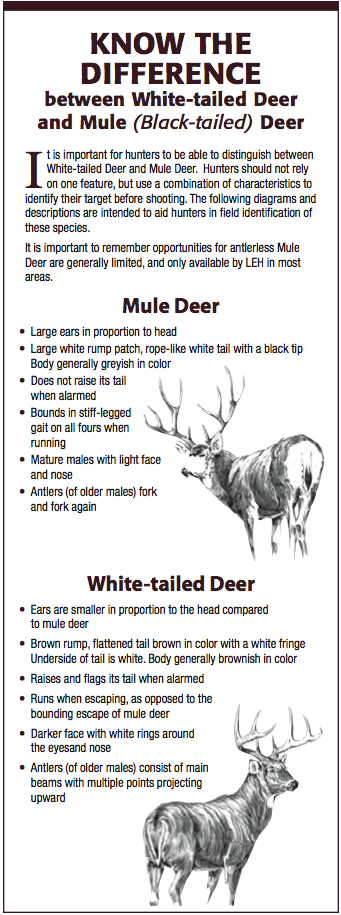
There's also a quick guide on differentiating between white-tail and mule deer. Do people still misidentify them that frequently?
Additionally, any carcasses are now considered attractants.
They also reversed their stance on ear-tagged animals.
Feral pig - means a pig of the genus Sus that is not in captivity or is not otherwise under a person’s control
Feral Pigs (see definition section): a hunting licence is required to hunt feral pigs on Crown land. it is an offence to possess or transport a live feral pig with the exception of a person who was the owner of the feral pig, or an agent of the owner, for the purpose of recapture and returning it to captivity or control.
Please DO NOT AVOID hunting animals with ear tags or collars, unless specified under regional sections in the synopsis. This will ensure that biologists acquire accurate data on mortality rates. if you kill a marked animal, please contact your local Ministry office with the number on the ear tag or collar because the meat may not be safe to eat if immobilization drugs were used. ear tags and collars must be returned to the Ministry office.
DISPOSAL OF CARCASSES OR WILDLIFE PARTS
Carcasses or part of a carcass of an animal or fish are included in the Wildlife Act definition of an attractant. Other than for the purpose of hunting in accordance with the provisions of the Wildlife Act and regulations, it is prohibited to provide, leave, or place an attractant in, on or about any land or premises where there are or where there are likely to be people in a manner in which the attractant could attract dangerous wildlife to the land or premises and be accessible to dangerous wildlife. A person that commits an offence under this provision is liable, on a first conviction, to a fine up to $50,000 and/or a term of imprisonment not exceeding 6 months.
There's also a quick guide on differentiating between white-tail and mule deer. Do people still misidentify them that frequently?

- Location
- Kelowna, BC
I have seen a lot of whitetail in region 3 but hopefully the new regs are not too hard on them.
The total limit is still 2 whitetails. You just aren't forced to get 1 buck and 1 anterless anymore though: you can double up on either. Shouldn't be too bad


... Anyone know why we can't hunt in 2-1?
Because 2-1 is Manning Park. No hunting or shooting allowed in that particular Provincial Park.
Because 2-1 is Manning Park. No hunting or shooting allowed in that particular Provincial Park.
Of course! Silly me. Thanks.

- Location
- interior b.c.
Gutted our moose season some more, I won't be buying a tag unless I get a draw.






















