beam scale repeatability question...

Ducimus

CGN Ultra frequent flyer
Rating - 100%
40   0   0
Location
Alberta
So I've got a Dillon beam scale. I zero it before use. There are no drafts around. I check for a level surface before use with a bubble and shim the legs of the scale as necessary. The pivot points are clean.

After I zero the scale if I give the beam a tap it doesn't always return to zero. It could end up a little high or low. I re-zero and tap the beam and again it doesn't return to zero. Now the amount it is off is approximately the weight 2 sticks of Varget. Is this normal or is there a problem?

 
If you are allowing the beam to settle to a dead stop it may well be inclined to bind a tiny bit one way or the other. Used correctly you should be reading it while it swings - near equal amounts above and below the zero mark. The beam will read slightly less on each swing up and down so take that into consideration.
 
I can't speak for the Dillon, but almost every other beam scale I've had since the 1960s have done the very same thing...... except for one.
A tired old Redding #2 beam scale is the most accurate scale I have ever used with the exception of a much newer digital scale.
It can be very frustrating when a scale does that, especially when it is new.
 
If you are allowing the beam to settle to a dead stop it may well be inclined to bind a tiny bit one way or the other. Used correctly you should be reading it while it swings - near equal amounts above and below the zero mark. The beam will read slightly less on each swing up and down so take that into consideration.

I let it settle a few secods after it stops moving. I'm thinking two sticks or so are not going to make much difference down range?
 
And here I thought I was crazy.
I tap the beam with my tweezers and catch it on the up swing.
If it goes past and then back down, you're right, it makes a slight difference.
 
I have an expensive electronic scale with calibration weights at my disposal for reloading.

Each stick of Varget weighs about 1.5 milligrams give or take a bit. Every stick of varget varies a bit in size. So two sticks of varget can be (if you get two big ones) approximately 3 milligrams which is .05 (1/20th) of a grain.

1/10 of a grain = 6.479 milligrams

When i reload for accuracy with a .223 and .308 I always try to go to the desire weight. Occasionally i need to add one more stick of Varget because i am under weight and it take the total weight just over by maybe a milligram..

My 308 shoots at .3 MOA and my new .223 rifle shoots at 0.6 MOA..(hoping to do better with more load development)

So i guess what i am saying is that one stick of varget should not make much of a difference. However if you have a variation of 4 sticks, 2 sticks + or - , that would be up to 6 milligrams or 1/10 of a grain, it could show in your accuracy..

RDG
 
Last edited:
Many are far too "anal" about powder weights.
If it makes you feel better, fly at it, but from years of experience (and observation) in a small case ( e.g. 223) .1 grains is unlikely to matter enough to notice on the range or anywhere else.
In larger, Magnum cases, it takes .3 grains or more to make any detectable difference.
In chrongraphing the 300 Win Mag, I have seen a 72.0 grain powder charge actually deliver slightly more velocity than did a 72.3 grain charge with all components otherwise identical.
I know this sounds strange, but the case volume, bullet weight variance, neck tension and primer all factor in.
Two kernels of Varget are not going to "make or break" a good shooting load.
Practically all beam scales exhibit the characteristics you describe. I have a 304 RCBS that doesn't, but my 1010 does.
Load the ammo and enjoy! No point in picking flyspecs out of pepper and getting all stressed out about it. Eagleye.
 
There is little doubt that Warren Page was the most successful, most famous shooter of all time. In world class bench rest shooting he won the national title nine times.
He was equally famous for long range shooting as well as experimental wildcatting.
In hunting he won the Weatherby trophy, and is in the hunters hall of fame.
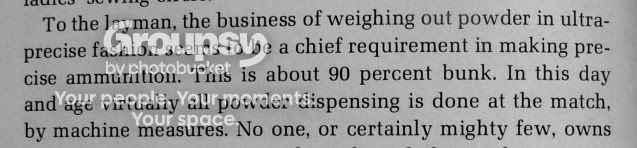
In his book, "The Accurate Rifle," this is what he says, on page 174, about powder charges.
Note he states they measure the charges at the match, by powder measures, and do not weigh each load.

AA.jpg
 
After I zero the scale if I give the beam a tap it doesn't always return to zero. It could end up a little high or low.

I have an Ohaus 505-10 scale that does this if the beam has wandered to one side or the other, so that one end or the other of the pivot edges rubs against the housing. It's fairly noticeable as it causes the scale to be out probably 0.02grams, or ten times what you are experiencing. I have never noticed any problems if the knife edges are centered on the agate block. Above all, I agree that it is an academic pursuit only, 1.5 mg is bugger-all in practial terms.
 
There is little doubt that Warren Page was the most successful, most famous shooter of all time. In world class bench rest shooting he won the national title nine times.
He was equally famous for long range shooting as well as experimental wildcatting.
In hunting he won the Weatherby trophy, and is in the hunters hall of fame.
In his book, "The Accurate Rifle," this is what he says, on page 174, about powder charges.
Note he states they measure the charges at the match, by powder measures, and do not weigh each load.

AA.jpg

Are you trying to tell me that I need to buy more reloading equipment...:D
 
Are you trying to tell me that I need to buy more reloading equipment...:D

I don't quite get you, unless you are mistaking his word, "machine measure."
By machine, all he means is standard powder measures. He particularily likes Lyman.
If there is confusion, I could post more of his statements, but I was just getting across that most world class bench rest sshooters did not weigh each powder charge.
 
I don't quite get you, unless you are mistaking his word, "machine measure."
By machine, all he means is standard powder measures. He particularily likes Lyman.
If there is confusion, I could post more of his statements, but I was just getting across that most world class bench rest sshooters did not weigh each powder charge.

Ya I meant I have to buy a powder measure now. I currently weight every charge on the beam. It gets to be a bit of a drag.
 
I don't quite get you, unless you are mistaking his word, "machine measure."
By machine, all he means is standard powder measures. He particularily likes Lyman.
If there is confusion, I could post more of his statements, but I was just getting across that most world class bench rest sshooters did not weigh each powder charge.

Given that post what does he consider an acceptable weight variance of powder throws?

Steve
 
Assuming it makes a difference,it would only be relevant if the powder burns the exact some way each time and ignition is identical each time.I find it hard to believe this is a exact duplication every single time!
 
I can't speak for the Dillon, but almost every other beam scale I've had since the 1960s have done the very same thing...... except for one.
A tired old Redding #2 beam scale is the most accurate scale I have ever used with the exception of a much newer digital scale.
It can be very frustrating when a scale does that, especially when it is new.

X2 for Redding. Redding and an Ohaus lab beam I purchased used for 40 bucks is all I've ever used. My initial reaction to the OP was going to be "yes, there is something wrong". Apparently there isn't but my Redding definately achieves and holds zero very well.

While defering to better reloaders than I, when they point out that Nth degree weighing is irrelevant, I still say if you're going to buy a scale, even in this price range, one that works as expected is preferable to one that doesn't.
 
While its not something I adhere to, there are those who believe that volume measure provides better uniformity than measuring by weight. In the case of ball powders, they might have something. But if there's a weight variation between subsequent charges thrown by a powder measure, is it wise to assume they are exactly the same volume?
 
Back
Top Bottom