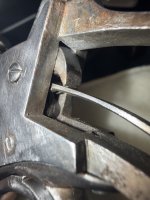
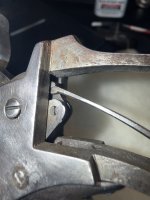
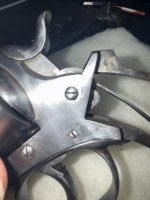
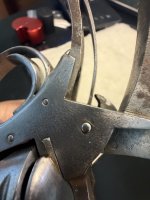
I recently purchased it online to have as collector piece and once in awhile shoot it. Was told it was in perfect shape. Once getting it .I’m getting second thoughts on shooting it. It has no safety or half caulk. Would have to chamber 4 and leave one open. Also when caulked there is a bit of play. What worries me is cylinder is .44 and bore .38-.39. I know I need to bore slug to find proper measurement but bore seams small. I’m using.44 Russian 200grain reduced load smokeless. Will bring to gunsmith to check out. Anyone here with any experience with these?













































You are using an out of date browser. It may not display this or other websites correctly.
You should upgrade or use an alternative browser.
You should upgrade or use an alternative browser.
Belgium Bulldog in .44 Russian is it safe to fire
- Thread starter Scruffer
- Start date
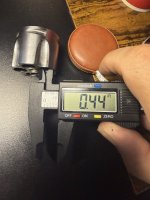
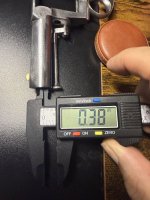
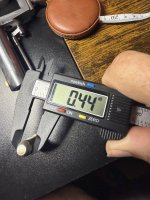
Land to landYoure measuring land to land, or groove to groove?

Can leave 5 beans in wheel, rebounding hammer.
The cylinder will likely just free wheel, I had a couple Bulldogs in 442 Webley back in the day.
Mine had to same silly bore dimensions ( BBL went from .429 to .405 in 2.5 inches... it's kinda the forcing cone I suspect), use a PL bullet and BP or Unique Powder.
It's not a 44 Russian IMO.
442 Webley likely.
44 Russian fits like dream, don't even entertain firing a 44 Russian in it is my advice.
I had 1 with broken hammer (200$) and bought one that someone had fired a 44 Russian in it (200$) ... 'tweaked' the frame.
Tweaked one donated the hammer to the intact one.
The cylinder will likely just free wheel, I had a couple Bulldogs in 442 Webley back in the day.
Mine had to same silly bore dimensions ( BBL went from .429 to .405 in 2.5 inches... it's kinda the forcing cone I suspect), use a PL bullet and BP or Unique Powder.
It's not a 44 Russian IMO.
442 Webley likely.
44 Russian fits like dream, don't even entertain firing a 44 Russian in it is my advice.
I had 1 with broken hammer (200$) and bought one that someone had fired a 44 Russian in it (200$) ... 'tweaked' the frame.
Tweaked one donated the hammer to the intact one.
Last edited:
If the OP's is like mine, I'd use a HB PL .430 - .429 loaded inside the case.These take a heeled bullet ~.45 cal .use a cut down 44 Russian/special/magnum brass
And soft lead bullet .if you can’t crimp them a bit of crazy glue works
It'll bump up to .44 as it leaves the case.
Remember, it has it compress down as the bore has a mean taper.
I drilled the nose out too ( Like a manstopper bullet), logically it will help taper down to muzzle diameter.
Going from .45 to .40 in 2.5" is a lot more to ask than going from .43 to .40.
IMO. Respectfully of course
Might be a good idea to shoot round balls with a light loads of BP ( no smokeless ) they are very forgiving. Make sure you fill the case up with some filler if you are going light loads. You can still get a really good crimp with lead balls. Good idea to have that gunsmith do a once over if you do not know how to check it yourself.
Last edited:

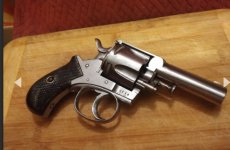
All arguments aside, here is my suggestion: First, there will be a bit of play when the hammer is co**d. The reason being is that the hand is attached to the trigger and needs to have some play so that when you pull the trigger, it can still move up a fraction of an inch to release the hammer. If the hand was tight against the ratchet, it would not be able to rise and jam the mechanism. Check to see if there is any play in the cylinder when you pull the trigger. Hold the trigger at its rear-most position and check the play in the cylinder at the same time. If there is still considerable play, then you may have a problem. Chances are the play will be less, or perhaps none at all. Secondly, if your bulldog does not have a rebounding hammer, it will have a "safe" position where the hammer nose is retracted far enough behind the recoil shield to allow you to rotate the cylinder with cartridges inserted. If it doesn't, there is a problem. From your pictures I am guessing it's a Belgian made "British Bulldog". Probably would not take a 44 Russian. The American made ones (Iver Johnson, Hopkins & Allen or Forehand & Wadsworth) have a long enough cylinder to accommodate a 44 Russian cartridge. You will have to find, or make 44 Webley. Don't give up on it. These are really cool little guns.I recently purchased it online to have as collector piece and once in awhile shoot it. Was told it was in perfect shape. Once getting it .I’m getting second thoughts on shooting it. It has no safety or half caulk. Would have to chamber 4 and leave one open. Also when caulked there is a bit of play. What worries me is cylinder is .44 and bore .38-.39. I know I need to bore slug to find proper measurement but bore seams small. I’m using.44 Russian 200grain reduced load smokeless. Will bring to gunsmith to check out. Anyone here with any experience with these?
Thanks there actually was less play with trigger pressure, it does chamber the 44 Russian no problem, most have a half caulk to allow to load . Don’t know if broken or does not have one.All arguments aside, here is my suggestion: First, there will be a bit of play when the hammer is co**d. The reason being is that the hand is attached to the trigger and needs to have some play so that when you pull the trigger, it can still move up a fraction of an inch to release the hammer. If the hand was tight against the ratchet, it would not be able to rise and jam the mechanism. Check to see if there is any play in the cylinder when you pull the trigger. Hold the trigger at its rear-most position and check the play in the cylinder at the same time. If there is still considerable play, then you may have a problem. Chances are the play will be less, or perhaps none at all. Secondly, if your bulldog does not have a rebounding hammer, it will have a "safe" position where the hammer nose is retracted far enough behind the recoil shield to allow you to rotate the cylinder with cartridges inserted. If it doesn't, there is a problem. From your pictures I am guessing it's a Belgian made "British Bulldog". Probably would not take a 44 Russian. The American made ones (Iver Johnson, Hopkins & Allen or Forehand & Wadsworth) have a long enough cylinder to accommodate a 44 Russian cartridge. You will have to find, or make 44 Webley. Don't give up on it. These are really cool little guns.
Think I saw this one on #######. I've been looking for my first antique for a while now and have don't lots of research and googling. .442Webley is what these were made for I believe camber full length .44 Russian depending on what bullet you use. Best to show it to a gunsmith that deals with antiques perhaps, might explode who knows, looks like this is made from Belgian metal. I think there are posts on here asking about smokeless loads in their Belgian bulldogs. This following post isn't about smokeless but its about bullet resizing since the bore width is different, you would have to resize the bullets.
https://www.canadiangunnutz.com/for...ext=Air can cause detonation,a bit more power.
https://www.canadiangunnutz.com/for...ext=Air can cause detonation,a bit more power.
The big US pistols did that.I read a forum where some bulldogs they would load,4 and leave the firing pin in empty chamber
But they didn't have rebounding hammer.
At rest, in otherwards not cocked, will the cylinder rotate freely?
If so, your 'safe' chamber, will just roll out from under the hammer when handling it.
No point if that is the mechanism. I'd bet it is the same as the F & W's I had.
See if it rolls freely. That'll tell you.
And a tip? How many grooves is the rifling? If it has a odd number of grooves, then your caliper reading will be off.
Maybe this will help?
https://www.canadiangunnutz.com/forum/threads/bulldog-fodder.1092594/
Last edited:
You can safely ignore most “experts” in this thread with the exception of OldGuns.
But youre supposed to measure from grove to grove, so the difference youre seeing may be exaggerated.
When you say theres no half ####, no safe: there is not any position where the hammer is held back from making contact with the primer? Its fully back ready to shoot single action, or touching the fired primer? Or is the hammer unexposed through the back of the chamber face?
More photos may help. Regardless, might be closer to fireable than you may think.
But youre supposed to measure from grove to grove, so the difference youre seeing may be exaggerated.
When you say theres no half ####, no safe: there is not any position where the hammer is held back from making contact with the primer? Its fully back ready to shoot single action, or touching the fired primer? Or is the hammer unexposed through the back of the chamber face?
More photos may help. Regardless, might be closer to fireable than you may think.
You can safely ignore most “experts” in this thread with the exception of OldGuns.
But youre supposed to measure from grove to grove, so the difference youre seeing may be exaggerated.
When you say theres no half ####, no safe: there is not any position where the hammer is held back from making contact with the primer? Its fully back ready to shoot single action, or touching the fired primer? Or is the hammer unexposed through the back of the chamber face?
More photos may help. Regardless, might be closer to fireable than you may think.
Attachments
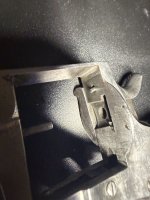
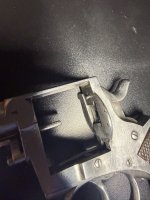
I have never seen one that didn't have some mechanism to keep the firing pin off the primer. Any which did, were always damaged. Take off the grips and look at the bottom of the hammer. There should be a notch at the back, and a corresponding, spring-loaded "hook" underneath which slips into place when the hammer is pulled back slightly. If it is not, see if the hook is missing, or the notch has worn off.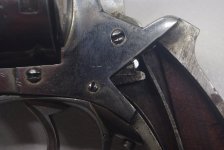
I have never seen one that didn't have some mechanism to keep the firing pin off the primer. Any which did, were always damaged. Take off the grips and look at the bottom of the hammer. There should be a notch at the back, and a corresponding, spring-loaded "hook" underneath which slips into place when the hammer is pulled back slightly. If it is not, see if the hook is missing, or the notch has worn off.View attachment 1189906
Attachments