Birmingham percussion. Info anyone?

ww270win

Member
Rating - 100%
23   0   0
Location
Alberta
Hi All
I bought this from a dealer.
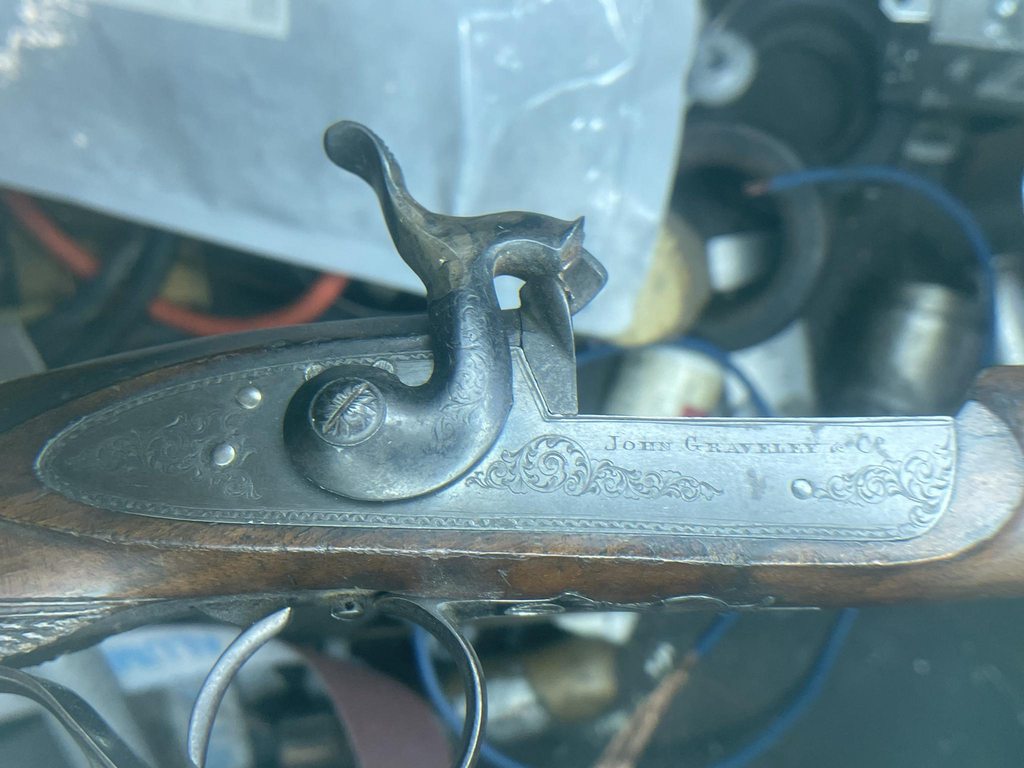
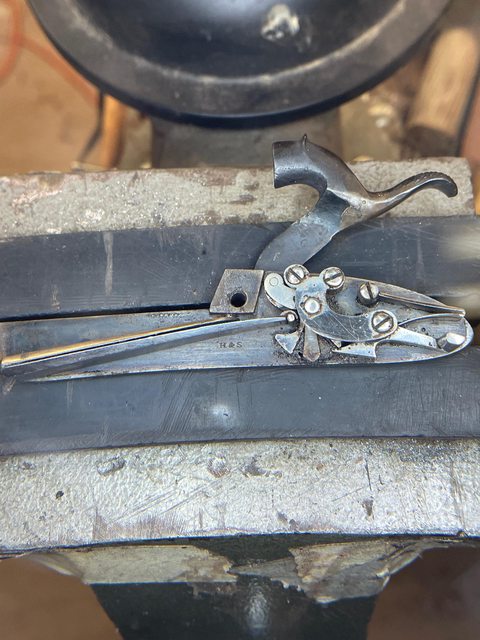
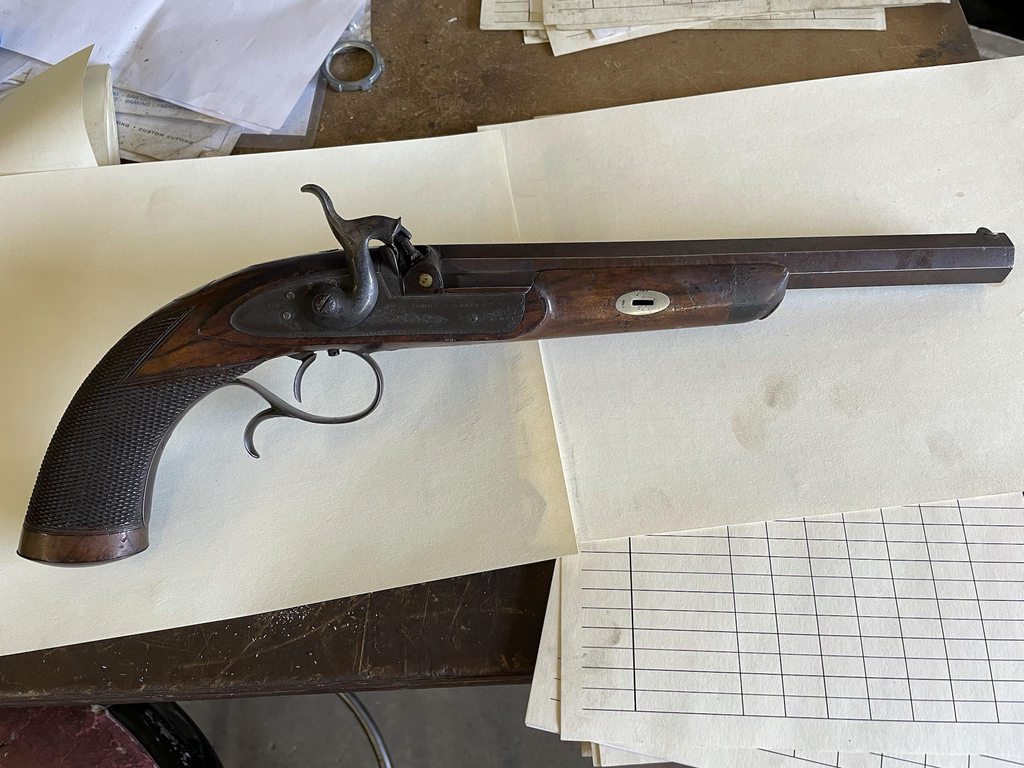
On top of the barrel it says London. The lock is engraved "John Gravely". The letters M&S are punched on the inside of the lock.
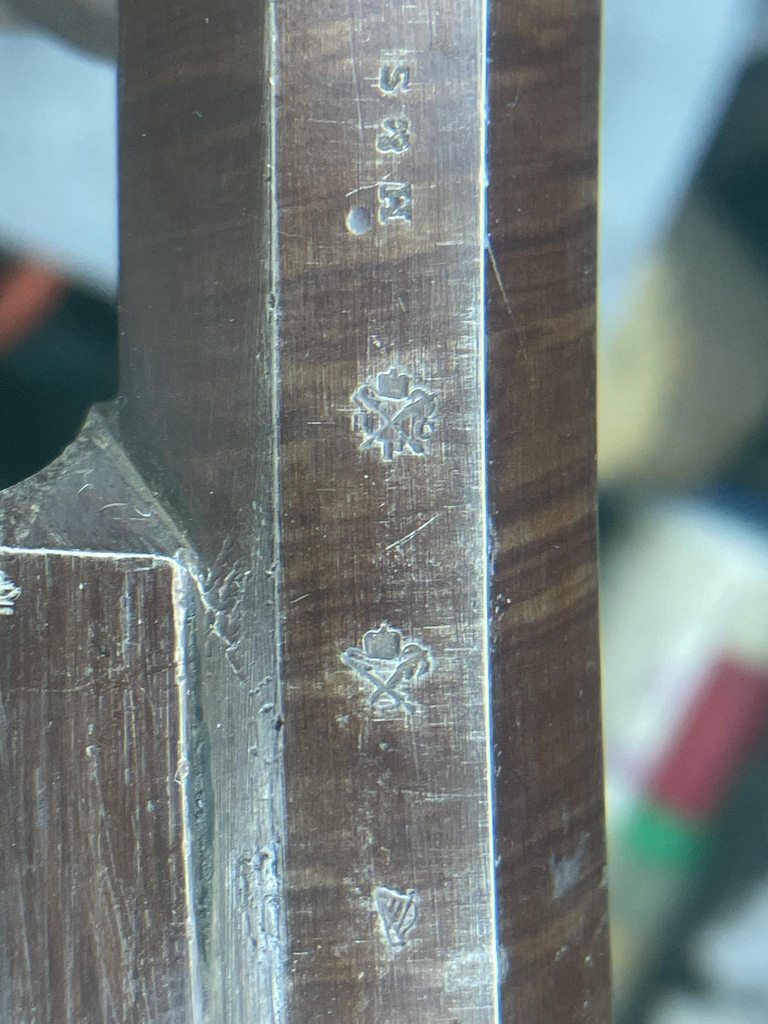
On the bottom of the barrel, is again the stamp M&S, a Birmingham proof mark, another proof mark and a stamp of a harp.
Does any one have any info about the time period of manufacture, and the maker. I found some info on the proof marks.
But noting on the M&S, and the harp.

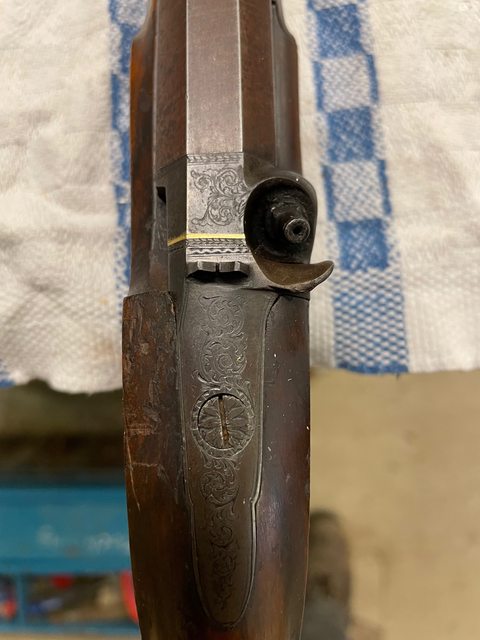
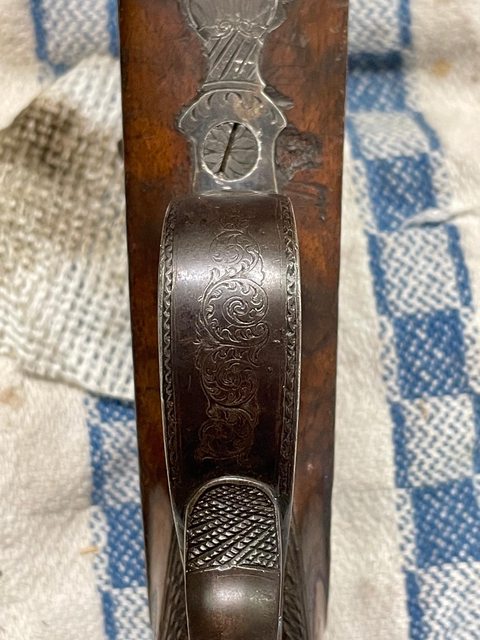
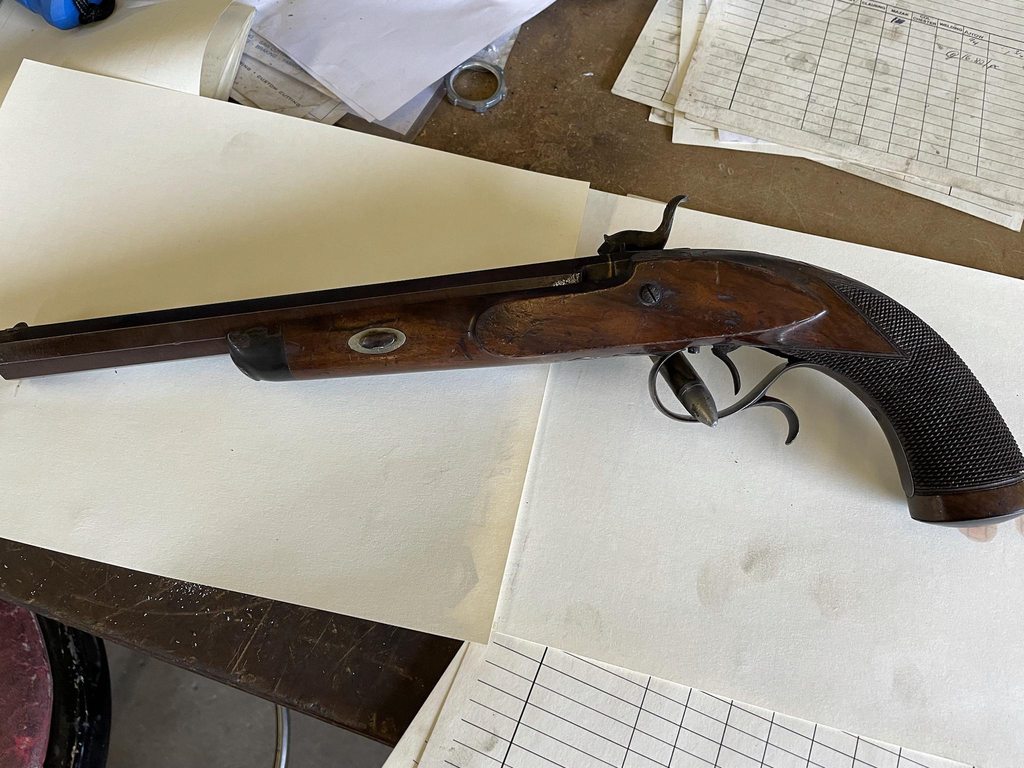
The pistol is superbly made, with engraving all over. The wood to metal fit is excellent. The lock is top notch craftsman ship. All parts inside are highly polished without round edges.
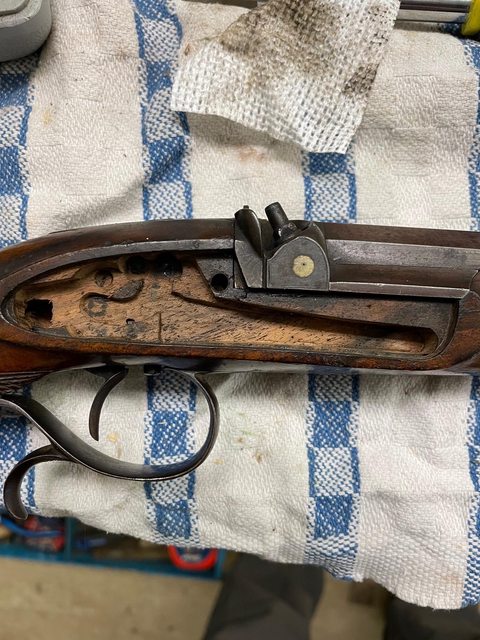
The set trigger is very compact. When I got it, the set trigger was not working. After some cleaning and adjustment, it's good now.
The barrel was pretty rusty throughout. But as it turns out, not many deeper pits.

The checkering is still quite sharp. The fore end cap is of some translucent material, which was painted black. I believe it may be the original finish, because it is flush with the finish on the fore end stock.
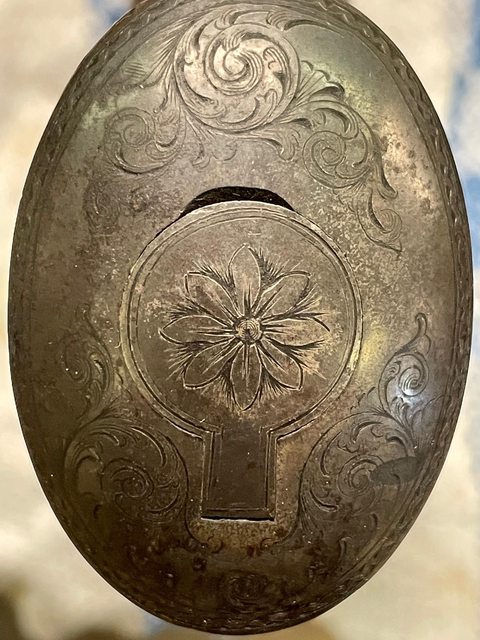
The bottom of the stock contains a trapdoor, about 5/8 diameter, and about 1" deep.

Someone welded the hammer, and just ground it with an angle grinder. Part of the hammer cup is missing as well.
I shot it with 15 grains of 3f black powder. At 10 meter, I could get 3 shots in about 3". I think the barrel will smooth some up with repeated shooting.
I can't stand to have a gun in the locker and not shoot it!
raOBqHah.jpg

Zsuyuklh.jpg

4tZh9Rwh.jpg

IhXmheQh.jpg


Any info is greatly appreciated.

Cheers
ww270win
 
Last edited:
First, the bad news: John Graveley did not make your fine pistol, and you are unlikely to know which one of the 450 or so Birmingham gun quarter workshops made it, or the names of the craftsmen involved. Suffice to say it was made there, and it carries the proper Birmingham proof and view mark. The 'harp' mark is a mystery, but I'm still looking.

The good news is that the name inscription is actually quite interesting from a historical standpoint. John Gravely is indeed known, but he was never a gun maker (hence his name cannot be found in the usual references).

John Graveley was born in Britain about 1798, near Leeds (possibly Halton). He emigrated and arrived in New York City in 1821, establishing himself as a dealer in hardware and Sheffield cutlery in Maiden Lane. He then moved to Charleston in South Carolina, and by 1830 had partnered with William Timmons, selling ironmongery and cutlery there. By the mid-1830s Graveley had moved to New York, and in 1836 partnered with Charles Wreaks. Graveley and Wreaks sold knives to the fur trade magnate John Jacob Astor, and are probably best known as suppliers of ‘Bowie’ knives that bear their mark. The two dealers had a showroom in Astor’s Astor House hotel, the first luxury hotel in the city. Astor’s frontier trade connections into the interior probably provided Graveley and Wreaks with a sizeable market for hardware goods. The Graveley and Wreaks partnership ended in 1839. Graveley returned to Charleston and re-established his business there (35 Broad St.), as John Graveley & Co. Then, around 1860 and the outbreak of the Civil War, Graveley returned to Britain, settling down at Leamington Priors, with his wife and two daughters. He died there in 1865. Graveley’s nephew Cowlam Graveley remained in Charleston and was a partner in Graveley & Pringle, hardware merchants. The firm sold Sheffield cutlery, and also supplied arms to the Confederacy, including Enfield rifles.

From the above, it would seem that your pistol dates somewhere between 1839 and 1860. By the way, the horn end cap is surely original to the pistol. The trap door is for extra percussion caps.

A quality piece and very nice find, connected to some interesting North American history!
 
Last edited:

Thanks Pinfire for the great info.
Nice writeup. The way I understand, that John Graveley, ordered one or more likely many of these pistols with his name on it.
Anything on the M&S stamp?
Regards,
ww270win
 
You're welcome. Your pistol would have been ordered by Graveley from his Charleston business, from a supplier, more than likely in Birmingham, England. Graveley would have had contacts in the iron business there (he was also an importer of raw iron), and there were Birmingham gun-making firms that happily filled export orders, making sure the requested information was engraved on the piece (in this case, John Graveley & Co.). However, such gun-making 'firms' were usually no more than one, two or three workers, many operating from rented workshop bench spaces and with rented tools. This was well before the days of 'factory' production, at least for civilian pistols and sporting guns. A small Birmingham workshop might produce a few of these a month, they were not mass-produced. Your pistol might have been a special request or part of a small shipment imported on spec. It might have been one pistol in a case, or one of a pair - there's no hint on the pistol that I can see. It looks like a target pistol, or possibly a dueller (in which case there definitely would have been two). In either case, it should be an accurate weapon, subject to the condition of the barrel. The damaged hammer looks like someone spent time dry-firing it, which is a shame. The cross-key oval looks to be silver, a nice decorative touch.

I'm so far stumped on the M&S mark. It looks like the actual maker signed his work, a good sign of quality. However, it could represent a partnership of two names, or 'someone & Son'. A quick search turned up about 90 names of makers and craftsmen starting with the letter 'm', each would have to be looked into individually to whittle down to a shortlist of possible makers. And if are lucky enough to find out who M&S is/are, there were likely many other hands involved with the making of your pistol. In the Birmingham Gun Quarter there were many trades associated with the gun “trade”, as the parts, and putting together of the parts, requires specialist attention. In an 1861 directory for Birmingham, the following gun-related trades were listed: gun and pistol makers, barrel makers, barrel smoothers, barrel browners, barrel riflers, break-off fitters and forgers, breech makers, finishers, furniture makers, implement makers, implement and barrel filers, lock makers, nipple manufacturers, rib forgers, gun and rifle sight makers, screwers, stockers, stock dealers, stock finishers, stock polishers and varnishers, and gun wadding makers -- mostly all working under different roofs. Gun-making was a highly diffuse business, and rarely if ever the output of one person in one location. And your pistol is a good example where the name on the gun is not the maker!

I would suggest you try to find records of other guns marked John Graveley, and see if the same marks show up or if someone has identified Graveley's supplier. Researching guns is a very deep rabbit hole! Usually frustrating, sometimes rewarding, but always deep.
 
Could that harp type marking point towards an Irish gunmaker??

I highly suggest you contact Mick's Guns out of the UK. About thirty years in this business.
This is his website. There's personal contact info on top of his front page. Micheal Shepard.
 
Last edited:

Pinfire you’re just a treasure trove of knowledge!
It's interesting to read.

The accuracy is definitely gone.
I shot 10 balls at around 10 meter. It is all over the paper.
I considered to bore it out and rifle it. Upon closer inspection, it looks like the breach plug is soldered to the barrel.

If it just would have been threaded on, I would have attempted to bore it out to 50 cal. And rifle it.

At least i have a sample to build a percussion or flintlock according to the measurements I have from this pistol.
My first one I built, is a little out of proportion, if I compare it to this one. But its a winner for accuracy.

Brutus
I will look that guy up.
Thank you.

ww270win
 
What a great post this has been! I can add very little to the fund of information here, except maybe to note that the style of the pistol is much more reminiscent of continental target pistols like those of LePage or Kuechenreuter - certain it has little 'English appearance about it.

Meanwhile, I've emailed the Birmingham Proof House with a copy of the proof marks, to see if they can throw any light on it by way of a firm date.
 
What a great post this has been! I can add very little to the fund of information here, except maybe to note that the style of the pistol is much more reminiscent of continental target pistols like those of LePage or Kuechenreuter - certain it has little 'English appearance about it.

Meanwhile, I've emailed the Birmingham Proof House with a copy of the proof marks, to see if they can throw any light on it by way of a firm date, as well as the odd little harp.
 
Last edited:

Update!
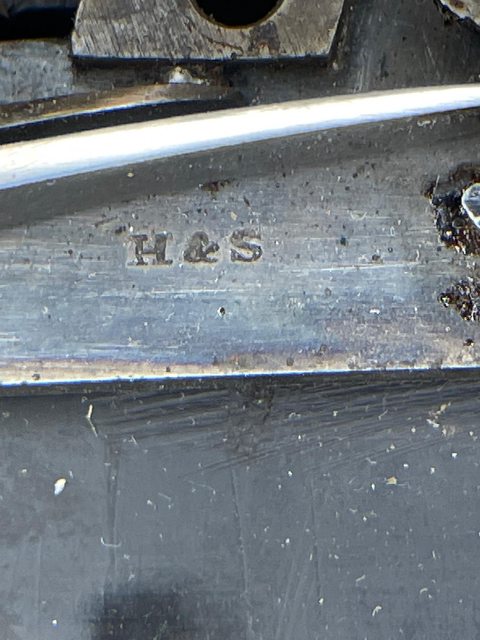
The “M” in the barrel stamp is actually an “H”
I had a look tonight on the inside of the lock. There it was clearly legible.

ww270win
 
The harp stamp is a 'mark' of the Irish Assay Office in Dublin and is usually applied to gold and silver jewelry made in Ireland. It is, in fact, a 'patented' guild mark and in law can only be applied as part of the 'proof' of gold or silver content.
 
The harp stamp is a 'mark' of the Irish Assay Office in Dublin and is usually applied to gold and silver jewelry made in Ireland. It is, in fact, a 'patented' guild mark and in law can only be applied as part of the 'proof' of gold or silver content.

This makes perfect sense Tacfoley.
Once I seen the harp all I could think of is the Royal Irish Ranger regimental cap badge.
 
Here I have some more pictures.

On the inside of the lock the H&S is clearly legible.

J9iWSLml.jpg
U74PZgAl.jpg


shN6BGBl.jpg
r58t5skl.jpg


gsxihh0l.jpg
NrC7jsBl.jpg


Could the harp stamp be for the inlay on the breech plug?


Thanks for all the great info.

ww270win
 
It is very unlikely that the breechplug is soldered. The bolster on the barrel in front of the patent breech will be.
Don't try to unbreech the barrel without making the tools and jigs to hold the barrel and plug securely when applying torque.
Reboring and rifling might be an option. It would be easier to install a liner. Depending on the desired caliber, a liner could be turned from a piece of rifle barrel. If a smoothbore would work for you, the bore could be lightly reamed and polished.
 
I'm still not convinced about the Irish connection. Ireland did not have a proof house, and though guns in Ireland were marked (I'm not sure when the practice started), it was a number code if I'm not mistaken. But hey, anything is possible.

I'm pretty sure H&S is the mark of Hollis and Sheath.

The Hollis gunmaking line started with Richard & William Hollis, who traded in Bath Street, Birmingham, from 1814 to 1818. Isaac and Frederick Hollis continued the business as the Hollis Brothers until 1839 (when Frederick died). In 1845 Isaac re-named the business Hollis Brothers & Co who traded up to 1848. In 1848 Isaac Hollis took in Isaac Brentnall Sheath as a partner, and the firm of Hollis & Sheath was established, expanding into 10 Weaman Row. In 1851 Hollis & Sheath moved their principal offices to 49 Whittall Street, but in 1853 moved back to Weaman Row and additional premises at 5-9 Weaman Row gave them the address of 5-11 Weaman Row. Hollis & Sheath may have had an office or agent in London. In 1861 the firm changed its name to Isaac Hollis & Sons on the departure of Sheath. No need to go through more recent history, but the firm went through various amalgamations until 1953 when Hollis, Bentley & Playfair finally closed in Birmingham.

This would help narrow the date to your pistol to between 1848 and 1860.

Isaac Hollis is known to have provided Pattern 1856 rifles to the Confederacy, so the trade connections were in place.

So much can be gleaned from a few marks...
 
Last edited:

Thanks guys for all your input and suggestions.

I think it's safe to assume that the pistol was built by Hollis & Sheath, for the John Gravely & Co.

I did a picture search on H&S percussion pistols. The closest I could find was a pair of duelling pistols.
On which the lock, bolster, and primer spray deflector, looked pretty close to the setup on my pistol.
I also found a picture of a rifle, with a similar setup. And when I scrolled down, on one of the pictures, it showed the
escutcheon with the wedge. The wedge has what looked like a pry mark on the bottom side.
My pistol has the same pried edge. My guess is that it was meant to get a finger nail under it to start the wedge out of the stock.

Again. Thanks Guys!
ww270win
 
Back
Top Bottom