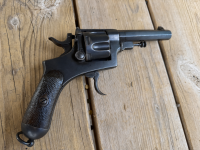
Well, I got my cerrosafe, and I'm back.
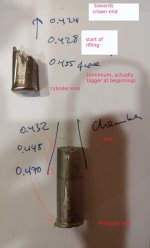
I'll attach a picture.
Definitely an interesting alloy. I followed advice and blocked the barrel with a cleaning patch, then poured some in. I didn't want to overfill it, as I was afraid to have it spill into other parts. That causes me not to have the full forcing cone cast. Still, I think that it's useful: the forcing cone is at least .455 (but visibly more). The rifling right after is is .428. Then it goes down to .424. Knocking out the cerrosafe was quite difficult: I ended up putting a wooden dowel in the barrel and smacking it with a rubber mallet. Several times.
As for the cylinder, that was uglier. Try as I might, I couldn't get it out. I figured that it probably had a lip on the part that would be closer to the barrel, so I heated a piece of metal and wiped off the excess cerrosafe. I still couldn't get it out. I was banging with the dowel, with no movement. I ended up having to use hot water to get it moving, so I partly damaged it. That being said, enough of it wasn't melted to get a diameter measurement that is probably reasonably accurate. It looks like those go from .470 at the head of the cartridge, to .432 on exit of the cylinder.
In other words, the restriction is at its most just after the forcing cone, at .424.
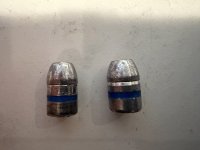
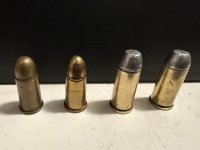
Separately, I also got the H&C kit. The bullets in there measure .431 or maybe .4315 at their widest (a driving band with a lube groove in the middle). The heel seems to be .409-.411. They're 170 gr.
Anyway, I await more advice! Thanks.
I'll attach a picture.
Definitely an interesting alloy. I followed advice and blocked the barrel with a cleaning patch, then poured some in. I didn't want to overfill it, as I was afraid to have it spill into other parts. That causes me not to have the full forcing cone cast. Still, I think that it's useful: the forcing cone is at least .455 (but visibly more). The rifling right after is is .428. Then it goes down to .424. Knocking out the cerrosafe was quite difficult: I ended up putting a wooden dowel in the barrel and smacking it with a rubber mallet. Several times.
As for the cylinder, that was uglier. Try as I might, I couldn't get it out. I figured that it probably had a lip on the part that would be closer to the barrel, so I heated a piece of metal and wiped off the excess cerrosafe. I still couldn't get it out. I was banging with the dowel, with no movement. I ended up having to use hot water to get it moving, so I partly damaged it. That being said, enough of it wasn't melted to get a diameter measurement that is probably reasonably accurate. It looks like those go from .470 at the head of the cartridge, to .432 on exit of the cylinder.
In other words, the restriction is at its most just after the forcing cone, at .424.
Separately, I also got the H&C kit. The bullets in there measure .431 or maybe .4315 at their widest (a driving band with a lube groove in the middle). The heel seems to be .409-.411. They're 170 gr.
Anyway, I await more advice! Thanks.

 .
.