Brown Bess - Restoration?

spurr99

Member
EE Expired
Rating - 100%
18   0   0
Location
Newfoundland
I just found a Brown Bess that I wish to restore. I have the original locks and I want to convert it back to a flintlock from percussion. I need a professional to remove the welded nipple so that I can re-attach the lock.

I need an experienced Bess restoration professional and can't afford to let a hacker touch this piece.

Who in Canada is the Brown Bess authority/ restoration professional?

here are the pics.

2008_03190013.JPG

2008_03190014.JPG

2008_03190015.JPG

2008_03190016.JPG

2008_03190017.JPG

2008_03190018.JPG

2008_03190019.JPG

2008_03190020.JPG

2008_03190021.JPG

2008_03190022.JPG

2008_03190023.JPG

2008_03190024.JPG

2008_03190025.JPG

2008_03190026.JPG

2008_03190027.JPG

2008_03190028.JPG

2008_03190029.JPG

2008_03190032.JPG

2008_03190033.JPG


Cheers
JS
 
Last edited:
It possibly could never have been a flintlock, some late mod muskets in the "bess' pattern were percussion, right from the get go.

But then again it could very well be a conversion as there were thousands switched over to the "new" system.

Is it possible to post a picture??

Given the type of conversion it might be a easy do it at home drill out and re tap and install a liner.

Or it might be not worth it and better to just get a new barrel fit to it and convert her back and forth as situation requires.

Any how..... any way you go the bess is a damn fine arm.

Cheers
 
Last edited:
I have done this work. Properly done, the work is not evident except under close examination. I always marked the work on the inside. Poorly done, it looks awful. At that time it was possible to get first class reconversion parts. Even though I did reconversions for customers, I have very mixed feelings about doing the work. First, it destroys and denies the historical usage of the gun. Second, there will be welded over and refinished areas. If you replace the entire lock, the gun becomes a bitser.
I am not big on reconversions. That is my opinion, others feel differently. I think it destroys too much of the authenticity of the gun to be justified.
 
I think the P39 conversions all had a snail brazed or welded onto the breach or used a new breach plug with a snail. I don't think they used a drum in the conversion. I did convert a bess back to flint but the gun was extremely tired before I started and I am not completely happy with my work. At least it is much better now than when I started.

cheers mooncoon

BessinPiecesb.jpg


BessPartsB4.jpg


FinishedLockb.jpg
 
Last edited:
Bess

Thanks guys,

I will post pics.

Mine is a rare mid 1700's Royal Navy Sea Pattern Brown Bess. I actually have the original lock that was removed 100 years+ ago. It will be a beauty restored not to mention $$$... but I need the right guy to remove the nipple.


Pics to follow soon.
 
If it is a rare gun, ANY restoration should be done by someone who really knows what he is doing. A valuable gun is not one on which to start a learning curve.
 
From the posted photos, I think the gun is a pattern 1839 and the lock you have is a dog lock and I suspect dates before 1720. The dog lock is almost certainly unbridled and the lock from your gun had a bridle as can be seen from the lock inletting. I think you would be wise to find a p39 lock for it. Worth noting that the p39 lock is slightly different from the 1842 lock with the difference being in the shape of the recess for the snail or bolster

cheers mooncoon
 
WOW WOW WOW!!!

Imagine if that old girl could talk!

She looks quite heavily used, but shes all there!

Im completely torn as to what I would suggest..all the steel looks quite pitted, but its hard to tell just by looking at pictures.
The wood looks great!


Maybe before you do anything a heavy cleaning is in order "mind you thats only my 2 cents!

Do you have the "new" percussion lock??

The flint lock is really awesome! I aswell find it odd that it has both a bridle on the frizzen and the dog catch on the hammer..

Maybe it origionally had no bridle and that was later added, and then at a even later period it was converted to percussion.

And then maybe;) some time soon it will be reconverted to flint.
I do believe it all could be done...Drill out the percussion bit super clean the bore, add a liner and then one of those screw in vents.,
or send the barrel to a barrel maker in the states "I dont think any Canadians do that" and get them to make you a exact match and your good to go.


what a grand old girl, and a very cool project that can go into many directions!


Cheers
 
Last edited:
I think the gun is a Sea Service musket.
The doglock is from a "Newfoundland sealing gun", I think.
 
Lots of good advice here. Personally I would clean it up carefully and oil to make sure that there was no further deterioration in condition.

Then it would go back up on the wall and Loyalist Arms or similar would get a call to send me a new reproduction that I could shoot to my hearts content without a worry in the world. Just my $0.02.
 
Yes, Sea service musket converted to percussion. Flint version was used from appox 1778-1815, Later 1839 to percussion. Hard to know the exact history or when the musket was converted.

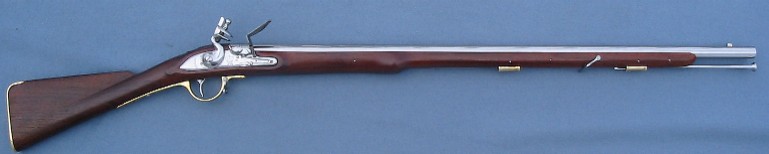
On the sea service musket, you will note the end of the stock towards the muzzle. It has no cap or ram rod pipe like the 2nd pattern brown bess. Also the butt plate was nailed on or screwed as in yours. sometimes they were painted in ashphalt.

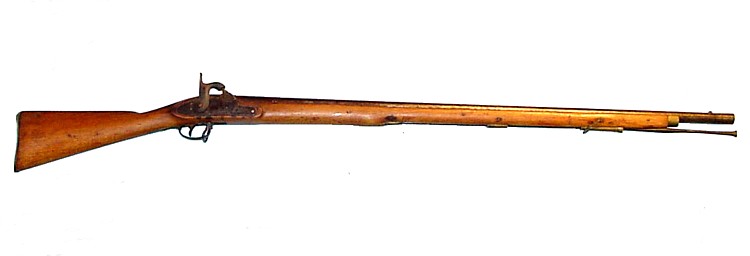
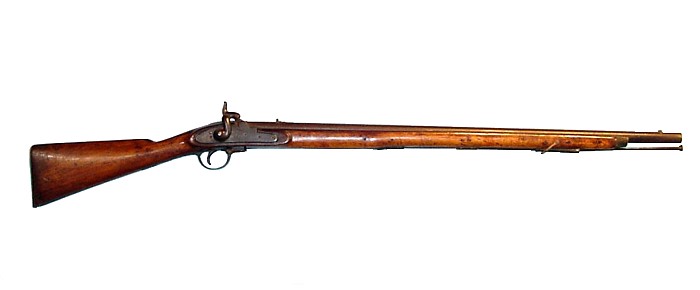
The 1839 looks like this, Note the butt stock shape compared the Brown Bess.

British Volunteer Pattern 1839 Carbine
ps1348.jpg


British Militia Musket, Caplock. Note the hammer shape and extended hammer neck.
1349.jpg


Sea Service Repro
seamusket1.jpg


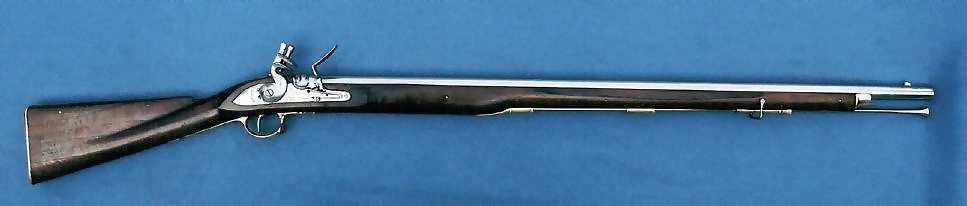
India pattern or 3rd pattern brown bess
shortland_india.jpg


Parts and some expertise:

Canada

Try loyalist Arms ht tp://www.loyalistarms.freeservers.com/ Give advise??

US location

The Rifle Shoppe (ht tp://www.therifleshoppe.com/) has many of the parts you might need. You can call them and ask who is good to do a restoration.

UK parts

ht tp://www.peterdyson.co.uk
 
Last edited:
Back
Top Bottom