












































Bullet Cost vs. Group Size

Ganderite

CGN Ultra frequent flyer
Rating - 99.7%
355   1   0
I happen to have a quantity of 3 different bullets on hand for loading my 223 ammo.

CQB is shot at 35 to 10 yards, with my AR-15. Accuracy is not an issue. All that matters is reliability.

For CQB I have been loading Wolf brand 55 gr FMJ bullets.

I was just given 2000 Winchester 55 gr FMJ bullets, and assumed they are better quality and more accurate.

If they are better than the Wolf, I won't waste them on CQB.

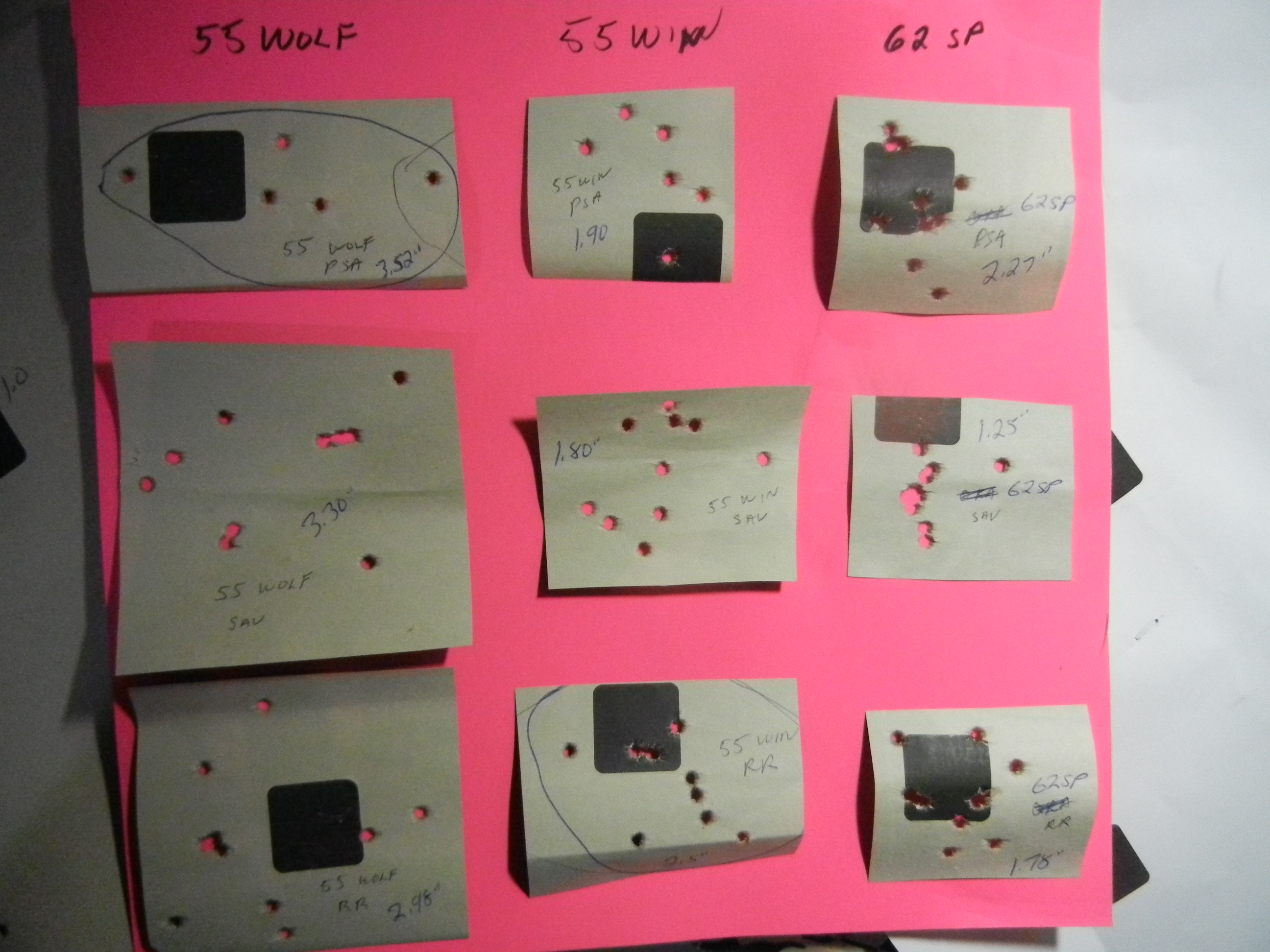
So I ran a test, and shot the two bullets through 3 different rifles. A Pair of AR15s and a Savage bolt action.

For a control load, I also shot a 62 gr soft point bullet, which I assumed would be much better than the 55gr FMJs.

And that is what happened. 62 gr was best in all 3 rifles and the 55gr Wolf was worst.

100 yard results
kV9AUyW.jpg


Load data - 55 gr 24.0 gr H335 62 gr 23.2 gr H335
 
What is the barrel twist of the 3 rifles? 1:7 or 1:8 will do better with the 62 grain (and higher - 68, 77)

How much are the Wolf projectiles compared to say Campro 55's? Henry @ Budget sells Campros for $125/1000. If accuracy is not the issue then load the cheapest.

If I was comparing accuracy with the 55's and H335 I would try loading up to 26 grains in 1/2 grain increments from your 24.0
 
Last edited:
My 55gr Campro's with 24.8 H335 chrono at 2850 fps.
Only shoot 50yds or less. With a vortex sparc 2 at 50 yds less than 1/2".
I can't shoot a red dot at 100yds------but thats just me.
This is with a Norinco AR with 14.5" barrel. I do like H335.
 
What is the barrel twist of the 3 rifles? 1:7 or 1:8 will do better with the 62 grain (and higher - 68, 77)

How much are the Wolf projectiles compared to say Campro 55's? Henry @ Budget sells Campros for $125/1000. If accuracy is not the issue then load the cheapest.

If I was comparing accuracy with the 55's and H335 I would try loading up to 26 grains in 1/2 grain increments from your 24.0

I paid about 10 cents each for the Wolf. They are the cheapest and adequate for CQB. The 24 gr load was developed in 6 different rifles and was the compromise of "good in all ". A couple rifles preferred 25 gr. But my H335 is actually Olin 844, a non-canister powder. It may be faster or slower than H335. I don't know.

Twist of all the rifles is either 1:9 or 1:7. Not an issue with these bullets. I have used up to the 80gr Sierra MK in the 1:9 Savage.
 
Reminds me of when the Swiss clubs could still use our PE90's
First year we got the rifles we had to wait to get the 62gr Swiss service GP90(1990) rounds, and were given some 55gr. IVI 5.56mm, which was useless at 300m.
That batch could not hold the 10 cm / 4 inch 10 ring at 300m. Were lucky if it could hold inside the 40 cm / 16 inch 7 ring
Also bought some from 55gr. Centaur which were much better than the IVI.

GP90 easily capable of holding the ten ring with many X's
 
Last edited:
It's interesting how the crappy bullets were a near equalizer of the three rifles, but the savage showed the greatest improvement with the superior bullet.
 
Joyce Hornady once explained to me that a soft point or hollow point bullet would always be a better bullet than a FMJ for accuracy. I have found this to be the case.

The improvement from FMJ to SP is huge. The improvement from SP to match bullet is small.
 
Last edited:
Joyce Hornady was explained to me that a soft point or hollow point bullet would always be a better bullet than a FMJ for accuracy. I have found this to be the case.

The improvement from FMJ to SP is huge. The improvement from SP to match bullet is small.

Pure ganderitte gold. A dozen reloaders, just saved the frustration and expense of trying to solve the unsolvable problem.
 
Joyce Hornady was explained to me that a soft point or hollow point bullet would always be a better bullet than a FMJ for accuracy. I have found this to be the case.

The improvement from FMJ to SP is huge. The improvement from SP to match bullet is small.

Fascinating. Any idea why this is? I bought a bunch of 147gr FMJ that I shoot from my 30.06 bolt action Winchester 670a. Accuracy at 100 yards isn't great. Same powder but with 150gr SP the accuracy is much better. I bought the 147gr FMJ as I wanted to practice with cheaper projectiles but the same weight as my hunting SP. In hindsight that may have been a bad idea.
 
Makes me think of Hornady 150gr FMJ/BT .308 vs. Campro 147gr FMJ/BT .308
In my Rem 700 the difference in group size was about double for the Campro.

Fascinating. Any idea why this is?
I was reading some articles by ballistic engineers who talked about consistency of the base of the bullet being more important than the tip. A SP or match bullet uses the copper cup open end up so you have a solid copper jacketed, very consistent base. A FMJ on the other hand has the cup open end down so the bases are less consistent. When the bullet leaves the barrel it's critical the entire base of the bullet leaves at the same time. An uneven base may have one side leave a tiny fraction of a second before the other side which can cause a jet of high pressure gas to push the bullet from that side. It isn't enough to destabilize the bullet and make it tumble but it does detract from the accuracy.
Or so I have read....
 
Fascinating. Any idea why this is?

It's related to the relative positions of the center of mass and center of pressure. Hollow points tend to have a center of gravity towards the rear (because there is less mass in the front) which moves it closer to the center of pressure, rendering the projectile more stable in flight.

Here is a page that explains it in some detail.
 
It's related to the relative positions of the center of mass and center of pressure. Hollow points tend to have a center of gravity towards the rear (because there is less mass in the front) which moves it closer to the center of pressure, rendering the projectile more stable in flight.

Here is a page that explains it in some detail.

I assume the hollow point bullet being more accurate would also apply to handgun bullets?

I ask because I recently ran out of the 9mm Campro 124 gr RN FMJ that I usually load and ended up loading 3 boxes of Campro 124 gr hollow points i’ve had on my loading bench for the last couple years. Didn’t really know what to expect from them as it was also a new load for me, but when I tested them out at the range I thought they ‘appeared’ more accurate and grouped better than my usual 124 gr RN FMJ which I tested side by side against the 124 Hollow points.

I was just doing my normal IPSC live fire practice routine, which always starts with freehand group shooting at distances from 5-30 metres, so it wasn’t bench shooting or by any means a controlled test comparison, but my hollow points definitely ‘seemed’ to group tighter for me even at these extremely short ranges.
 
Makes me think of Hornady 150gr FMJ/BT .308 vs. Campro 147gr FMJ/BT .308
In my Rem 700 the difference in group size was about double for the Campro.


I was reading some articles by ballistic engineers who talked about consistency of the base of the bullet being more important than the tip. A SP or match bullet uses the copper cup open end up so you have a solid copper jacketed, very consistent base. A FMJ on the other hand has the cup open end down so the bases are less consistent. When the bullet leaves the barrel it's critical the entire base of the bullet leaves at the same time. An uneven base may have one side leave a tiny fraction of a second before the other side which can cause a jet of high pressure gas to push the bullet from that side. It isn't enough to destabilize the bullet and make it tumble but it does detract from the accuracy.
Or so I have read....

Exactly so.

Within the FMJ family there is a wide range of quality. Some have fairly uniform jackets. Some don't.

I have often used cheap Soft points as match bullets when I was short of bullets. Up to about 500 yards, they shot the same as match quality. Beyond 600, the wind has more effect because of a lower BC.
 
I assume the hollow point bullet being more accurate would also apply to handgun bullets?

I ask because I recently ran out of the 9mm Campro 124 gr RN FMJ that I usually load and ended up loading 3 boxes of Campro 124 gr hollow points i’ve had on my loading bench for the last couple years. Didn’t really know what to expect from them as it was also a new load for me, but when I tested them out at the range I thought they ‘appeared’ more accurate and grouped better than my usual 124 gr RN FMJ which I tested side by side against the 124 Hollow points.

I was just doing my normal IPSC live fire practice routine, which always starts with freehand group shooting at distances from 5-30 metres, so it wasn’t bench shooting or by any means a controlled test comparison, but my hollow points definitely ‘seemed’ to group tighter for me even at these extremely short ranges.

My Sig 210s(Swiss Army P49) likes Hornady XTP bullets a lot. Also does well with the cheaper HAP bullets.
I use Canpro for the Inglis HP and P38.
 
Last edited:
I used to have access to an electronic testing system that measured the birefringence of the thickness of glass when an extremely low amperage current was run through two opposing strips. This measurement allowed them to measure certain points on glass and metal containers about a half cm wide. The strips were slightly longer than the circumference of the object to be measured and were extremely accurate and consistent in finding sidewalls that were to thin.

The thing is, with the proper receivers hooked up the signals could be translated to read out the thickness all through the full 360 degrees of rotation or at a single point.

A few decades ago there was another such meter invented that changed the bullet making industry immensely. Mostly to our favor.

That meter was called a "JUENKE GAUGE"

It measured the thickness of bullet jackets after they were assembled. The industry had to make significant changes to their extruding machines to get the jacket thicknesses concentric all the way around, from top to bottom. Yes, I realize that some bullets have tapered jackets. This means they are measured at set points from the base to the sidewall and up the ogive.

This little guage showed them, in real time, where their issues with consistency were happening and they didn't have to go through the lengthy process of cutting the jackets for measurement.

I set up one of our gauges at work to measure the hand swaged match bullets I was making. My equipment, made by Corbin, just wasn't rigid enough to give me the precision I needed so I started purchasing my HBR 135 grain, flat base, spire point, open tip match bullets from Randy Robinette out of the US. He had some massive equipment that utilized J4 jackets and produced excellent quality bullets that could be depended on from batch to batch for consistency.

I wish I had kept the records of the measurements I had painstakingly put into a log book. I misplaced it during a move from one shop to another and lost it.

The one thing I can say, hunting bullets and even match bullets are better now than they've ever been as far as jacket consistency goes. Same goes for weight.

When we measured surplus ammo from pre WWII and during WWII and later, jacket thicknesses were surprisingly inconsistent on lighter bullets. It was a bit better on heavy bullets.

From shooting recently released surplus, such as Hirtenberger, I would say things have changed in the way they manufacture bullets.

Remember, around fifty years ago, four inch (8cm) groups at 100 yards were the norm and considered to be perfectly acceptable.
 
The real question is where do you get wolf bullets for 10 cents a pop?
I've been shooting the 55gr campro. But they're 120$ for 1000. From what I've heard the campro fmjs are lake city.
I load with bulk D4198 in mixed brass so don't expect much in accuracy. And don't receive much in return. Around 5" at 100yds with my reddot guns. A bit less with a scope.
 
Back
Top Bottom





















