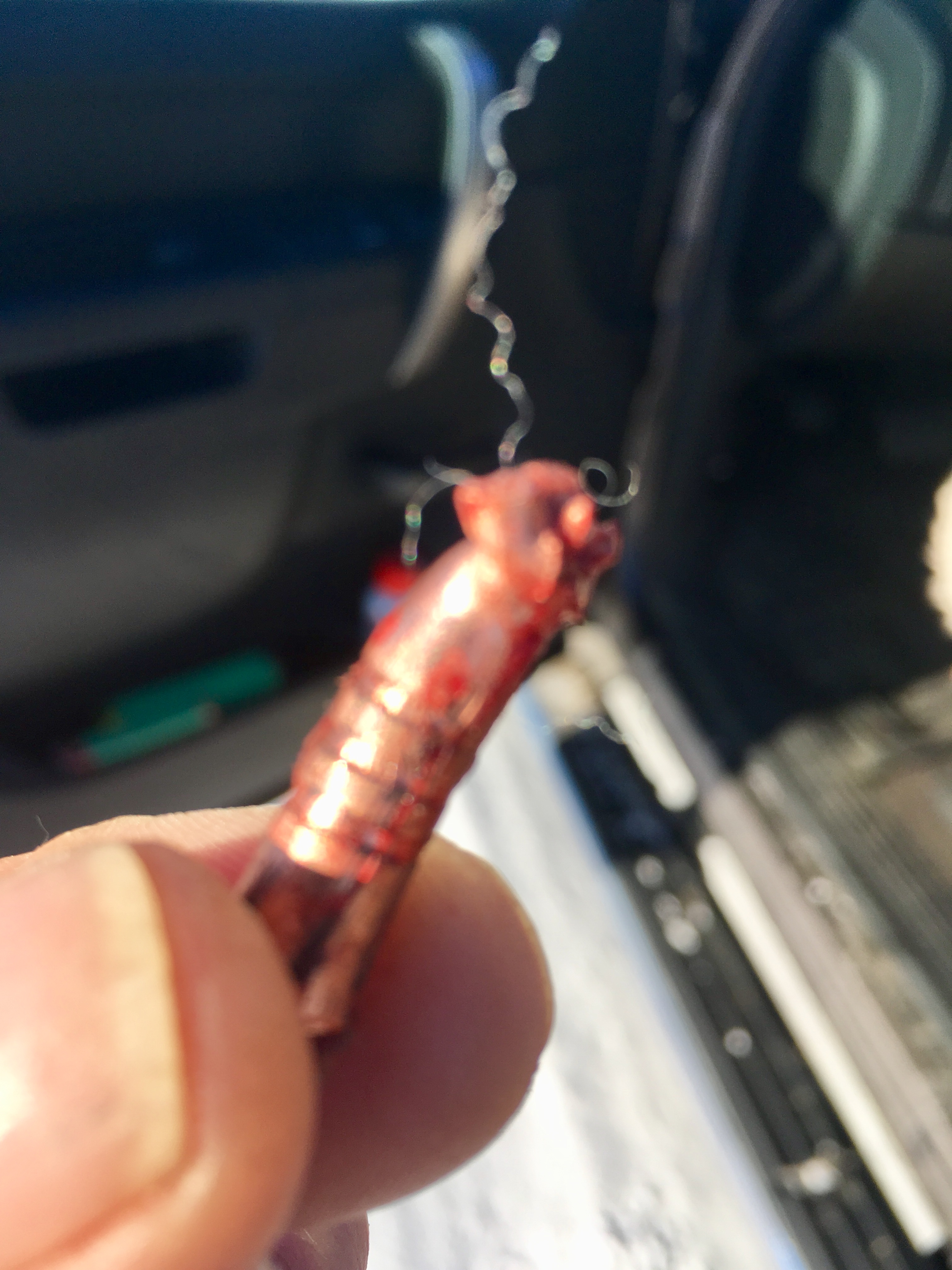
Bullet failures - What your experience has been.

What bullet construction has failed you the most, on big game.

  • Mono Metal

    Votes: 25 20.3%
  • Partition or A Frame Style

    Votes: 2 1.6%
  • Bonded

    Votes: 6 4.9%
  • Cup and core

    Votes: 42 34.1%
  • Ballistic tip style

    Votes: 39 31.7%
  • Other

    Votes: 9 7.3%

  • Total voters
    123
With respect to bullet failures, while its long into this thread, perhaps we should define our terms. A bullet failure is when the bullet performs differently that we have come to expect, or performs differently than what has been advertised by the manufacturer. Anchor3593 would consider a bullet that expanded and retained 90% of its original weight a failure because he wants the bullet to grenade inside the body cavity. To others this would be a disaster. A mono that sheds its petals has failed, and worse is one that has the petals fold back on themselves towards the hollow point, which might, but I can't prove, be a result of precession at impact. The idea is that the bullet in yaw forces the petal to fold across the hollow point, preventing fluid from entering and driving expansion. A lead core soft point that doesn't expand, shatters, or expands to the point that there is no shank left to provide a linear axis for rotational stability has failed. A solid that bends, rivets, or that has a squashed base has failed. These failures to perform within the design parameters of the bullet have nothing to do with whether or not the game animal was recovered, its purely about the bullet performing within its design parameters.


I can’t believe what I’m reading. A petal coming off is failure?
 
I can’t believe what I’m reading. A petal coming off is failure?

I'm not sure what you're referring to, since petals is the plural of petal. What I said about a single petal was referring to a single petal that stays attached to the shank, but folds inwardly across the hollow point thereby preventing expansion. Yes, I would call that a failure.
 
I'm not sure what you're referring to, since petals is the plural of petal. What I said about a single petal was referring to a single petal that stays attached to the shank, but folds inwardly across the hollow point thereby preventing expansion. Yes, I would call that a failure.

So a TSX is a failure when it loses petals. Losing possibly 25% of its weight on its way through an animal (all the petals). But a NP is a success as it is designed to lose 33% (your number) of its weight initially before carrying on through the animal. Sounds to me like they are similar. And successful.

The biggest problem I have with the TSX is that recovering them is unlikely. Unless you have some serious meat to burn through.

 
What caliber and bullet weight is your son shooting? What game has he shot with it?
Thanks Zaz

P.S. My son uses Nosler Ballistic Silver tips, and I have been taking note of how effective those are. Tougher than anticipated.
[/QUOTE]

Zaz, 7mm-08. 140gr. N540 powder but I haven't clocked it for velocity. Deer only. His buck from two years ago was almost straight on in the chest, at an estimated 50 yards coming towards him. Recovered it against the hide about half way down. Wasn't anticipating that kind of toughness. I had a similar shot and result last year but it was with a Federal Trophy bonded bullet and the buck was standing. Same caliber, bullet weight and powder.

Regards
Ronr
 
I’ve taken quite a few whitetail deer with the TSX and TTSX, but never recovered a bullet. So the bullets got the job done but I don’t know how they expanded or how much weight they retained.
 
Here is a smattering of Barnes bullets I’ve recovered since I decided to start recording such things. If we are recovering less than 10%, well you do the math. You will excuse me for being a bit obtuse about samples of one. And buckmastr is correct. When you find one, it’s done a pile of digging.

KecFz8p.jpg
 
Last edited:
Ya they sure have worked good for you. I want to like them as they shoot so darn good out of my rifles but I have had 2 (the only 2 shot at an animal) that I would consider failures. One was a 257 weatherby mag on a whitetail buck that didn't open at all, we found it in the deer after lots of tracking and additional shots. The second was this year on a cow moose with a 127lrx from a 6.5 prc at 140 yards. 3100'/sec muzzle velocity. I got the moose, which is the prime objective, but the bullet pencil holed through both sides.Next to no blood but as I said it did succumb to that 1 shot. So it worked I guess but don't think it opened at all, unproven of course.
 
Ya they sure have worked good for you. I want to like them as they shoot so darn good out of my rifles but I have had 2 (the only 2 shot at an animal) that I would consider failures. One was a 257 weatherby mag on a whitetail buck that didn't open at all, we found it in the deer after lots of tracking and additional shots. The second was this year on a cow moose with a 127lrx from a 6.5 prc at 140 yards. 3100'/sec muzzle velocity. I got the moose, which is the prime objective, but the bullet pencil holed through both sides.Next to no blood but as I said it did succumb to that 1 shot. So it worked I guess but don't think it opened at all, unproven of course.

Of all the mystery bullets I've read about I'd love to see a pic that pristine 257WBY that travelled through the deer and was recovered.

On the moose, what condition were the internal organs in on the 6.5 pass through? Dead things don't bleed much.
 
Ya they sure have worked good for you. I want to like them as they shoot so darn good out of my rifles but I have had 2 (the only 2 shot at an animal) that I would consider failures. One was a 257 weatherby mag on a whitetail buck that didn't open at all, we found it in the deer after lots of tracking and additional shots. The second was this year on a cow moose with a 127lrx from a 6.5 prc at 140 yards. 3100'/sec muzzle velocity. I got the moose, which is the prime objective, but the bullet pencil holed through both sides.Next to no blood but as I said it did succumb to that 1 shot. So it worked I guess but don't think it opened at all, unproven of course.

How big of a hole were you expecting?
 
a bullet has yaw out of the muzzle and wig-wags a bit for the first 100 yards.


First, I was taught this in Ballistics 101. Mann, in his book "The Bullet's Flight" (probably published in the 20's) Set up cards at various distances and noted the egg shaped holes made by yawing bullets, and, as I recall, the yawing stopped around 100 yards. I don't think I have read the book in the last 50 years, but I might still have a copy somewhere. In the book he had pictures of his set up and of the egg shaped bullet holes.

In our lab we had a 40 yard tunnel, and I recall taking pictures of bullets in flight. the back ground was white cardstock with lines on it for reference. We could see yaw.

Thanks, I just looked that up: Franklin Weston Mann, The Bullet's Flightpublished in 1909. It still appears to be available new.

In your professional observations, did you find yaw occured with every bullet?
 
So a TSX is a failure when it loses petals. Losing possibly 25% of its weight on its way through an animal (all the petals). But a NP is a success as it is designed to lose 33% (your number) of its weight initially before carrying on through the animal. Sounds to me like they are similar. And successful.

The biggest problem I have with the TSX is that recovering them is unlikely. Unless you have some serious meat to burn through.


The difference in the loss of weight between the TSX and the Partition, is the front section of the Partition is lost violently and uniformly from bullet impact to bullet impact. The TSX is intended to function best when the bullet fully expands and retains 90% or more of its original weight. Understand that full expansion is not only an increase in the frontal area of the bullet, it is also the way in which the bullet's center of gravity if moved forward, making straight line penetration possible. When it loses petals, the frontal area is diminished, and the center or gravity moves rearward, which may result in erratic penetration. So we see A) loss of mass without benefit of the violent vaporizing of part of the bullet, B) reduced frontal area, which reduces the volume of the wound cavity, and C) the center of gravity failing to move to the front of the bullet resulting in loss of straight line penetration. That sounds like a failure to me.
 
Boomer, what you say makes sense, but conflicts with some mono bullets 'claim to fame', namely Cutting Edge or Hammer bullets - where the petals are made to purposely break off, inflict their own damage, while the base keeps on going.
To me this seems like a good idea, however, it is all speculation until I get to try them or read first hand reports from users.

Personally, have only used accubonds on game in 4 calibers (AB, and ABLR), no issues whatsoever. Used a Norma Oryx first time this year and it too worked as advertised - VERY impressive for close up stuff. No failures from me.
 
Thanks, I just looked that up: Franklin Weston Mann, The Bullet's Flightpublished in 1909. It still appears to be available new.

In your professional observations, did you find yaw occured with every bullet?

Every bullet yaws twice during its time of flight, first when it exits the muzzle and again when it impacts a denser than air medium. The degree and length of time of bullet yaw is dependent up two factors, the length of the bullet and the bullet's rotational velocity. The shorter the bullet the less yaw it will exhibit from a rifled bore, because its stability is more rigid. The faster twist of the rifling, the faster the bullet spins, and the shorter the time that the bullet is in yaw, because its stability is more rigid. Target shooters sometimes refer to "bullets going to sleep," as a means to explain why long range accuracy can sometimes appear to be better than near range accuracy, but its actually the time the bullet needs to recover from precession. When a bullet impacts a living target, it precesses. If the bullet's rotational velocity is not high enough to allow it to recover from that yaw, the force of the impact moves along the shank of the bullet so expansion is not at 90 degrees, and penetration is reduced. Art Alphin from A Square found that test firing 500 gr .458 solid in the .460 Weatherby with a 1:16 twist and from a .460 A-Square with a 1:10 twist, that the shorter precession time due to the faster twist increased penetration. If you can find a copy of "Any Shot You Want" which was A Square's loading manual, the chapter on bullet penetration is fascinating.
 
Boomer, what you say makes sense, but conflicts with some mono bullets 'claim to fame', namely Cutting Edge or Hammer bullets - where the petals are made to purposely break off, inflict their own damage, while the base keeps on going.
To me this seems like a good idea, however, it is all speculation until I get to try them or read first hand reports from users.

Personally, have only used accubonds on game in 4 calibers (AB, and ABLR), no issues whatsoever. Used a Norma Oryx first time this year and it too worked as advertised - VERY impressive for close up stuff. No failures from me.

A bullet that is designed to loose a percentage of its original weight tends to do so uniformly and violently, so the disintegration of that part of the bullet enhances the wound volume, rather than detracts from it. A proper solid game bullet has a flat nose, parallel sides, and a short length, to ensure straight line penetration and a wide wound volume from the shock wave pushing soft tissue away from the flat nose. A bullet that is designed to loose its front section to violent fragmentation leaves an intact shank section that has those same characteristics of the solid game bullet. If a tapered bullet fails to expand, or lose enough of its frontal section to form a parallel sided projectile, wound volume will be narrower, and penetration will be erratic, as the bullet follows the path of least resistance.
 
Last edited:
Straight line penetration occurs when the bullet changes as little as possible on impact. That’s where fmj bullets benefit. Less speed loss, more penetration. A Barnes should out penetrate a NP as it loses less weight upon impact.

This test, Barnes 150ttsx vs 165 NP, the Barnes out penetrated the NP by nearly 30%. Just as we expected.
https://m.youtube.com/watch?v=Xw-x3rRgdYI
 
Straight line penetration occurs when the bullet changes as little as possible on impact. That’s where fmj bullets benefit. Less speed loss, more penetration. A Barnes should out penetrate a NP as it loses less weight upon impact.

This test, Barnes 150ttsx vs 165 NP, the Barnes out penetrated the NP by nearly 30%. Just as we expected.
https://m.youtube.com/watch?v=Xw-x3rRgdYI

It depends how much of the front section of the bullet has been lost. If the bullet remains tapered, straight line penetration is unlikely. If the penetration follows the path of least resistance, the bullet is less effective, regardless how deeply it penetrates. I'm not saying monos don't work. I've used them, occasionally I still do, and I've seen them work, but I believe the evidence supports the idea that their performance is less consistent, than other types of premium bullets. The reason might have more to do with the rifle that fires them, than the bullets themselves. If there is insufficient velocity to initiate fast expansion, or if there is insufficient rotational velocity from a barrel with too slow a twist, problems will occur from precession at impact that interferes with expansion. These problems don't occur with lead core bullets, that are less sensitive to precession at impact.

You might be able to shoot animals with TSXs for the rest of your life and with the rifle and load you use, and the range at which you shoot, never experience a failure. If for example you shoot a 7mm or .300 magnum and never consider a shot beyond 300, the odds are in your favor. But the evidence is against it if you shoot at longer ranges, use slow twist barrels, or moderate or low velocity cartridges.
 
Last edited:
Back
Top Bottom