Bullet Weight and Recoil

ambishooter

CGN frequent flyer
Rating - 100%
2   0   0
I am still trying to figure out the relationship between bullet weight and recoil. Assuming a constant Power Factor, same gun same powder, primer and round nosed bullets of varying weights. I am assuming a lower velocity as the bullet gets heavier as the power factor is retained. Will the powder charge increase as you move up to heavier bullet?
 
yes more recoil... for every action there is an equal and opposite reaction.....

Generally you use less powder for heavier bullets because of the increased pressure generated by having to move a heavier bullet with the same amount of powder. Or... use a different powder altogether.
 
The reason recoil goes up as bullet weight goes up (even if muzzle energy is kept constant) is because recoil is related to conservation of momentum and bullet weight goes up faster than velocity goes down for equal muzzle energy.

In case that was clear as mud,

momentum = mass x velocity

muzzle energy = 1/2 x mass x velocity^2


The velocity squared term in the energy equation means that the bullet weight goes up faster than velocity goes down when keeping the energy constant. The bullet weight going up faster than velocity drops means that total momentum goes up as the bullet weight goes up, resulting in more recoil.


Mark
 
For a non-compensated pistol, to achieve the least perceived recoil, you want a combination of the heaviest possible bullet with the fastest possible powder. (the opposite is true for compensated pistols)
 
Run some numbers into this and you'll quickly see the relationship: http://www.handloads.com/calc/recoil.asp

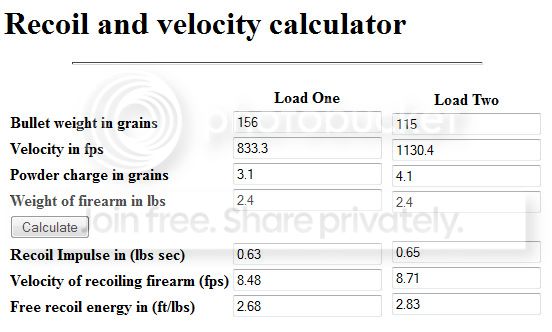
I ran the numbers though, and I always get less recoil calculated for the much heavier bullet when keeping power factor the same no matter what I do. Am I doing something wrong? I decided to use real life 9mm loads at a 130 PF using N320 for the stock CZ Shadow:

RecoilCalc.jpg


I think people who are doing the math on this forum are forgetting that it's not only the bullet that leaves the barrel when you press the trigger. Those of us who have struggled with using a chrono too close know this fact all too well. Using more powder = more gas volume traveling at higher velocity = more energy, which also likely influences actual recoil. Perhaps the calculator has it right after all. Maybe that's why they ask how much powder is being used. ;)
 
One factor that is often overlooked is the time component.

The slower moving heavier bullet takes longer to leave the barrel. The net product of two loads may be equal, but the peak pressure felt at the hands, and the time the hands are experiencing that force changes.

Some folks prefer the longer gentle shove to the short harsher snap.
 
Recoil can be boiled down to numbers, but felt recoil is quite subjective.
For a comparison, I have a load with a 300gr at about 2150, produces just over 3000 lb/ft
and another load with a 240 gr at about 2400 fps, producing just over 3000 lb/ft.
The 300gr has a good push, but is quite pleasant to shoot.
The 240gr load, from the same gun, same day, same shooter, is just obnoxious.
Like wiping snot off the stock, checking the rifle to make sure it didn't break kind of obnoxious.
A very accurate load, but I just don't want to shoot them!
 
This has been a nice and productive discussion. Being a newbie in reloading (7 months) there are just too many factors to consider. I've been using 124/125 gr LRN and considering moving up to 135 gr. Is this weight difference significant enough to produce a lower recoil with likely a lower powder charge?
 
ambishooter, it's only about an 8% difference in bullet weight so I doubt it would make perceptible difference in felt recoil, at least for my sensitivity. You will of course end up using a slightly smaller starting powder charge. I can certainly say that I do notice a significant difference between 124 and 147 gr when loaded to shoot the same power factor. My own cast 9mm bullets are dropping at 156 gr, so it's not like 147 gr is pushing any kind of limit.

You made me think a bit when you said LRN, as in lead. Lead requires less powder than jacketed to reach the same power factor. So a 124 gr lead bullet would actually have a lower physical recoil score than 124 gr jacketed when using the recoil calculator. And does this mean that something that is harder to push through a barrel (lead) is somehow more efficient in soaking up the energy behind it? I also noticed that moly coated bullets ended up going slower according to the chrono with the same powder charge than non-moly. Less friction is less efficient in transferring the energy to the bullet?

So may questions, so little time. I think I'm going to go shooting now.
 
Last edited:
Thank you for the info. I am still a long way to go learning about reloading. My next investment likely will be a chrono so I do not need to borrow one. Now the next question is, has any Cgnutters has ever used a Teflon Coated lead bullet? Don't get me wrong, teflon coating has nothing to do with armor piercing bullets. That idea is purely a myth and whoever started the idea must be laughing to the rest of his life. I have heard about Teflon Coated bullets shoots better, or I may say cleaner than copper plated/jacketed and definitely bare lead. The issue is, how do you apply this coating on lead bullets? Spray and bake? Or spray and air dry? Any idea on how to do this and where to get the teflon?
 
ambishooter, I'm not sure if I've shot teflon coated bullets or not. But in the Philippines this summer, apart from scuba diving 3 times a day, my wife and I shot these blue coloured coated bullet "commercial" reloads that looked very unusual. They shot good enough and seemed to be as accurate as I am. Perhaps these were teflon coated bullets? There's been a lot of talk on the cast boolits forum about these coloured boolits, but there seems to be no consensus on what the heck they really are, nor how to make them at home.

To be honest I haven't spend a whole lot of attention to that thread there lately because my lubed lead bullets shoot great and don't lead my barrel at all. I've literally shot thousands of rounds between cleaning. My thought is that a lead bullet will clean up the mess the bullet shot before it left! ;)

I almost gave up on lead once because there were literally "wires" coming off the grooves near the end of my barrel in many of the guns I own. It was worse than having a "smooth" bore after just firing a couple hundred rounds. That problem is now solved, and now I'm in my happy place.
 
Back
Top Bottom