












































Caliper accuracy question

You have a "master" caliper that is accurate to .00005"? What brand and model is that - I'd like to look up the specs, because I have trouble accepting that.
Perhaps you mean .0005", and not .00005" ?

I'll let you know all the details when I'm back at work Thursday.

Edit: our small working gauges are similar to these.

https://www.amazon.ca/Mitutoyo-ABSOLUTE-500-196-20-Stainless-Resolution/dp/B001C0ZPNO


Did you get those details yet?
 
Did you get those details yet?

Ahh I sent a pm to tokay instead of you. Not for the very accurate one, apparently it's in RD so I'm waiting on a quote and details for a new one.

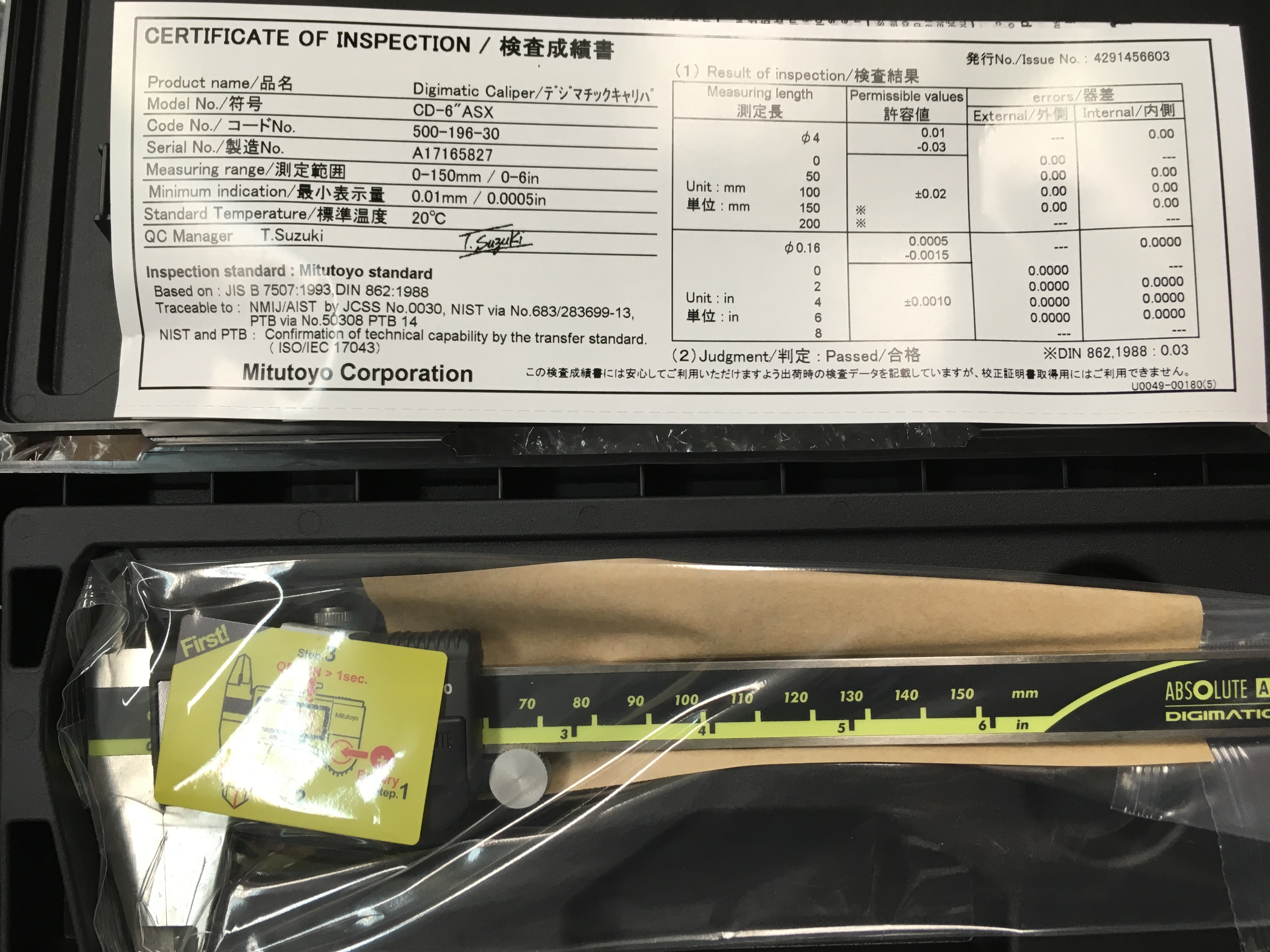
However here is the readings from the cert on one of the 0.001" min/max ones. Some come in at 0.001, some at 0.0005... some.. better.

962U6fX.jpg
 
Ahh I sent a pm to tokay instead of you. Not for the very accurate one, apparently it's in RD so I'm waiting on a quote and details for a new one.

However here is the readings from the cert on one of the 0.001" min/max ones. Some come in at 0.001, some at 0.0005... some.. better.

I did see the earlier post but that's not the instrument you were going to get specs for. The certifiate on that instrument says it has an accuracy range of +/- .001", and a minimum sensitivity of .0005". Maybe you're getting those two numbers confused? They are not the same thing.

I'm still kind of doubt full of the existence of a caliper with +/- .00005" accuracy.
 
Wow. Spot on .308.

Problem is that's a bullet for 223.

What am I doing wrong?

2qdzayg.jpg


Like mentioned, it appears you're measuring a 30 caliber bullet of around 150 grains.

By the way, the accepted and suggested method of measuring bullets is "across the diameter" not the length.
 
I did see the earlier post but that's not the instrument you were going to get specs for. The certifiate on that instrument says it has an accuracy range of +/- .001", and a minimum sensitivity of .0005". Maybe you're getting those two numbers confused? They are not the same thing.

I'm still kind of doubt full of the existence of a caliper with +/- .00005" accuracy.

Yes I'm waiting to hear from Red deer, or the quote for the new one of the more accurate one.

And yes that has a rated minimum accuracy of +\- 0.001", however having readings below 0.0005 to result in the listed number being 0.0000" means at the highest it's tested at 0.00024" accuracy. Any higher and it would roll over to 0.0005"

Although I believe you are correct and I did misscount the zeros originally. The more accurate ones would be rated to 0.0005".
 
Wow. Spot on .308.

Problem is that's a bullet for 223.

What am I doing wrong?

2qdzayg.jpg

From what I am reading in this thread, that bullet is somewhere between .306 and .310 at best. Even if measured to the nearest tenth with the finest of ring gauges and verified to be .3080", the fact that your caliper does indeed measure it to be .3080", and does so repeatedly, is absolutely meaningless because a dial caliper cannot possibly be more accurate than + or - .002".
The entire statement just made is, of course, a load of crap. If you and your caliper are capable of consistently measuring known sizes to within plus or minus .0005", then you and your caliper are capable of that level of accuracy regardless of what the guarantee might say. To state that no caliper is accurate to any better than plus or minus .002" is pure foolishness. It is fair to say the manufacturer won't guarantee it but not that the instrument is not capable. Accuracy guarantees are set at a level which is easily achievable; actual accuracy will vary on an individual basis.
 
I haven't bought a calliper in quite some time, but back in the day, Tesa was the way to go. Or starrett. But Mit's.....meh.
 
however having readings below 0.0005 to result in the listed number being 0.0000" means at the highest it's tested at 0.00024" accuracy. Any higher and it would roll over to 0.0005".

That isn't accuracy, it is sensitivity, which basically means the smallest change (increase or decrease) that the instrument is capable of recording. Accuracy is different, and that's why the manufacturer's certificate in your photo has different values for accuracy and sensitivity: accuracy = .001", sensitivity = .0005"

Accuracy can be defined as the amount of uncertainty in a measurement with respect to an absolute standard. Accuracy specifications usually contain the effect of errors due to gain and offset parameters.
Sensitivity is an absolute quantity, the smallest absolute amount of change that can be detected by a measurement.

Although I believe you are correct and I did misscount the zeros originally. The more accurate ones would be rated to 0.0005".

Now you're catching on. I did ask you about that 5 decimal places before.


That isn't accuracy, it is sensitivity, which basically means the smallest change (increase or decrease) that the instrument is capable of recording. Accuracy is different, and that's why the manufacturer's certificate in your photo has different values for accuracy and sensitivity: accuracy = .001", sensitivity = .0005"

Accuracy can be defined as the amount of uncertainty in a measurement with respect to an absolute standard. Accuracy specifications usually contain the effect of errors due to gain and offset parameters.
Sensitivity is an absolute quantity, the smallest absolute amount of change that can be detected by a measurement.


Now you're catching on. I did ask you about that 5 decimal places before.

Accuracy is the measurements. They were taken to be 0.0000 in increments of 0.00005.
 
Leeper finally got around to saying what is correct. If you have a measuring device that you can repeatably get the proper reading on a standard and learn to use the same method and stresses on whatever you're measuring the device is fine.

With all of the variables out there, such as temperature, pressure applied, squareness to what is being measured there isn't a company in the world that will guarantee precision on anything other than their standard at specified conditions.
 
Accuracy is the measurements. They were taken to be 0.0000 in increments of 0.00005.
You've got too many zeros in there again.

The instrument for which you posted specs is accurate to +/- .001", and can read increments as small as .0005". That's what the certificate says. Those are good specs for a digital caliper.

What that means is you can get readings in increments of .0005", but the accuracy is still +/- .001" of that reading.
 
Last edited:
Like mentioned, it appears you're measuring a 30 caliber bullet of around 150 grains.

By the way, the accepted and suggested method of measuring bullets is "across the diameter" not the length.

Are you sure? It loads into a 223 case without a problem.

The position of the bullet is just for the photo. I do measure across the diameter and not as shown in the photo.
 
Leeper finally got around to saying what is correct. If you have a measuring device that you can repeatably get the proper reading on a standard and learn to use the same method and stresses on whatever you're measuring the device is fine.

With all of the variables out there, such as temperature, pressure applied, squareness to what is being measured there isn't a company in the world that will guarantee precision on anything other than their standard at specified conditions.

That is true. An instrument is only as accurate as the user is capable of achieving but also the user is only as accurate as his instrument. A proficient user would use instrument specifications to choose a measuring device based on his accuracy requirement. That's why accuracy specifications are an important considerations for proficient / knowledgeable persons.

A caliper is usually accurate enough to use for measuring COL for reloading but I have found that calipers can be unreliable for measuring bullet diameter, and it's good to have a micrometer to use to occasionally check the caliper readings. Once you know and trust the caliper's accuracy and repeatability then you're good to go. In practical terms, calipers that have been calibration checked and are used in good conditions by a proficient user seem to be capable of accuracy approaching +/- .001". Throw in non-standard conditions and variables (temperature, improper use, no calibration check, dirt, damage, wear, etc.) then practical accuracy will drop off remarkably.
 
Last edited:
You've got too many zeros in there again.

The instrument for which you posted specs is accurate to +/- .001", and can read increments as small as .0005". That's what the certificate says. Those are good specs for a digital caliper.

What that means is you can get readings in increments of .0005", but the accuracy is still +/- .001" of that reading.

You've got too many zeros in there again.

The instrument for which you posted specs is accurate to +/- .001", and can read increments as small as .0005". That's what the certificate says. Those are good specs for a digital caliper.

What that means is you can get readings in increments of .0005", but the accuracy is still +/- .001" of that reading.

No. The accuracy is determined by that reading. It has readings of 0.0000 against their standard. So it was less than is required to get the gauge to even be out by 0.0005 which is the smallest it can read.

We have others with the same certs with measurements from 0.001 to 0.0005". The accuracy is whatever they measure. The tolerance of the accuracy is 0.001 for them to sell it in that range.

The zeros yes.
 
No. The accuracy is determined by that reading. It has readings of 0.0000 against their standard. So it was less than is required to get the gauge to even be out by 0.0005 which is the smallest it can read.

We have others with the same certs with measurements from 0.001 to 0.0005". The accuracy is whatever they measure. The tolerance of the accuracy is 0.001 for them to sell it in that range.

The zeros yes.
That's not accuracy you're trying to describe. I'm not really sure what you're trying to say but as long as you're getting good results then it doesn't matter if you understand the textbook definitions.

If you do want to learn more about it, google "accuracy and sensitivity", or "what is the difference between accuracy and sensitivity".
 
Last edited:
Back
Top Bottom




















