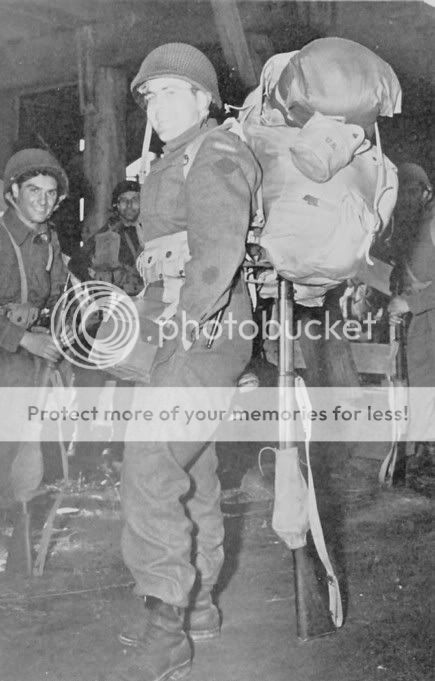
Canadian troops in the Aluetians WW2?

Paraman

Member
Rating - 0%
0   0   0
I know this is off topic but I don't know where else to post it. :confused:

I once read that Canadian forces assisted the US during the battles to push the Japanese out of Attu and Kiska. Can anyone confirm this and was it ground, naval or air forces that assisted.

Many thanks. :)
 
I believe the unit your are refering to was the First Special Service force. This was a joint US/Canadian unit formed during WWII. Ever see the movie The Devils Brigade? As far as the attack on Kiska goes one unit was to make a sea borne attack and another an airborne attack if required. As it turns out when the amphib attack went in they discovered the Japense had evacuated before they arrived and the airborne drop was not made. If I recall correctly this was there first operation and while they did not get into an actuall fight on Kiska the unit did prove its self through out the rest of the war.

I might not have all the details right, I'm pulling this from memory. I can't find my refernce book on the Force right now, but I hope this helps.
 
The Aleutians Operations 1942-1943

When the Japanese occupied the islands of Attu and Kiska in the Aleutians in Alaska in June 1942, the Allies had to remove them before they could attack the Kuriles. The Aleutians would be the only land battles in North America during World War II. The cold weather and remote location would make resupply of the Japanese garrison difficult, while the Americans would send thousands of highly trained soldiers to attack the outpost that conceivably could threaten Canada and the Western coast of the United States.


When the Dutch Harbor installations were attacked on June 3, 1942, the Americans were not fully prepared for an invasion. But occupying Attu and Kiska was a feint for the Midway operation, with little value other then the tactical goal of drawing the US Pacific Fleet into a major surface engagement. Reading the Japanese codes, the US Navy ignored the landings on Attu and Kiska and went to the defense of Midway, sinking most of the First Air Fleet.

The Americans left the Japanese garrisons in the Aleutians alone until a sufficient fleet with effective land units could be assembled. In January 1943, an attempt to reinforce the Japanese garrisons was repulsed with heavy losses in the Battle of the Komandorski Islands. In March 1943, the US Army 7th Division landed on Attu, and killed all but 30 of Attu's 4700 defenders. The end came in the form of a disorganized, drunken charge, called “Banzai”by the Americans, who heard the word screamed by the advancing Japanese.


In May 1943, the crack 10th Mountain Division and a Canadian force landed on Kiska, and after some sporadic fighting, the Americans found the island deserted. The Japanese had abandoned the island, except for a covering force that committed suicide.

From June 1943 until the end of the war, aircraft from the Aleutians attacked the Kurile Islands, Japan's northernmost possessions. The Aleutians saw cold-weather fighting that was bitter and protracted, and largely ignored by the American public.

 
Don't remember which island it was, but the Japs, hightailed er and we went in and shot the #### out of ourselves. Some thing like 300 causlities. I think the weather was real bad.

KTK

Found the article:

Kiska island
Main article: Operation Cottage
On August 7, 1943, an invasion force of 34,426 Allied troops landed on Kiska. Castner's Cutthroats were part of the force, but the invasion force was made up of units primarily from the United States 7th Infantry Division. The invasion force also included about 5,300 Canadians. The Canadians primarily came from the 13th Canadian Infantry Brigade of the 6th Canadian Infantry Division. The Canadian forces also included the Canadian component of the First Special Service Force, also known as the "Devil's Brigade".

The invasion force landed only to find the island abandoned. Under the cover of fog, the Japanese had successfully removed their troops on July 28 without the Allies noticing. The Army Air Force had been bombing abandoned positions for more than a week. On the day before the withdrawal, vessels of the United States Navy fought the inconclusive and possibly meaningless Battle of the Pips 80 miles to the west.

While the Japanese were gone before the invasion of Kiska was launched, Allied casualties during the operation nevertheless numbered 313. All of these casualties were the result of friendly fire, booby traps set out by the Japanese, disease, or frostbite. As was the case with Attu, Kiska offered an extremely hostile environment.
 
Last edited:
I believe the unit your are refering to was the First Special Service force. This was a joint US/Canadian unit formed during WWII. Ever see the movie The Devils Brigade? As far as the attack on Kiska goes one unit was to make a sea borne attack and another an airborne attack if required. As it turns out when the amphib attack went in they discovered the Japense had evacuated before they arrived and the airborne drop was not made. If I recall correctly this was there first operation and while they did not get into an actuall fight on Kiska the unit did prove its self through out the rest of the war.

I might not have all the details right, I'm pulling this from memory. I can't find my refernce book on the Force right now, but I hope this helps.

Thats the story a friend who was in Fredricks Freighters (what they called themselves) told me. They never did get to Norway or even use the skis. The Weasel was adopted by the U.S. Army though.The Canucks who were used to the Bren complained so bitterly about the lousy B.A.R. that they got issued the Johnson L.M.G.
 
The american also had some minor land battles with german forces in Northeastern Greenland, including some aireal bombardment of german weather stations, as well as intercepting norwegian sealers, hunters and a single norwegian weather reporter, send by the norwegian Quislings and their german masters to this remote part of North America during WW2.
 
A former Commander from my old Militia Unit in Sherbrooke, QC was part of the raid, seving as a lowly 2/Lt in one of the Canadian Units. He brought back some Japanese fur leggings, first aid bandages and few 20mm shells that he picked-up on Kiska. These items were at time one time on display at the Armoury Officer's Mess.
 
- Canadian Units were using Lee-Enfields, only US Infantryman's Individual Equipment they used were the US GI M-1 helmets and US Issue webbing. Also the Officer I mentioned in the earlier post, used a US Winter reversible parka, also now located in the Regimental collection. Was it general issue or did he acquire it by other means I do not know.

- Canadian members of the 1 rst Special Service Force were using American Issue Uniforms and Equipment.
 
Last edited:
The ''Regiment de Hull'' (infantry then) was there...dresed up in US uniforms...on some pictures the only way to tell is the berret and the badge...
Not much fighthing...apparently when they arrived the japaneese force had just left....our guys found ration piles they were reluctant to eat suspecting poisoning or something...first introduction of suhi into our diet!!!

..No battle Honors for this one...
 
Last edited:
An old gentleman I used to hunt deer with was on Kiska with the 1st Special Service Force. He still had his US issue sleeping bag and talked about being issued an M1 carbine. Like a lot of other WWII veterans he passed away a few years ago. Only after he was gone did I learn from his son that he had been one of "The Devil's Brigade". His son has pictures of him taking training in Montana.
 
JacquesT -

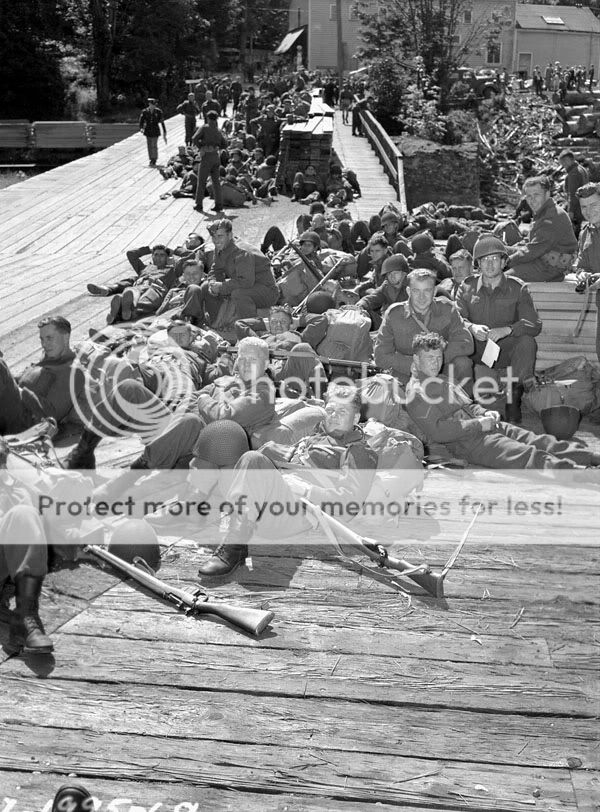
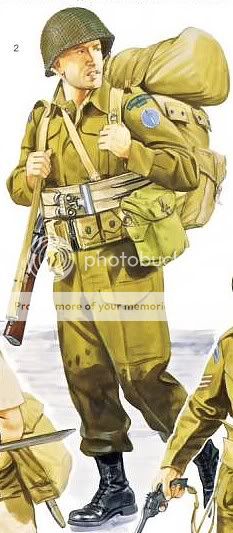
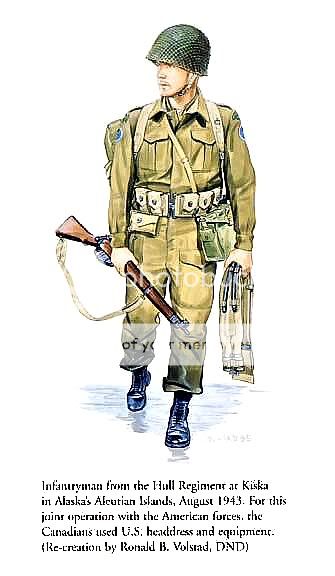
I think you have misinterpreted the photos, since all of my references clearly indicate that the Canadian troops in the Aleutians wore Canadian battledress, not American uniforms. Admittedly, with all of the other gear being American (especially their 'parkas', if those are being worn in the photo, and also helmet and load-bearing equipment) they do indeed have a very American appearance .... and their high-topped combat boots definitely add to that impression.

This photo from the Library and Archives Canada website (of members of the Régiment de Hull in fact, awaiting embarkation from Vancouver Island in July 1943, prior to the landing on Kiska] shows their Canadian battledress, and also their No4 Lee-Enfield rifles -
Kiska03.jpg


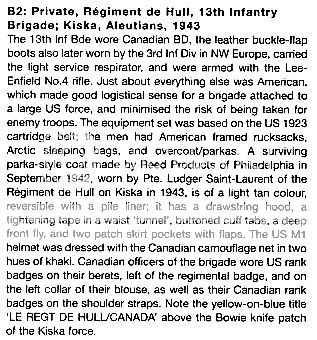
This depiction, by Canadian military artist Ron Volstad, is from Osprey Men-at-Arms #359, "Canadian Forces in World War II" -
Kiska01.jpg
Kiska01_text.jpg


This one, also by Ron Volstad, is from "Canadian Military Heritage, Vol. III: 1872-2000" published by the Directorate of History and Heritage, Dept. of National Defence -
Kiska02.jpg


(The text of the entire three-volume set of Canadian Military Heritage, along with most of the images, is available online, by the way, at:
http://www.cmhg.gc.ca/cmh/en/default.asp?flash=1)

A few more links:

http://www.civilization.ca/cwm/newspapers/operations/aleutian_e.html

http://www.history.army.mil/brochures/aleut/aleut.htm

http://en.wikipedia.org/wiki/Battle_of_the_Aleutian_Islands
 
Last edited:
My father was flying with RCAF Coastal Command out of Ucluelet in Cansos and they made several sorties to the Aleutians during 1942 or early 1943. Somewhere along the line, maybe in a poker game, he collected an essentially new Japanese bayonet (which I still have) which was probably left behind when the Japanese left.
My father was eventually transferred to RAF Alness in Scotland and their Sunderland crashed and burned with a full load of fuel and depth charges, killing all hands, while heading out on an anti-submarine patrol so I never heard the real story.
 
JacquesT,

Great pictures!

I don't think I'd want to stand around with that load on my back for very long, either .... :(

Mind you, at least one Canadian figured out a method for taking some of the weight off, so to speak .... ;)

Kiska05.jpg


(Good shot of his No. 4 Lee-Enfield, also, with action cover in place ....)
This image is included in Jack Summers' "Tangled Web - Canadian Infantry Accoutrements, 1855-1985".
 
Back
Top Bottom