I can't find a before picture but this came from Intersurplus. I think it had been stripped before I got it but it was pale blonde and you could barely see any figure in the wood. I think I put on 5 coats of Shaftol dark then 5 more of the light. Full 24 hours between coats, let it cure for a month then a coat of Howard's.













































You are using an out of date browser. It may not display this or other websites correctly.
You should upgrade or use an alternative browser.
You should upgrade or use an alternative browser.
Caring for your oil finished wood stock
- Thread starter 1899
- Start date



Looks great!I can't find a before picture but this came from Intersurplus. I think it had been stripped before I got it but it was pale blonde and you could barely see any figure in the wood. I think I put on 5 coats of Shaftol dark then 5 more of the light. Full 24 hours between coats, let it cure for a month then a coat of Howard's.
Yes thanks, you are correct - it is dry. I’ve done 2 coats with 24 hours between each and it is looking better already.If it’s just to keep it pretty, Howard’s whenever you feel like rubbing it on. Lovely stuff
Yours looks dry a bit. I’d do some coats of
Shaftol let sit for a bit then howards

A 3 pound cut of natural shellac, couple of coats and a nice buff and then boiled linseed oil.
Beeswax or hard paste furniture wax afterwards, but a wax finish really doesn’t last very long.
I also have a secret weapon for certain wooden implements that you wouldn’t believe.
Beeswax or hard paste furniture wax afterwards, but a wax finish really doesn’t last very long.
I also have a secret weapon for certain wooden implements that you wouldn’t believe.
One of the best and easiest to apply products I've used to maintain oil finished stocks for almost 50 years is cheap and available anywhere in Canada, and at all the big box stores.
Kiwi Shoe Polish
It's easily applied at room temperature for a quick touchup, and if you need it to penetrate deeper, a hair dryer with different heat settings will increase its viscosity. If you want even more penetration, heat the stock as well.
If you want it shiny, buff it up with a soft cloth after it hardens for a couple of hours.
Kiwi shoe polish takes me back to my cadet days! I went through a LOT of that stuff.
Yup, I taught my stepson and grandson how to "spit polish" their boots as well.
It's got everything in it that most of the other formulas for oiling and finishing wood have, but it's less expensive.
I was first turned onto it by some troopies in 1969, using it on the wood furniture of their FNFAL rifles.
It's got everything in it that most of the other formulas for oiling and finishing wood have, but it's less expensive.
I was first turned onto it by some troopies in 1969, using it on the wood furniture of their FNFAL rifles.
Works well. Enhances grain but not real shiny. Looks appropriate on older guns. Has beeswax and orange oil in it as well if I remember right. Locally they stock it at Home Hardware stores in my area.I’ve never heard of this Howard’s product, but it seems to be a popular choice. How does it affect the look of the stock? Does it enhance grain? Does it leave a shiny finish?
Also, for those using beeswax- how does you apply it?

You know what it looks like when you put a layer of oil on a stock and its still wet? It’s like that. If you have an oil finish on a figured stock it looks like you could jump in and swim around.I’ve never heard of this Howard’s product, but it seems to be a popular choice. How does it affect the look of the stock? Does it enhance grain? Does it leave a shiny finish?
Also, for those using beeswax- how does you apply it?
So wet and deep?
Clay of Prophet River put me on to it. Its kind of a Cooper thing, I think but if you happen to be standing by a cabinet full of British double rifles and such gleaming like they are ready to jump out and go hunting with or without you they probably are wearing it too. So are the cabinets

You know what it looks like when you put a layer of oil on a stock and its still wet? It’s like that. If you have an oil finish on a figured stock it looks like you could jump in and swim around.
So wet and deep?
Clay of Prophet River put me on to it. Its kind of a Cooper thing, I think but if you happen to be standing by a cabinet full of British double rifles and such gleaming like they are ready to jump out and go hunting with or without you they probably are wearing it too. So are the cabinets
I’m going to grab some and have a go. Thanks for the info.

- Location
- Steel Town and The Peg
Looks really good. I've been using that product for years now. The best way to maintain your stock is to wipe on a small quanity of Schaftol once per year (one thin coat). Don't add anything else, especially anything containing synthetic "waxes", as it will contaminate the finish and prevent you from successfully applying future coats of Schaftol. If you need to apply a water sealant, bees wax works just fine. However, you will need to clean the finish with good old fashioned vinegar before applying a future coat of Schaftol. This tried and true process will give you a beautiful and natural oil finish that feels good in the hands.I really liked oil finished wood stocks. I've never had the pleasure to own a high end English rifle or shotgun with the many, many coats of hand rubbed oil finish over red oil (alkanet root), but I have had, and do have German and Austrian rifles with oil finished stocks. I also found the Weatherby Mk5 Euromark quite appealing, although I have only owned Mk5's with the shiny finish.
I have used boiled linseed oil to finish a blank for a Santa Barbara Mauser (I was practicing!)
For maintenance I often used a piece of walnut on my Steyr Mannlicher Luxus. At some point in the past I discovered Scherell's Schaftol, and have been quite happy with it. It comes in Hell or Dunkel, which is light and dark respectively. What do you use to maintain your oil finished stock? Do you ever rub in some wax?
Here is a before and after from just one application of Schaftol on a Steyr Mannlicher Luxus I purchased from a fellow CGNer the other day. It really brings out the grain quite nicely.
View attachment 1051149View attachment 1051150
I've never oil finished a wood stock, but as a cabinetmaker and woodworker i've oil finished miles and miles of other wood products, like wood counters, butcher blocks. Tables, shelves, etc.
Most wood products today are finished with some sort of film finish - a finish that forms a hard film on the surface of the wood. The most popular modern version would be some form of polyurethane. Shellac and varnish are older versions. Film finishes are almost always more durable, but they tend to give the wood that flat "wood wrapped in plastic" look.
Oil finishes penetrate the grain and really make the wood "pop". But they also provide less protection than a film finish, and they need to be re-applied frequently. Fortunately, reapplication is usually no harder than shining your shoes: just rub a little on, wait a moment, buff it off.
To increase durability, it is common to add some sort of wax to the finish.
In my shop, i exclusively use tung oil. I get the polymerized stuff from lee valley as it is easier to work with.
You can use boiled linseed oil (BLO), and it will look great at first, but as others noted it doesn't hold up as well and it does have a reputation for being a "poor man's oil".
Similarly, there are lots of cheap paraffin waxes out there, but i stick to pure bee's wax, which many local bee keepers sell in blocks online.
To use it, first i gently heat up the tung oil in a double boiler on the stove with a good exhaust fan running. Don't let it boil, and for the love, do not use your wife's good double-boiler, go to the thrift store and buy your own just for wood finish! When the tung oil is hot, use a cheese grater to grate in the bee's wax and a ratio of about 1:4 wax to oil. As soon as the wax is melted and well mixed, i pour it into mason jars and let it seal. Make sure to keep gently stiring the whole time, or the disolved wax can settle and you will get an uneven ratio from one jar to the next. Let it cool and set over night, and by the next day it should have about the consistancy or mayonnaise, maybe some $10 butter.
To apply, simply rub some in with a clean rag, let it sit for about 5 minutes or so, then buff it with a dry cloth. On larger surfaces, i use an electric car buffer. For a new project with bare wood, i will do 3 coats over 3 days, with a light scuff sand with 320 grit paper between coats. Then do a refresher coat whenever it looks tired. New wood always needs many more frequent refresher coats, older wood settles down and only needs a coat every so often. After you're done applying the finish, hang your rags outside to dry, then burn or discard them a couple days later. Never throw finishing rags directly into the garbage in a clump, they can spontaneously combust.
I have used this finish for many years now and found it to be both beautiful and very durable. I actually use it on all the work bench tops in my shop. My portable bench is made of maple and goes with me to all the job sites for cabinet installs, normally by boat to island jobs, so it's been carried through the forest, dropped into metal boats, splashed with lake water and plenty of rain, and i just give it a refresher coat every so often and it's as good as new.
Most wood products today are finished with some sort of film finish - a finish that forms a hard film on the surface of the wood. The most popular modern version would be some form of polyurethane. Shellac and varnish are older versions. Film finishes are almost always more durable, but they tend to give the wood that flat "wood wrapped in plastic" look.
Oil finishes penetrate the grain and really make the wood "pop". But they also provide less protection than a film finish, and they need to be re-applied frequently. Fortunately, reapplication is usually no harder than shining your shoes: just rub a little on, wait a moment, buff it off.
To increase durability, it is common to add some sort of wax to the finish.
In my shop, i exclusively use tung oil. I get the polymerized stuff from lee valley as it is easier to work with.
You can use boiled linseed oil (BLO), and it will look great at first, but as others noted it doesn't hold up as well and it does have a reputation for being a "poor man's oil".
Similarly, there are lots of cheap paraffin waxes out there, but i stick to pure bee's wax, which many local bee keepers sell in blocks online.
To use it, first i gently heat up the tung oil in a double boiler on the stove with a good exhaust fan running. Don't let it boil, and for the love, do not use your wife's good double-boiler, go to the thrift store and buy your own just for wood finish! When the tung oil is hot, use a cheese grater to grate in the bee's wax and a ratio of about 1:4 wax to oil. As soon as the wax is melted and well mixed, i pour it into mason jars and let it seal. Make sure to keep gently stiring the whole time, or the disolved wax can settle and you will get an uneven ratio from one jar to the next. Let it cool and set over night, and by the next day it should have about the consistancy or mayonnaise, maybe some $10 butter.
To apply, simply rub some in with a clean rag, let it sit for about 5 minutes or so, then buff it with a dry cloth. On larger surfaces, i use an electric car buffer. For a new project with bare wood, i will do 3 coats over 3 days, with a light scuff sand with 320 grit paper between coats. Then do a refresher coat whenever it looks tired. New wood always needs many more frequent refresher coats, older wood settles down and only needs a coat every so often. After you're done applying the finish, hang your rags outside to dry, then burn or discard them a couple days later. Never throw finishing rags directly into the garbage in a clump, they can spontaneously combust.
I have used this finish for many years now and found it to be both beautiful and very durable. I actually use it on all the work bench tops in my shop. My portable bench is made of maple and goes with me to all the job sites for cabinet installs, normally by boat to island jobs, so it's been carried through the forest, dropped into metal boats, splashed with lake water and plenty of rain, and i just give it a refresher coat every so often and it's as good as new.
Last edited:

There is quite a bit of discussion and information on this subject on Rimfire Central and the Shotgun forum. The consensus there is that a lot of these furniture products and wood conditioners like Schaftol, Howard’s etc. contain distillate products and or silicone which can harm or lift a finish on a gun stock. I have never had an issue with this and I’m sure thousands of people use these products as well without issue. Makes for some interesting reading anyway. There seems to be a lot of praise for Renaissance wax, I have never tried it myself thought.


thewoodsrunner
Regular
I put a "London polish" oil finish on my custom CZ Mauser .375 H&H stock last winter, not the first time. 18 coats. Hand-rubbed. I then polish with Renaissance Wax, a museum-grade polish and preservative that is a great waterproofer and polish, i do all the hidden stock surfaces as well. Anyway, carried the thing plenty deer hunting earlier in the season this year (grizzly country), I am a tracker and still-hunter and cover a ton of ground over the hills and valleys. By end of season i had worn through all those layers of finish to the wood at the carry-contact points. I'm done messing with straight oil finishes for gun a that gets this kind of field use, these kind of miles. Gonna layer on the spar urethane this winter and see how that holds up, i'd rather not have to redo it every year. I'll still be polishing with renaissance wax, seems it is good on virtually everything.

My favorite finish on a walnut rifle stock is black walnut danish oil. I also like a hint of red. First coat of black walnut oil, then 1 coat of cherry danish oil followed by 2 or 3 more black walnut. Apply oil and keep all areas wet for 10 to 15 minutes and then rub off with a cloth and let dry 24 hours between coats. I have a stock of Behr's 600 Scandinavian tung oil finish, unfortunately it's not available any more. 4 coats of that on top, or some thing similar, wet sanded with 0000 steel wool and you are good to go.
This is a factory Husqvarna finished in that style.
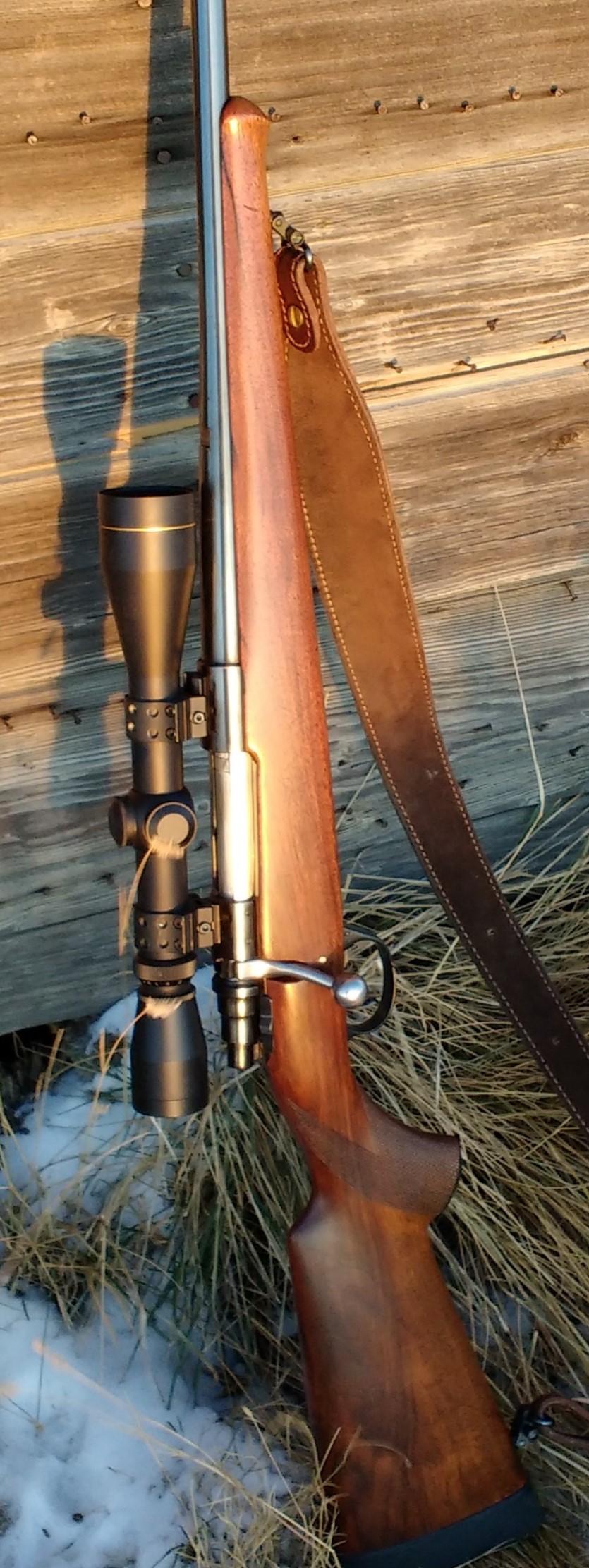
This is a factory Husqvarna finished in that style.

Third Rail
CGN Ultra frequent flyer
I use Behr Tung Oil (discontinued) on all of my refinished guns. Barrel and butt plates are pulled and every bit of raw wood is covered. I am not afraid to sit in the rain as it beads. Touch ups are really simple and the repair/blend is unnoticeable. Could not be more simpler.
If I anticipate hunting in really nasty weather, I use a little bit of Minwax.
If I anticipate hunting in really nasty weather, I use a little bit of Minwax.
I’m getting soft in my older years, used to talk tough about how no gun was too pretty to take hunting.
Had to back off from that. Turns out I don’t have to take a blued and 2 or 3 X walnut into the rain. Kind of ruins my whole day. If it ruined my whole week or month I’m probably in BC hateing life.
Had to back off from that. Turns out I don’t have to take a blued and 2 or 3 X walnut into the rain. Kind of ruins my whole day. If it ruined my whole week or month I’m probably in BC hateing life.
- Location
- Steel Town and The Peg
That is one beautiful rifle you have there ! I recognize yours is a working/tool gun and a practical and durable finish is required.I put a "London polish" oil finish on my custom CZ Mauser .375 H&H stock last winter, not the first time. 18 coats. Hand-rubbed. I then polish with Renaissance Wax, a museum-grade polish and preservative that is a great waterproofer and polish, i do all the hidden stock surfaces as well. Anyway, carried the thing plenty deer hunting earlier in the season this year (grizzly country), I am a tracker and still-hunter and cover a ton of ground over the hills and valleys. By end of season i had worn through all those layers of finish to the wood at the carry-contact points. I'm done messing with straight oil finishes for gun a that gets this kind of field use, these kind of miles. Gonna layer on the spar urethane this winter and see how that holds up, i'd rather not have to redo it every year. I'll still be polishing with renaissance wax, seems it is good on virtually everything.
View attachment 1053128






















