Carl Gustaf Rolling blocks?

Define "modern cartridge". Original rolling blocks Swedish or otherwise are not well suited to the majority of smokeless rounds. There's also a difference in strength between a Swedish action from a 12.17 and one rebuilt to 8x58.
 
i would go super low pressure ..... something like 45 colt , with a really loose chamber .

i've heard stories about these coming apart , especially the older ones , due to the old heat treating being uneven and that they are well over 100 years old .
newer rifles have safety's built into them in case they do come apart , i suspect these would not .

how it is built would determine if it is something fun , or if it is a bomb waiting to happen
 
Couple of photos of the action.
GetAttachmentThumbnail

GetAttachmentThumbnail
 
Last edited:
I forget what the max pressure recommended for the old bp actions is but its out there. Rear thrust is the important part of the equation.

Most people who rebarrel stick with cartridges from the black powder era or just after or they go with smaller medium pressure rounds. 38-55, 45-70, 45colt, maybe 30-30 or 22hornet. Ones done back in the 1950-1970 time frame got a little more ambitious but these days the economics of building a rifle are a little different and if you want something more modern or hot it's cheaper to buy a bolt action. If you're determined to build something less conventional there are modern makers recreating some of the stronger 1800's actions like the Winchester 1885 othe Sharps.
 
I re-barreled 2 that were originally 8 X 58 RDK. One to 38-55 and the other to 40-60 Maynard.

Got an 8x58 buried away and eventually plan to follow a similar path. Pick a cartridge that is contemporary to the rifle's age and you probably can't go too far wrong, as long as common sense is used (ie: not trying to load a 45-70, say, to near .458 Winchester performance). I also have a RB action, that was converted into a shotgun at some point in it's life, and it's not in any shape to even consider building on.
 
The original 12.7mm rolling blocks are essentially Remington No. 1 rifles. The 8mm conversions did handle a hotter cartridge but are not the equivalent of the Remington No. 5, which was made for a variety of smokeless rounds.
Bushing the firing pin may be a good idea when rebarreling, even if chambering for a classic black powder era cartridge.
 
rolling blocks.com has a lot of parts but if your gunsmith is talented bush the firing pin , make a new firing pin, make up new pins for the block and hammer.do all the reading on the forums as wells Facebook . some guys will share starting loads but it is up to you to do the decision making and the risk. I was given two loads to try with my 40/50 sharps when I owned it from Reverend Al . He was shooting the same caliber but in a Hepburn
4198 21.5gr. AA2495-22gr with a 400 gr pill.
 
Are you rebarrelling because you can't find ammo for it or because the barrel is toast?

I had one in 12.7 and it seemed like a very solidly built gun. Did not see a need to rebarrel. I've also had a commercial Husqvarna made one in 16ga - it looked very similar... so may be an option to ream out to that if the barrel is done? (I'm going by memory so they might be significantly different).

See my signature for another option ;)
 
At the time they first came out they were one of the strongest actions available and the proof test to try and destroy an action was way above most other actions of the time and they failed to get the action to fail with any blackpowder loads even with a bullet purposely lodged mid way up in the barrel.

From the September 1953 issue page 70 AMERICAN RIFLEMAN... In a article in DOPE BAG the writer refers to P.O. Ackley's well known tests of the strength of various military actions.. He also says that Ackley also tested other actions including an old pitted rolling block action from a 50-70 which Ackley then barreled up in 30 06 Improved and started running his high pressure tests through it. He finally started getting more notable results when he reached a duplex load of 30 gr. Hi Vel # 2 combined with 30gr 2400 and bulged the barrel, but the action still held.. Finally on the 20th shot with that load the action broke in two from the back of the barrel down through the breech block pin...He says compare that to the 1903 Springfield's which generally blow up on the first shot with that load.. Lol

He went on to say that he used a similar action that had been barreled in 11mm blackpowder (a common cal. for the olden days) He rebarreled it to 375 H&H Mag. Tied it to an old tire & fired 10 rounds thru it with no apparent damage to the rifle..

There was a comment from Gen. Hatcher that detailed some of the tests on rolling blocks in old Government reports .. Like stacking a load of black powder and a bullet on top of it in the barrel & repeating that until the barrel was half full then firing it .. Reporting the action still held...

And Remington alone made 1.5 million Rolling blocks between 1866 to 1917 and it has been said other makers, both licenced and otherwise made at least another half million to 1.5 million. At one time it was the most commonly used military rifles equipping armies and navies all over the world. Some being in service right up until WW2. With so many made and used up until recent times why do we seldom if ever hear about any real world failures of properly maintained rolling block rifles in good condition?

The action does have some weaknesses although and the main one on earlier made black powder ones is a very large firing pin breach block hole that should be sleeved to a smaller firing pin, another issue is after repeatedly being used for many decades and with some warm to hot loads the action will develop slop and excessive headspace and will need to have this corrected to continue to be safe.

I have one of the Swedish CG M1867 made ones that was originally made in 1874 and then upgraded in 1897 in Sweden to 8x58mmR Danish Krag and Steve Holbern reworked it to .45-70 with a new modern barrel and re-casehardened it. It handles any modern smokeless factory .45-70 ammo I use in it with ease and I have even loaded it up to 35,000 psi level loads which it also handles no problem whatsoever. I get zero pressure signs and my brass usually needs very little full length resizing after, actually I usually just neck size and full length resize every 3th reload.

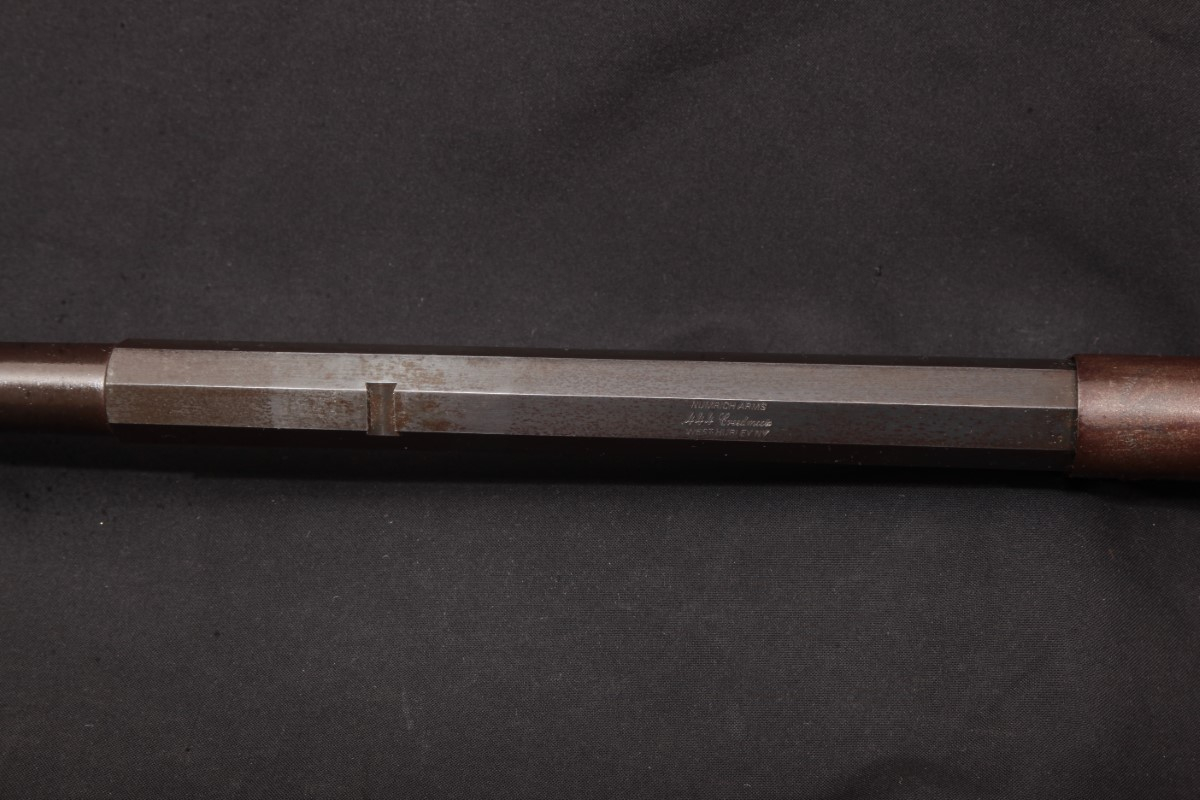
At one time in the 1970's thru into the early 1990's Numrich Gun parts offered a .444 Marlin barreled rolling block action for buyers to restock and finish off into a sporter. I have never heard of one of these actually failing. Navy Arms in the USA did the same at one time and SAAMI rates the .444 Marlin at 44,000 CUP.

This is what Numrich had to say about them - I HAVE A REMINGTON ROLLING BLOCK 45-70 MARKED NUMRICH ARMS Posted: January 25, 2005 09:27 AM

Our hosts (company) offered (Surplus Rolling Block) kits in two calibers, 45-70 and .444 Marlin and in a couple of styles. There was some discussion on the .444 being a little bit too much for the BP RRB's with factory ammo.

Frank De Haas had an article in the NRA Gunsmithing Guide- Updated (out of print) and there is a .45-70 conversion pictured built on the kit. It gives these specs on the Numrich barrel: Cal: 45-70,Length: 32", Weight:-71/2 Lbs., Dia:- 1.125" Grooves:- 4 groove w/a dia. of-.459.

I believe the problem with the .444 had to do with the kit being installed on the (surplus) BP actions and pounding out "excessive headspace" in very short order.

If you have this caliber, I suggest that you check the headspace prior to firing, just to be safe.

The cartridge, .444 Marlin, should be fine if you shoot cast bullets and loads that are equivalent to the trapdoor numbers.

And

Some years back, our hosts offered kits containing barrels and wood for surplus RRB's. The "name" of one of the kits was "Creedmoor" (after the Creedmoor Plain Range where International Rifle Matches were held on LI NY) One of the calibers offered was the then new .444 Marlin. The other was the 45-70.


101467117_125729_7A3C2B21B512A8FD.JPG


22646544_2.jpg


22646544_1.jpg


Remington Rolling Block Cal: .444 Marlin SN 250

20190712221539-9793.jpg


Numrich kit assembled rifle using a BP Remington Rolling block receiver, with Numrich supplying the barrel & stocks.

Model: .444 Marlin

Serial Number: 4293
20190712221539-9793.jpg

20190712221539-9793.jpg


Markings: The top of the barrel is marked “NUMRICH ARMS/.444 CREEDMOOR/WEST HURLEY NY”. The upper tang is marked “REMINGTON ARMS COMPANY ILION, NY / ???? 1872 / ???? MARCH 18th 1874”.

 
Got a few rolling blocks but my favorite is in 7x57 Mauser. It's all original so must be #5?

It's carbine length and quite light. I think it's Mexican.
I bought it from P&S 15 years ago. Jean said it was one of the best he had seen.
 
The 8x58R is a tough one to reload for, but reloading component alternatives have become more available.

Bullets:

I bought an 8mm maximum Lee mould from midsouth shooters supply about 6 months ago (the heavier 225gr mould) and it throws a heavy and long 327'ish diameter slug. It's pretty much perfect for the 8x58R which tends to have a very generous chamber and neck area with a lot of free bore. My barrel slugged to .325" which is pretty average for these rifles, so a .327 or larger bullet is pretty much perfect.

I also have a supply of those Swedish 8x63 FMJ MG bullets hanging around and they shoot pretty well too. So even if they're undersized a .323 jacketed bullet will still shoot well enough.

Brass:

Reforming 8x56R brass seems to be the most economical solution. The rim is a tad too small and until they're fireformed they like to slip under the extractor. But once they're fired they're fine and they have enough length to not be much of a problem with a long bullet.

Other options include 45-70 and 7.62x54R but they end up being pretty short.

Powder:

I'm sticking with AA5744, it seems to be working just fine, but there are plenty of other cast bullet go-to's including unique that will work as well. Norma used to make a de-tuned load specifically for the Swede Rolling Block rifles, a 200 grain jacketed bullet travelling at somewhere around 2200 fps. That's actually pretty stiff and is a testament to how strong the action really is.

I think the action fragility is crossing over into urban legend territory mostly sue to hearsay and lack of confirmed information. I've read online article I could find and found out the following:

"Some guy in Sweden" had a Swedish rolling block that blew up in his face and killed him. There are reports that he had a selection of different 50 cal cartridges siting on his bench, the speculation is that he managed to get an unknown high power cartridge into the gun and created a pipe bomb.

When did this happen and who did it happen to? We don't know.

Was it an 8x58R rifle re-barreled to a 50 cal cartridge, or was it an older (weaker actioned) 12.7mm? We don't know.

Is it possible to fit something like a 500 Nitro Express in a 12.7mm chambered Rolling Block? We don't know.

Should we base the strength of these rifles on one instance, which may or may not have even happened they way legend tells us? Heck, translations from Swedish to English may account for half of the issues of this story.
 
I think the action fragility is crossing over into urban legend territory mostly sue to hearsay and lack of confirmed information. I've read online article I could find and found out the following:

"Some guy in Sweden" had a Swedish rolling block that blew up in his face and killed him. There are reports that he had a selection of different 50 cal cartridges siting on his bench, the speculation is that he managed to get an unknown high power cartridge into the gun and created a pipe bomb.

When did this happen and who did it happen to? We don't know.

You can see pictures of the blown rolling block in this article.
https://svartkrutt.net/articles/vis.php?id=53
 
Back
Top Bottom