












































You are using an out of date browser. It may not display this or other websites correctly.
You should upgrade or use an alternative browser.
You should upgrade or use an alternative browser.
Cartridge Quiz
- Thread starter Son of Tiriaq
- Start date


- Location
- Hillbilly shack in the boonies
army bullets ? 

army bullets ?
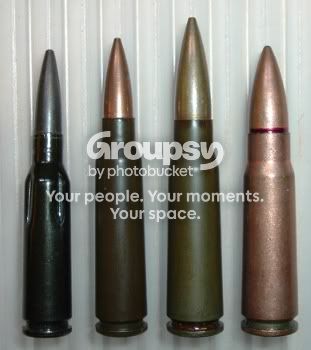
Communist Army Bullets, or at least something the bad guys in the movie would be using.

Bang on for the Chinese 5.8mm...
First hint for the other round...the headstamp is '21 78' and the '21' is upside down in relation to '78' (the date). What does this mean? It's not Hungarian!
Close GREEN, but it's not 7.62mm in caliber.
The Chinese 5.8mm is headstamped '71 98'. And, for those interested in headstamps, the E. German drill 5.45mm is '05 88' and the 7.62mm is '671 70'
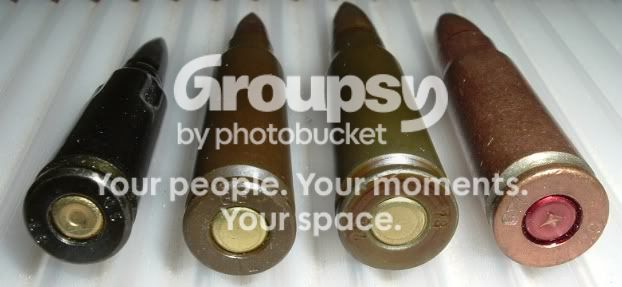
First hint for the other round...the headstamp is '21 78' and the '21' is upside down in relation to '78' (the date). What does this mean? It's not Hungarian!
Close GREEN, but it's not 7.62mm in caliber.
The Chinese 5.8mm is headstamped '71 98'. And, for those interested in headstamps, the E. German drill 5.45mm is '05 88' and the 7.62mm is '671 70'
Last edited:


I only found it by Googling "7x41mm". Until now, I had no idea that the Poles were experimenting with a 7mm intermediate cartridge in the 1970s.
It's interesting how many times someone has decided that an intermediate cartridge of about 7mm calibre has been ideal, only to not see adoption due to circumstances:
-.276 Pedersen
-The Germans experimented with a number of 7mm cartridges prior to and during WWII
-.280/30 British
-6.8mm SPC
It's interesting how many times someone has decided that an intermediate cartridge of about 7mm calibre has been ideal, only to not see adoption due to circumstances:
-.276 Pedersen
-The Germans experimented with a number of 7mm cartridges prior to and during WWII
-.280/30 British
-6.8mm SPC
tjhaile, you are absolutely correct. In addition to the calibers you mention above, here's a few more.
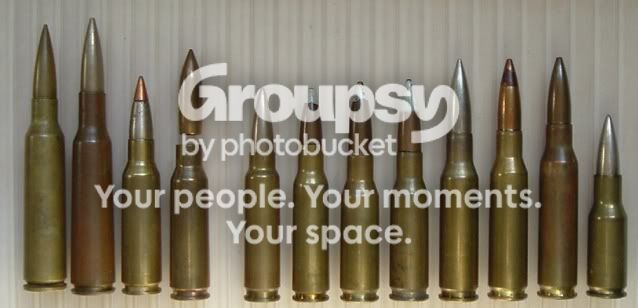
left to right:
7.2 x 57, French dating from 1917 (E.7 A.PX. 17)
.276 Pattern 13, abandoned at the outset of WWI (R ^ L)
7.2 x 45.7, German pre-WWII (N 8 x 46)
7.3 x 45.6, German pre-WWII (N)
7 x 44 Weibel, Danish, early 1930's (no headstamp)
.270 British (K 48 .270)
.280 British (RG 48 280)
.280/30 British (RG 51 .280/30)
7 x 49 2nd Optimum, British/Belgium/Canada (F N 55)
7 x 49 High Velocity, British (RG 52 7 M/M H.V.)
7 x 51 Compromise, British/Belgium/Canada (RG 52 7 M/M)
7 x 36 Madsen, Danish, 1960's (K .30)
There is a great article written by Tony Edwards in the Sept/Oct 2008 issue of the International Ammunition Journal titled 7mm - A British Ideal (The Failed Efforts to Find a New Infantry Cartridge) dealing specifically the various failed attempts over a 50 year period.
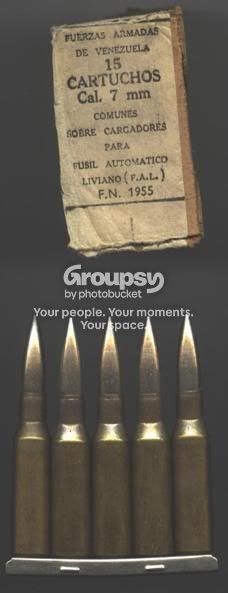
I think that the only modern 7mm to be adopted for use in an assault rifle would be the Venezuelan army and their FN FAL's. This was the 7 x 49 2nd Optimum (aka Liviano).
Paul
left to right:
7.2 x 57, French dating from 1917 (E.7 A.PX. 17)
.276 Pattern 13, abandoned at the outset of WWI (R ^ L)
7.2 x 45.7, German pre-WWII (N 8 x 46)
7.3 x 45.6, German pre-WWII (N)
7 x 44 Weibel, Danish, early 1930's (no headstamp)
.270 British (K 48 .270)
.280 British (RG 48 280)
.280/30 British (RG 51 .280/30)
7 x 49 2nd Optimum, British/Belgium/Canada (F N 55)
7 x 49 High Velocity, British (RG 52 7 M/M H.V.)
7 x 51 Compromise, British/Belgium/Canada (RG 52 7 M/M)
7 x 36 Madsen, Danish, 1960's (K .30)
There is a great article written by Tony Edwards in the Sept/Oct 2008 issue of the International Ammunition Journal titled 7mm - A British Ideal (The Failed Efforts to Find a New Infantry Cartridge) dealing specifically the various failed attempts over a 50 year period.
I think that the only modern 7mm to be adopted for use in an assault rifle would be the Venezuelan army and their FN FAL's. This was the 7 x 49 2nd Optimum (aka Liviano).
Paul
I have a .280/30, a 7x49mm, and a 7x51mm in my collection. I'm not sure if the 7x49mm is the 2nd Optimum or High Velocity. It is stamped with a C-Broad Arrow and DA 52, presumably indicating Dominion Arsenals manufacture.
Did both versions of the 7x49mm use the same case?
Did both versions of the 7x49mm use the same case?
You have a 7 x 49 2nd Optimum. The HV was only manufactured in Britain by Radway Green. The HV case has a higher shoulder and neck than the 2nd Optimum. You will also find the 7 x 51 Compromise with DAC 51 and DAC 52 headstamps. The '51 is pretty rare.
Paul
Paul






















