












































You are using an out of date browser. It may not display this or other websites correctly.
You should upgrade or use an alternative browser.
You should upgrade or use an alternative browser.
Cartridge specs for 56-50 Spencer?
- Thread starter Killer Kanuck
- Start date


Cartridges of the World doesn't have an illustration of this cartridge with dimensions, but has a table of rimfire cartridge dimensions - which are given for 56-50 Spencer as:
- Bullet diameter .512"
- Neck diameter .543"
- Base diameter .556"
- Rim diameter .639"
- Case length 1.156"
- O/A length 1.632"
Here is one drawing I located online, giving measurements from three original Spencer cartridges. The COTW dimensions of the .56-50 round are certainly close to these actual measurements from an original .....
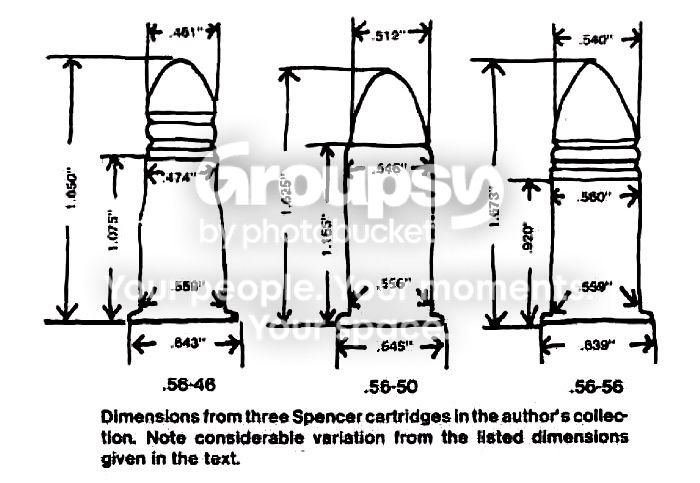
- Bullet diameter .512"
- Neck diameter .543"
- Base diameter .556"
- Rim diameter .639"
- Case length 1.156"
- O/A length 1.632"
Here is one drawing I located online, giving measurements from three original Spencer cartridges. The COTW dimensions of the .56-50 round are certainly close to these actual measurements from an original .....
The 56 50 looks Better eh! thats the one i was gona get and Trim the Length.
If the 56 56 rim is to Narrow the Extractor wont pull it out.
Thanks for posting them pics Grant.
Killer Maby buy a couple of each just to see. If they will go for it sometimes theres Minumum orders on brass.
I dont have a 50 Cal Remy to check the chamber Dimensions on like you as the one i have now is 50 70.
But wouldnt the 56 50 work if its Shortened?
If the 56 56 rim is to Narrow the Extractor wont pull it out.
Thanks for posting them pics Grant.
Killer Maby buy a couple of each just to see. If they will go for it sometimes theres Minumum orders on brass.
I dont have a 50 Cal Remy to check the chamber Dimensions on like you as the one i have now is 50 70.
But wouldnt the 56 50 work if its Shortened?
Here are the specs I found for the 50 Remington:
Bullet Diameter: 0.508
Case Length: 0.88
Rim Diameter: 0.665
Neck Diameter: 0.532
Shoulder Diameter: 0.564
Base: 0.565
So here's the comparison (Rem first, then Spencer)
- Bullet diameter - .508 to .512"
- Neck diameter - .532 to .543"
- Base diameter - .565 to .556"
- Rim diameter - .665 to .639"
- Case length - .88 to 1.156"
- O/A length 1.632"
So, am I correct in assuming that the rim is the sticky point? It might work at that size, but it'd be close. Should all the rest be able to be cleaned up with fireforming, trimming, etc?
TOTW only has 56-50 brass, but he said that people are using it to make 56-56 and 56-46. I'm going to email him to see what the rim diameter is on the Starline brass.
Bullet Diameter: 0.508
Case Length: 0.88
Rim Diameter: 0.665
Neck Diameter: 0.532
Shoulder Diameter: 0.564
Base: 0.565
So here's the comparison (Rem first, then Spencer)
- Bullet diameter - .508 to .512"
- Neck diameter - .532 to .543"
- Base diameter - .565 to .556"
- Rim diameter - .665 to .639"
- Case length - .88 to 1.156"
- O/A length 1.632"
So, am I correct in assuming that the rim is the sticky point? It might work at that size, but it'd be close. Should all the rest be able to be cleaned up with fireforming, trimming, etc?
TOTW only has 56-50 brass, but he said that people are using it to make 56-56 and 56-46. I'm going to email him to see what the rim diameter is on the Starline brass.
I was reading on another site that another issue is the rim thickness. Some have tried to turn the rim thinner by working on the rear. This leads to primers sitting proud of the rim. They must be turned on the forward edge.
Here is some info on that problem
http://www.awod.com/gallery/probono/cwchas/spencer.html
"Reloading Tips
There are some peculiarities that may be encountered when preparing a Spencer for use today. First, most Spencers have been dry fired, some a lot. Dry firing will pound the firing pin, which is case hardened, into the rim area of the chamber, which is not. The result is a dent of variable severity in the barrel breech. Often this dent will be bad enough to prevent cartridge chambering. If an otherwise correct cartridge will not seat completely, it may be necessary to find and carefully remove the dent.
Spencer cases are not currently available, so other types must be converted. The easiest cases to modify are 50-70's, but most rims are a little too large in diameter for Spencer chambers, the original 50-70 specification is .670". Turn them down to .650" and they will fit fine. Some of the newer 50-70 case rims are being made slightly undersize, due to the popularity of centerfire Spencer conversions.
Two other cases can be formed into Spencer rounds with a suitable neck expander. 348 Winchesters are the most readily available but, due to their smaller rim, these will only extract with the M-1867 Lane extractor. French Lebel cases often work well. However, their rims are also occasionally a little too small to extract reliably with the blade type extractor. In addition, they can be rather difficult to find in boxer primed versions.
A problem that occasionally appears is inability to close the breech on an apparently correct case. This is caused by the chamber's rim cut being less than .065" deep. The result can be negative headspace when using 50-70 based cases, which will prevent closing of the action. If this problem is encountered, the front face of the rim must be thinned. If the back face is thinned instead, which is much easier, primers may protrude when fully seated. It is very important to seat primers fully flush with the case. If a primer is not quite seated, the chance of a magazine explosion is great."
There is a bit more info on bullets etc .
Here is some info on that problem
http://www.awod.com/gallery/probono/cwchas/spencer.html
"Reloading Tips
There are some peculiarities that may be encountered when preparing a Spencer for use today. First, most Spencers have been dry fired, some a lot. Dry firing will pound the firing pin, which is case hardened, into the rim area of the chamber, which is not. The result is a dent of variable severity in the barrel breech. Often this dent will be bad enough to prevent cartridge chambering. If an otherwise correct cartridge will not seat completely, it may be necessary to find and carefully remove the dent.
Spencer cases are not currently available, so other types must be converted. The easiest cases to modify are 50-70's, but most rims are a little too large in diameter for Spencer chambers, the original 50-70 specification is .670". Turn them down to .650" and they will fit fine. Some of the newer 50-70 case rims are being made slightly undersize, due to the popularity of centerfire Spencer conversions.
Two other cases can be formed into Spencer rounds with a suitable neck expander. 348 Winchesters are the most readily available but, due to their smaller rim, these will only extract with the M-1867 Lane extractor. French Lebel cases often work well. However, their rims are also occasionally a little too small to extract reliably with the blade type extractor. In addition, they can be rather difficult to find in boxer primed versions.
A problem that occasionally appears is inability to close the breech on an apparently correct case. This is caused by the chamber's rim cut being less than .065" deep. The result can be negative headspace when using 50-70 based cases, which will prevent closing of the action. If this problem is encountered, the front face of the rim must be thinned. If the back face is thinned instead, which is much easier, primers may protrude when fully seated. It is very important to seat primers fully flush with the case. If a primer is not quite seated, the chance of a magazine explosion is great."
There is a bit more info on bullets etc .
Last edited:
Killer Kanuck:
Can you clarify what it is you want to do? In particular, are you trying to make cases for a reproduction centerfire version, or for an original with a centerfire conversion block, or are you actually looking to make rimfire rounds?
Assuming that you want to load centerfire cartridges, I trust that you are aware that such cases are in fact being made for the repro Spencers on the market, and that cases are also available for original Spencers which have a centerfire conversion block?
For example, Ten-X load cartridges in both smokeless ($129.99/box) and black powder substitute ($134.99/box) versions. See the screen capture below (click to enlarge.) I take it from this table that those prices are for 50 rounds - not bad at all for such limited-production cartridges. Mind you, loaded ammo likely means insurmountable shipping and export problems, and I seem to recall that Ten-X no longer sells empty brass ..... Besides, I can't tell from their listing whether this brass is best suited to original chambers or is intended for use in the modern centerfire repros (which have some chamber dimensional differences - mainly rim diameter, I gather.)
http://www.tenxammo.com/index.html
Never fear, however: Buffalo Arms (Idaho) carries centerfire versions of .56-50 brass (both for repro and original chambers) and the owner Dave Gullo has absolutely no problem shipping such items to Canada. I understand he is an ex-pat Canadian, in fact, and I have bought various items from him over the years, including .50-70 brass for shortening into ".50-60 Peabody Centerfire" (see below) ....
http://www.buffaloarms.com/browse.cfm/4,4681.html
http://www.buffaloarms.com/browse.cfm/4,720.html
Starline also make a .56-50 case, although they indicate it is specifically for the Taylor's reproduction Spencer, and thus has the somewhat smaller rim diameter compared to original specs. Here is a comment on that from their website: "56-50 Spencer (Taylor's) - Was built to C.I.P. specifications for operation in the Taylor Arms 56-50 Spencer. Rim diameter = .629 to .632, which may be too small to eject properly in some originals. Rim thickness = .057 to .061. Thickness of wall at mouth is .0125 average. Primer pocket is designed for large rifle primer. Case mouth may need to be annealed if not sealing properly. Maximum bullet seating depth = .375."
If none of these options work for you, you might consider getting .50-70 Govt. cases, and forming .56-60 from them. Here are the specs on the .50-70 Government:
Bullet diameter - .515 in (13.1 mm)
Neck diameter - .535 in (13.6 mm)
Base diameter - .565 in (14.4 mm)
Rim diameter - .660 in (16.8 mm)
Rim thickness - .065 in (1.7 mm)
Case length - 1.75 in (44 mm)
Overall length - 2.25 in (57 mm)
I formed the cases for my .50-60 Peabody (with centerfire conversion block) from .50-70 brass. Here is an image with dimensions added sent to me by a fellow-CGner ('Beater", IRRC) of an original Canadian-issue .50-60 cartridge he has ....
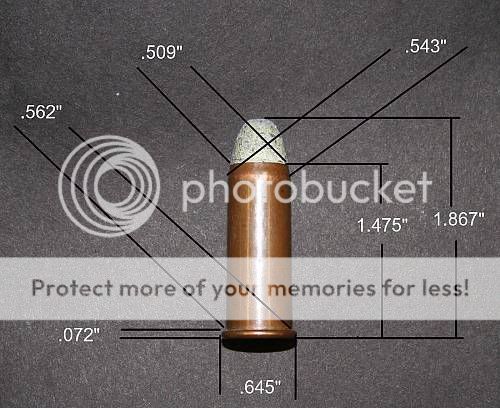
Despite the apparent dimensional differences, the shortened .50-70 cases work like a charm in my Peabody without further modification. I take it that the chamber tolerances back then were pretty wide, to accommodate considerable variation in cartridge dimensions ....
To show how "tolerant" the old guns were, the Canadian Government bought and issued only one type of cartridge for the three different rimfire breechloading calibers acquired in 1866-67 in response to the Fenian threat - i.e. .56-50 Spencers, .56-62 Starrs and .50-60 Peabodys ....
(In fact, the * in the Buffalo Arms listing for .56-50 cases which fit original chambers means that they are formed from some other cartridge case, and I'd guess they likely start with .50-70 cases .....)
Can you clarify what it is you want to do? In particular, are you trying to make cases for a reproduction centerfire version, or for an original with a centerfire conversion block, or are you actually looking to make rimfire rounds?
Assuming that you want to load centerfire cartridges, I trust that you are aware that such cases are in fact being made for the repro Spencers on the market, and that cases are also available for original Spencers which have a centerfire conversion block?
For example, Ten-X load cartridges in both smokeless ($129.99/box) and black powder substitute ($134.99/box) versions. See the screen capture below (click to enlarge.) I take it from this table that those prices are for 50 rounds - not bad at all for such limited-production cartridges. Mind you, loaded ammo likely means insurmountable shipping and export problems, and I seem to recall that Ten-X no longer sells empty brass ..... Besides, I can't tell from their listing whether this brass is best suited to original chambers or is intended for use in the modern centerfire repros (which have some chamber dimensional differences - mainly rim diameter, I gather.)

http://www.tenxammo.com/index.html
Never fear, however: Buffalo Arms (Idaho) carries centerfire versions of .56-50 brass (both for repro and original chambers) and the owner Dave Gullo has absolutely no problem shipping such items to Canada. I understand he is an ex-pat Canadian, in fact, and I have bought various items from him over the years, including .50-70 brass for shortening into ".50-60 Peabody Centerfire" (see below) ....
http://www.buffaloarms.com/browse.cfm/4,4681.html
http://www.buffaloarms.com/browse.cfm/4,720.html
Starline also make a .56-50 case, although they indicate it is specifically for the Taylor's reproduction Spencer, and thus has the somewhat smaller rim diameter compared to original specs. Here is a comment on that from their website: "56-50 Spencer (Taylor's) - Was built to C.I.P. specifications for operation in the Taylor Arms 56-50 Spencer. Rim diameter = .629 to .632, which may be too small to eject properly in some originals. Rim thickness = .057 to .061. Thickness of wall at mouth is .0125 average. Primer pocket is designed for large rifle primer. Case mouth may need to be annealed if not sealing properly. Maximum bullet seating depth = .375."
If none of these options work for you, you might consider getting .50-70 Govt. cases, and forming .56-60 from them. Here are the specs on the .50-70 Government:
Bullet diameter - .515 in (13.1 mm)
Neck diameter - .535 in (13.6 mm)
Base diameter - .565 in (14.4 mm)
Rim diameter - .660 in (16.8 mm)
Rim thickness - .065 in (1.7 mm)
Case length - 1.75 in (44 mm)
Overall length - 2.25 in (57 mm)
I formed the cases for my .50-60 Peabody (with centerfire conversion block) from .50-70 brass. Here is an image with dimensions added sent to me by a fellow-CGner ('Beater", IRRC) of an original Canadian-issue .50-60 cartridge he has ....
Despite the apparent dimensional differences, the shortened .50-70 cases work like a charm in my Peabody without further modification. I take it that the chamber tolerances back then were pretty wide, to accommodate considerable variation in cartridge dimensions ....
To show how "tolerant" the old guns were, the Canadian Government bought and issued only one type of cartridge for the three different rimfire breechloading calibers acquired in 1866-67 in response to the Fenian threat - i.e. .56-50 Spencers, .56-62 Starrs and .50-60 Peabodys ....
(In fact, the * in the Buffalo Arms listing for .56-50 cases which fit original chambers means that they are formed from some other cartridge case, and I'd guess they likely start with .50-70 cases .....)
I think I confused some people here. 
Grant, I'm trying to figure out if I could trim down and form 56-50 Starline brass to create brass for my 1871 Remington rolling block pistol in 50 Remington Army/Navy. But if rim of the Starline brass is even smaller than the original, I have a feeling it wouldn't work in a 50 Remington.
Anyone that has bought items from Buffalo Arms lately - is the shipping reasonable or way over priced like a few other places in the States?
Grant, I'm trying to figure out if I could trim down and form 56-50 Starline brass to create brass for my 1871 Remington rolling block pistol in 50 Remington Army/Navy. But if rim of the Starline brass is even smaller than the original, I have a feeling it wouldn't work in a 50 Remington.
Anyone that has bought items from Buffalo Arms lately - is the shipping reasonable or way over priced like a few other places in the States?
Aaaaaahhhh!
If you glanced through the Buffalo Arms brass listings, then you probably now know that they also offer .50 Remington cases (which also are formed from something else apparently .....)
http://www.buffaloarms.com/browse.cfm/4,707.html
I've never had any complaints about Buffalo Arms shipping charges .....
(By the way, many US vendors seem to have gotten an undeserved bad rap on this score, as a result of the US Postal Service having eliminated the more economical international parcel rates they previously offered. The minimum charge by the USPS for a parcel going outside the US (including to Canada) is now about US$21 - the merchants have no control over that, of course. So unless what you buy will somehow fit in a large envelope, and thus doesn't have to go parcel rate, they are kinda stuck ....)
If you glanced through the Buffalo Arms brass listings, then you probably now know that they also offer .50 Remington cases (which also are formed from something else apparently .....)
http://www.buffaloarms.com/browse.cfm/4,707.html
I've never had any complaints about Buffalo Arms shipping charges .....
(By the way, many US vendors seem to have gotten an undeserved bad rap on this score, as a result of the US Postal Service having eliminated the more economical international parcel rates they previously offered. The minimum charge by the USPS for a parcel going outside the US (including to Canada) is now about US$21 - the merchants have no control over that, of course. So unless what you buy will somehow fit in a large envelope, and thus doesn't have to go parcel rate, they are kinda stuck ....)
Last edited:
I guess that would explain the shipping on my last Brownells order.
Rocky Mountain Cartridges make 50Rem cases too, but I figured that if I could make 56-50 cases work, $1 a piece is better than near $2 a piece. Yup, I'm a cheap bastard.
Rocky Mountain Cartridges make 50Rem cases too, but I figured that if I could make 56-50 cases work, $1 a piece is better than near $2 a piece. Yup, I'm a cheap bastard.

vagrantviking
CGN Ultra frequent flyer
- Location
- Southern Alberta
Got some 4D dies just the other day. No shell holder.
I didn't see any mention of them on the web site but I'm sure they must make them...
I didn't see any mention of them on the web site but I'm sure they must make them...

There are three 50 cal rounds for the RRB pistol.
1) 50 RF USN based on a shortened 56-50 RF
2) 50 USN CF as above but CF
3) 50 US Army CF based on shortened 50-70 case
M1871 should use the third ctg.
3 will not chamber in 1&2 chambers due to larger rim.
1) 50 RF USN based on a shortened 56-50 RF
2) 50 USN CF as above but CF
3) 50 US Army CF based on shortened 50-70 case
M1871 should use the third ctg.
3 will not chamber in 1&2 chambers due to larger rim.






















