Case Head Separation Mystery - 7PRC reloads

The only thing I can think of is: a reduced load, below the minimal required powder required, accompanied with many full-length resizing.
I've seen this happen before, and I agree with track on his analysis.

The writing on the cases is what's throwing people off the issue.

The loader may have been trying to "fire form" used cases from a different rifle for the Fierce.

My assumption is, the reloader tried to bump back the shoulder after annealing, using a dirty resizing die, with plugged vent holes, is where the dents were created.

Then, he loaded up the cases with a fractional load in an effort to save the cases.

You're witnessing the results.

If there is a reason for such a fractional load, fill the empty air space above the powder with something like Dacron fiber or a similar filler that will be burned away, and the residue blown out the barrel.

I'm wondering if the person firing those rounds didn't have a bullet stuck in the barrel at some point????

He did manage to create a very nasty explosive condition within the chamber, rather than a controlled burn, loader beware.
 
I'm not convinced this was an "explosive" event. If this case damage was purely due to overpressure, then the action would also be damaged.

If headspace was good, and there was enough pressure to stretch the action 5 to 10 thousandths sufficient to tear the head off this brass, the action would not survive. At the very least, lugs would be set back a remarkable amount and bolt would be locked hard. Possibly someone could able to beat it open with a heavy object. If this happened, then even the most stupid person would not repeat it 20 times. A locked bolt would be the best case scenario, more likely that pieces of the action would go airborn.

These cases separated because of headspace issues, cause unknown.
 
These cases separated because of headspace issues, cause unknown.
That’s very possible. My only hesitation with full agreement has to do with a bit of evidence which might indicate high pressure on the two case heads recovered. Both had serious brass flow into the ejectors. The rifle obviously had twin ejectors (which is more evidence that it was possibly a Fierce firearm.
ā€œFierceā€ written on a case was the other.)
One case head had a missing primer and the other was seriously flattened. Head spacing could cause the primer issues but I’m not sure about.the measurable brass flow into the ejectors. I would have liked to recover more off the separated case heads for inspection.

Also, I regret not bringing those failed cases home for a full suite of measurements, which would shed more light on the possible root cause.

As was pointed out earlier, what really happened will never be known without more information.
However, I do believe that there is a high probability that firing 20 case separating rounds might well have compromised that firearm and the owner may be oblivious.

It concerns me to think that he might be sitting beside to me, shooting that rifle, at my next range session!
 
Last edited:
I do not believe an action could stretch enough to allow separation of properly sized cases without the action itself being heavily damaged. The fact that the episode was repeated 20 times says the action did not explode with the brass. Marks on the brass are normal when a head separates and slams into the bolt face.
 
Additional information and photos:
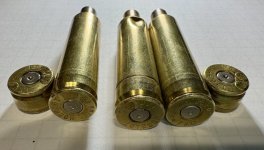
Another member of our club found additional failed cases and gave them to me for measurements and photographs. There were 5 more examples obtained including 2 failed case heads, 2 unfailed cases and 1 failed but not completely separated. Neither of the two non-failed cases had the hydraulic indentations (more evidence to suggest the marks are the result of hydraulic pressure from the failure).

I’ll try to take some measurements tomorrow and see how the fired cases compare to SAAMI specs.
 

Attachments

  • IMG_6012.jpeg
    IMG_6012.jpeg
    151.2 KB · Views: 19
  • IMG_6018.jpeg
    IMG_6018.jpeg
    131.3 KB · Views: 18
  • IMG_6010.jpeg
    IMG_6010.jpeg
    87.1 KB · Views: 18
  • IMG_6009.jpeg
    IMG_6009.jpeg
    90.2 KB · Views: 17
  • IMG_6011.jpeg
    IMG_6011.jpeg
    97 KB · Views: 18
  • IMG_6008.jpeg
    IMG_6008.jpeg
    153.4 KB · Views: 19
  • IMG_6020.jpeg
    IMG_6020.jpeg
    95.3 KB · Views: 18
Last edited:
Is there no documentation as to find out who the shooter was ?? Private club or Gub'ment ?? Either way, one would think that there would be some kind of range booking appointment / sign in sheet.

**ie**... At our rifle / pistol club, when you sign in with your start time, and membership number, you also have to log in what calibers (guns) you will be shooting at the time. Sign out requires the time and range condition (cleaned up)

Just me...Thinking along the lines of someone being able to find who it was... and perhaps talking to them., getting the details, and perhaps...saving them a catastrophic failure...or WORSE !
 
But why would the cases have dents in them, the high pressure should have ensured they were blown out if they were there prior to being fired.
Dents such as in the pics here get caused by an under loaded case, basically not enough powder .
Case head seperation is pretty cmmon as well, too much resizing is the main cause.
Ejector marks ? Too much pressure is also a common problem.
My take on this is that the reloader in question should take some lessons from someone experienced and safe before they have a catastrophic failure.
Cat
 
Last edited:
The dented cases are from too much case lube causing excessive headspace.
I don't believe you. In my experience with dents caused by too much case lube, the dent appears as about a 2mm diameter dent on the shoulder.

These dents are entirely different in shape, size, and location.

I also don't believe your claim that 'too much lube can cause excessive headspace.'

I would need to see documented results demonstrating your claims to believe them.
 
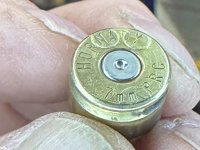
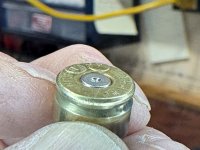
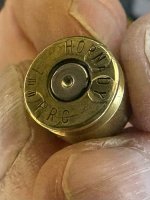
- primer shows zero signs of pressure deformation
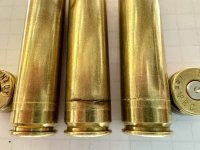
- classic case head separation lines immediately above the case web
- massive ejector flow
- large dent shape immediately below the shoulder

My current belief is this is a result of too much shoulder set-back (too much headspace) and not enough pressure to seal the neck of the case in the chamber.
 
Is there no documentation as to find out who the shooter was ?? Private club or Gub'ment ?? Either way, one would think that there would be some kind of range booking appointment / sign in sheet.

**ie**... At our rifle / pistol club, when you sign in with your start time, and membership number, you also have to log in what calibers (guns) you will be shooting at the time. Sign out requires the time and range condition (cleaned up)

Just me...Thinking along the lines of someone being able to find who it was... and perhaps talking to them., getting the details, and perhaps...saving them a catastrophic failure...or WORSE !
We do have a sign in book. Only thing recorded is the name and membership number and the time arrived at the range as well as which bays you will be shooting at. No sign out process. No calibre log. Difficult to determine when this event happened. Not everyone pays attention as to what shape the brass is when thrown into the brass bucket. It is concerning as TJ mentions. I don't want to be the one shooting next to hime if and when the gun fails, or be the one that arrives at the range to find his carcass laying on the firing line.
 
- primer shows zero signs of pressure deformation
- classic case head separation lines immediately above the case web
- massive ejector flow
- large dent shape immediately below the shoulder

My current belief is this is a result of too much shoulder set-back (too much headspace) and not enough pressure to seal the neck of the case in the chamber.
That's my take as well is that this event is caused purely by bad headspace. The overpressure needed to stretch a properly headspaced case would by necessity also stretch the action the same amount. That would only happen once because Kaboom.
 
Last edited:
Dents such as in the pics here get caused by an under loaded case, basically not enough powder .
Case head seperation is pretty cmmon as well, too much resizing is the main cause.
Ejector marks ? Too much pressure is also a common problem.
My take on this is that the reloader in question should take some lessons from someone experienced and safe before they have a catastrophic failure.
Cat
I know what your saying but it doesn't add up, presumably he used old cases that were on the verge of separating and loaded a low pressure round that produced shoulder dents but that doesn't explain the ejector marks and separation.
I agree, he needs to take a large step back and rethink what he is doing.
 
I know what your saying but it doesn't add up, presumably he used old cases that were on the verge of separating and loaded a low pressure round that produced shoulder dents but that doesn't explain the ejector marks and separation.
I agree, he needs to take a large step back and rethink what he is doing.
Those ejector marks may have been made previously on too hot a load, then the cases resized and too little powder used .
Without the details , who knows!😁
 
Last edited:
Dents such as in the pics here get caused by an under loaded case, basically not enough powder .
Case head seperation is pretty cmmon as well, too much resizing is the main cause.
Ejector marks ? Too much pressure is also a common problem.
My take on this is that the reloader in question should take some lessons from someone experienced and safe before they have a catastrophic failure.
Cat
Terrible Reloader ! šŸ™ˆšŸ˜±
 
Well we'll never know for sure what the load was.?
Shooters using a reference to hydraulic pressure certainly indicates someone spending too much time on utube.
Hydraulic pressure has nothing to do with firing a shell in a chamber, we are dealing with gas pressures.
Enjoy.
 
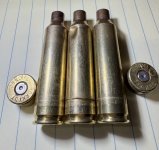
Interesting (and confusing) find in the brass pail at the range. I’m not sure I can explain what I’m seeing but maybe someone here can.

Approximately 20 rounds of reloaded 7PRC (some cases were marked with felt pen with the load recipe) were found in the brass pail. I couldn’t read all the writing on the cases but I read 175gr ELD-X and 180 gr M. The powder charges read 64.3, 64.0 (or possibly 69.0), 69.5 and 70.0gr. I couldn’t see powder type. One case was found with Fierce written on it. I presume that might be the rifle they were shot from.

All cases looked to be fired…based on the soot marks. All but 2 rounds had complete head separations and the 2 that weren’t separated were literally hanging on by a thread. All rounds, including the 2 unseperated, have severe ā€œdentsā€ in the case near the body/shoulder junction. The two remaining case heads had severe pressure signs (one missing a primer the other flattened real bad). Also both remaining heads had brass flow into the ejector hole. I didn’t find any of the separated heads. The only case heads I found were the two attached.

It certainly appears like the rounds were fired and were severely over pressured. Maybe a bad head spacing issue?/

All dents are smooth on the surface like they might be caused by hydraulic pressure from the outside. I’ve been reloading for many years but never experienced case head separation. Could those dents be caused by gas from the separated case head getting trapped between the case and the bolt/action. Then, once the pressure inside the case dissipated, the case collapsed.

What else could cause the denting?

Assuming all the brass failed during firing…
How would someone eject those failed rounds?
I wonder what the bolt and action of the rifle would look like after this kind of abuse!
I wonder what the experience level/IQ of the shooter/reloader might be?

Again, I can see one case head failure, maybe two…but 20…it seems inconceivable!
I'm curious... Could a 7mm PRC be fired in a 300 PRC? I would be interested to know the case neck diameter on those cases.
 
Back
Top Bottom