Cased Colt

jpc

CGN Ultra frequent flyer
Rating - 100%
692   0   0
1849 31 caliber born in 1855

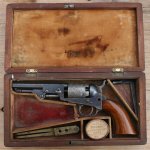
I became the happy owner of a cased 1849 and it has me puzzled. The previous owner of 35-40 years cannot remember where it came from or the details of the revolver.
It appears to have been seldom fired, but has suffered from handling and played with over the years. The hammer screw is sheared off about half way.
All numbers are matching including the cylinder. It looks like the case took most of the beating for the last 165 years
She has a two line New York address and was born in 1855.
Mould is Colt marked. Nipple wrench is not.

The mystery to me is the Cylinder is in the White.
Figure it must have gone through a chemical cleaning at some time
Any suggestions or theories ?

take care

jpc

Colt 1849 033.jpg
 

Attachments

  • Colt 1849 033.jpg
    Colt 1849 033.jpg
    103 KB · Views: 314
Nice find!
Given the amount of original finish remaining everywhere but the cylinder, someone must have stripped it for some reason. Cleaned it with vinegar or some such.
Are you going to try to remove the remains of the hammer screw or just let it be?
 
Nice find!
Given the amount of original finish remaining everywhere but the cylinder, someone must have stripped it for some reason. Cleaned it with vinegar or some such.
Are you going to try to remove the remains of the hammer screw or just let it be?

Remove--I will give it a try. Haven't had her apart as of yet to see what I am up against.
Maybe only option will be drill and easy-out.
What do you think?
 
If the screw snapped because the threads were frozen, it could get interesting. I'd give it a good long soak in Kroil as a first step. Maybe see if a little punch applied to the exposed end might move it. Drilling it out might be the final option.
Or, if there is enough screw is left for the hammer to operate, just install a cosmetic screw head to fill the hole, for appearance's sake.
 
Common drug store Iodine is the best rust loosener I have ever used. a couple droplets on the exposed/open end a couple hrs before trying to remove will help your job. I'm with the others that suggest that a drill-out & easy out will be the only way to get the remaining screw piece out.

I am in the midst of rebuilding a 1881 Colts SAA at the moment that was in much worse condition than yours appears so I know what your going through with the "what do I do Next" type of thing.

That is a small dia screw to be drilling with the precision required to not damage the threads in the pistol frame...not something to be attempted with a hand drill. Might I suggest that, if you don't have a milling machine available to you that you take it to a machine shop so that the hole can be drilled absolutely "centered" in the screw.
 
Common drug store Iodine is the best rust loosener I have ever used. a couple droplets on the exposed/open end a couple hrs before trying to remove will help your job. I'm with the others that suggest that a drill-out & easy out will be the only way to get the remaining screw piece out.

I am in the midst of rebuilding a 1881 Colts SAA at the moment that was in much worse condition than yours appears so I know what your going through with the "what do I do Next" type of thing.

That is a small dia screw to be drilling with the precision required to not damage the threads in the pistol frame...not something to be attempted with a hand drill. Might I suggest that, if you don't have a milling machine available to you that you take it to a machine shop so that the hole can be drilled absolutely "centered" in the screw.

I'm gonna catch your 6 on the iodine... bro-in-law used to use it to free seized diesel engines.
 
I have drilled out many screws. Sometimes it is best not to drill dead center. Drill off-center with an undersized drill, then open the hole in gradual stages using slightly larger drill bits, until one edge of the hole almost touches the edge. Then collapse the end of the screw. Done carefully, the female threads will be untouched, and there will be no need to pick out remains of threads or clean out the hole with a tap.
As it happens, in this particular case, the broken screw is seized in the hammer, and is moving in the threads.
 
Beautiful piece JPC you sure find some great ones.

Re: the cylinder in the white I'll second a comment made shortly after you posted, that it could be from cleaning with vinegar. I stupidly dropped a cylinder from a BP revolver into a vinegar solution (I don't recall if it was brilliant idea I had at the time, or literally grabbed the wrong jar) to clean it, letting it soak for an hour or so - it came out perfectly in the white, very much like that one.

NCBB
 
Back
Top Bottom