Circle with CEF over 15 is 15th Bn. CEF, 48th Highlanders of Toronto. But information that I have found indicates that the 15th Bn. exchanged their Rosses for SMLEs on the 15th of June 1915. My 15th Bn. Mk.III rifle was subsequently reissued to 19th Bn., Lincoln and Welland.













































You are using an out of date browser. It may not display this or other websites correctly.
You should upgrade or use an alternative browser.
You should upgrade or use an alternative browser.
CGN's shooting the Ross
- Thread starter x westie
- Start date
Here's a pic of mine. 1916 M10. Bore is mint. I also have a bayonet for it. Very accurate and it just loves cast bullets. Jeese those triggers sure are sweet aren't theyMine has GWVA stamped onto the stock, anyone know what that stands for? Just guessing, but could it be Great War Veterans Association?
Thanks for showing us CGN's a photo of your Ross...beautiful rifle....lots of history there........often wonder with todays engineering and CNC lathes the Ross could have been made more reliable and not have the reputation it still has of jamming in rapid fire....would love to see that bolt work....!!!

Hi-Standard
CGN frequent flyer
- Location
- Republic of Newfoundland
Thanks for showing us CGN's a photo of your Ross...beautiful rifle....lots of history there........often wonder with todays engineering and CNC lathes the Ross could have been made more reliable and not have the reputation it still has of jamming in rapid fire....would love to see that bolt work....!!!
With properly sized ammunition and rifle keeped relativly clean, the Ross's wouldn't jamb. It's only due to the fact that the issued Ross had correct 303 British chamber dimentions which didn't allow for dirty or incorrect size ammunition which caused the problems in the first place x westie. Later on most of the Ross's had their chambers reamed out oversized like the SMLE's, but by that time the damage was done and nobody wanted to shoot them anymore. They had also cured the bolt head misalignment problem as well on a lot of the rifles, but again all too late. It's a shame really, they were and are still beautiful rifles. Accurate, extremely strong action, smooth cycling, well made, albeit a little heavy. Although a P-14 isn't exactly a light weight rifle either

PerversPépère
CGN Ultra frequent flyer
- Location
- Shawinigan (Quebec)
I was thinking a sporterized M10 (no chance of restoring) would make an excellent rifle for the Burns Lake 1000 yard shoot here in BC.
If I could find one with a really good barrel it might be a good candidate for a conversion to 303 Epps. I think I could scare a few people, especially with iron sites
Anyone know how much a ream job would cost?
Don't you ever do this: converting the M-10 to .303 Epps almost guarantees you of a single-shot only rifle
! It changes the feed angle and reshaping the spring steel guiding fingers is a very risky proposition.PP.

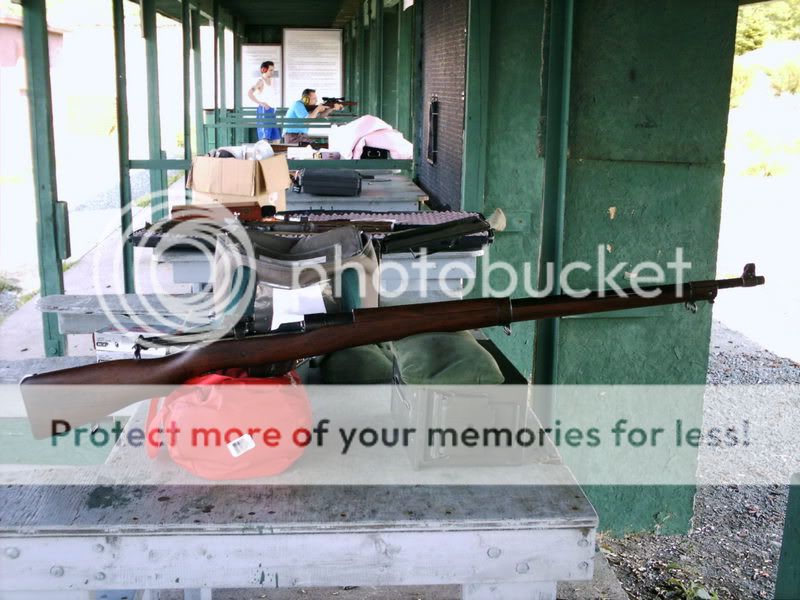
This thread motivated me to take a couple of M-10s to the range today.
I was shooting South African Surplus ammunition.
Here is a target at 50 yards. I know it's not very far but this particular 1916Ross has a pitted bore and I wanted to see what it would do before I wasted a bunch of ammunition. I was surprised to say the least. The target is on the table.
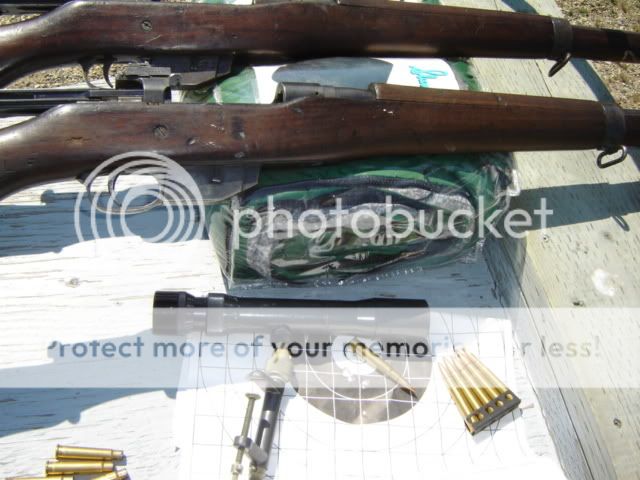
Next up, the 1918 Ross at 50 yards.
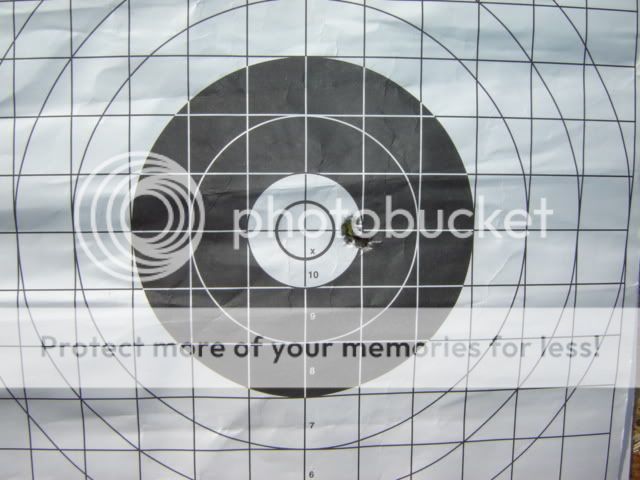
10 shots in 1 minute at 100 yards. The chargers don't load as slickly as they do in an Enfield but they work. No feeding issues, brisk ejectionand a nice triggers, can't really ask for much more. I need more practice.
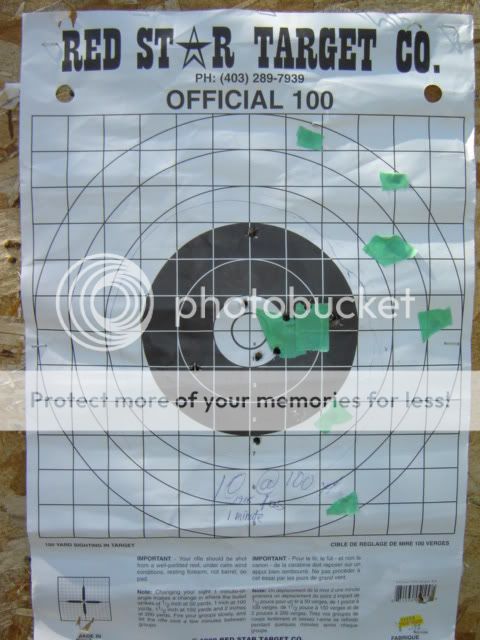
One more view of the pair.
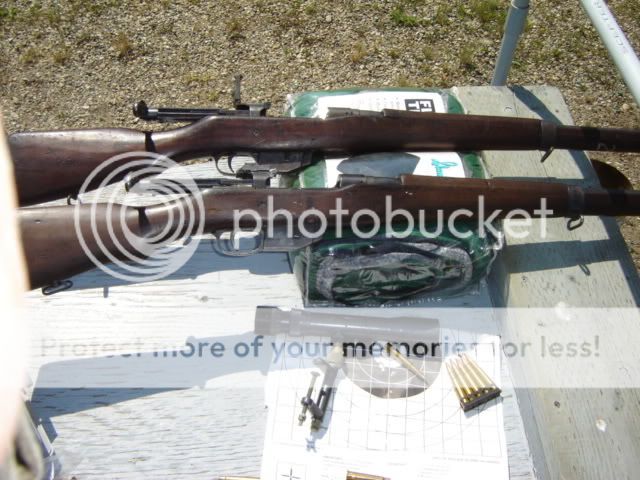
I was shooting South African Surplus ammunition.
Here is a target at 50 yards. I know it's not very far but this particular 1916Ross has a pitted bore and I wanted to see what it would do before I wasted a bunch of ammunition. I was surprised to say the least. The target is on the table.
Next up, the 1918 Ross at 50 yards.
10 shots in 1 minute at 100 yards. The chargers don't load as slickly as they do in an Enfield but they work. No feeding issues, brisk ejectionand a nice triggers, can't really ask for much more. I need more practice.
One more view of the pair.

http://s185.photobucket.com/albums/x287/skullyfmp/?action=view¤t=IM000957.jpg
http://s185.photobucket.com/albums/x287/skullyfmp/?action=view¤t=IM000947.jpg
My Ross collection .
My grandfather trained with a Ross prior to receiving his SMLE . He gave them a good name . He served with The Royal Newfoundland Regiment in WW1 .He was a Blue Puttee ( one of the first 500 ) . They were all but wiped out at Beaumont Hamel on July 1st 1916 . He was one of the fortunate 68 that answered role call next day .
Nice lookin' guns! That must have been one very subdude roll call. People these days just can't imagine that kind of loss and what it meant to communities.
Pete
Yeah, the Newfies got shot to Hell at Beaumont-Hamel......
they rebuilt the regiment and went in at Gueudecourt and got shot up badly again....
so they rebuilt the regiment and went in at Sailley and that wasn't a massacre, but it was quite bad enough.....
and then they rebuilt again and went in again at Monchy-le-Prueux....
and there is practically nothing taught in our schools. And Canada sends out fireworks for people to celebrate on July 1..... which is Memorial Day in Newfoundland. My old friend Jack Snow in Lewisporte did all he could to keep the Memorial Day tradition alive. I helped during the years I was running the newspaper.
But in Canada, nothing is known, and almost nobody gives a dam.
Typical.
they rebuilt the regiment and went in at Gueudecourt and got shot up badly again....
so they rebuilt the regiment and went in at Sailley and that wasn't a massacre, but it was quite bad enough.....
and then they rebuilt again and went in again at Monchy-le-Prueux....
and there is practically nothing taught in our schools. And Canada sends out fireworks for people to celebrate on July 1..... which is Memorial Day in Newfoundland. My old friend Jack Snow in Lewisporte did all he could to keep the Memorial Day tradition alive. I helped during the years I was running the newspaper.
But in Canada, nothing is known, and almost nobody gives a dam.
Typical.
Unaltered Rosses are not often encountered. Ones with fine bores are even less common. Like everything else, prices have been increasing. An intact Mk. III will likely be priced between $400 and $1000, depending. Really nice ones are very scarce. Sported Mk. IIIs with decent bores turn up regularly, and usually sell in the $100 to $250 range. These can be great shooters. Civilian sporters and Mk. II** target rifles will usually be in better condition.


Touching story...
...My grand father worked at the Ross plant located on the Plains of Abraham in Québec City...never got the full story of what he did exactly...all I remember is that he had a lots of gages anf tools...
I believe that all the archival documentation on the Québec City plant burned down so little is left except a few pictures...There is a great book on the Ross story with reports and all...
My M10 stock (sportarised) is marked HG...Home Guard!? I shot with it a couple of time and was amazed with the accuracy...I should do it again...
Cheers
J
My Ross collection .
My grandfather trained with a Ross prior to receiving his SMLE . He gave them a good name . He served with The Royal Newfoundland Regiment in WW1 .He was a Blue Puttee ( one of the first 500 ) . They were all but wiped out at Beaumont Hamel on July 1st 1916 . He was one of the fortunate 68 that answered role call the next day .
...My grand father worked at the Ross plant located on the Plains of Abraham in Québec City...never got the full story of what he did exactly...all I remember is that he had a lots of gages anf tools...
I believe that all the archival documentation on the Québec City plant burned down so little is left except a few pictures...There is a great book on the Ross story with reports and all...
My M10 stock (sportarised) is marked HG...Home Guard!? I shot with it a couple of time and was amazed with the accuracy...I should do it again...
Cheers
J
HG plus a number? Does it have a HG plus a number serial on the left side of the barrel breech? Is the aperture in the rear sight windage slide very small? Could be Cdn WWI Home Guard. The HG rifles were purchased 1914/15 for the Home Guard use. They do not have the markings found on all standard issue Mk. III rifles - the Quebec roundel, number + letter suffix + date serial on the butt. The Savage 1899 muskets acquired by the Montreal Home Guard are another example of a HG rifle.
Hg
You are right, HG stamped on the right side of butt and on left side of barrel just before the serial number...no other marking on the butt...the iron butt plate has a brass trap door for the oiler...
Aperture sight hole is of good size...not a tiny hole.
HG plus a number? Does it have a HG plus a number serial on the left side of the barrel breech? Is the aperture in the rear sight windage slide very small? Could be Cdn WWI Home Guard. The HG rifles were purchased 1914/15 for the Home Guard use. They do not have the markings found on all standard issue Mk. III rifles - the Quebec roundel, number + letter suffix + date serial on the butt. The Savage 1899 muskets acquired by the Montreal Home Guard are another example of a HG rifle.
You are right, HG stamped on the right side of butt and on left side of barrel just before the serial number...no other marking on the butt...the iron butt plate has a brass trap door for the oiler...
Aperture sight hole is of good size...not a tiny hole.
Yes, that's a Canadian Home Guard rifle. There is not a lot of information about the HG. Mine is HG 100 on the butt, which I assume is a unit marking. I've talked to a chap whose HG rifle was from a Toronto Police Force HG unit. The small hole rear sights were the earliest production of Mk.III rifles. I am assuming that these rifles were retained by the HG members after the HG was disbanded. I do not know if they were purchased using gov't funds, public subscription, or private purchase. The way they are serialed on the barrel suggests that they were processed by the factory in the same manner as commercial sporting rifles. I've never heard of one with marks indicating susequent gov't issue, although anything is possible.
Hey there, people- let's try to get the Ross model designations correct, so we're all on the same page. Particularly bad with the last ones with "M1910" or "M-10" on the receiver rings. The same basic receiver was used for six or seven different models. If we're talking Military:- MkI (1903) MkII (1905) and Mk III (1910). The corresponding Commercial models:- 1903 Sporters, then three different 1905 Sporters:-1905R(Vanilla .303) 1905M (.303 and very scarce) and 1905E (.303 and 35WCF) High grade rifle to the same standard as a 1907 Scotch Deerstalker in .280 only.Finally, the 1910 series of Sporters:- R-10 (vanilla, .303 and no checkering) E-10 (wood as the M-10, but in .303 and .35 WCF) and the top of the line M-10, chambered in .280 only.The .22rf 1912 Cadets came as Military and Commercial- Military usually show stock markings and a matt walnut, Commercials have a serial up on the barrel and a much better stock finish.
For anyone interested, a stockmaker in Pennsylvania was loaned pattern stocks for a Cadet, a short Military MkII***, a Military MkIII and a .280 M-10 Sporter, and for a fair price, will produce a really decent 98% complete stock for you.At this time, I'm pretty sure these can still be imported into Canada. Contact me off-forum for contact assistance, if interested. I do have most all Ross spares here in Dixie, but will not consider returning any back to Canada.
For anyone interested, a stockmaker in Pennsylvania was loaned pattern stocks for a Cadet, a short Military MkII***, a Military MkIII and a .280 M-10 Sporter, and for a fair price, will produce a really decent 98% complete stock for you.At this time, I'm pretty sure these can still be imported into Canada. Contact me off-forum for contact assistance, if interested. I do have most all Ross spares here in Dixie, but will not consider returning any back to Canada.

Wooo got my Ross fixed Jason at Gunco got the rear screw out in about a minute and a half... then i found out my replacement one from Numrich was shorter and a finer thread pitch. Luckily he had one that fit!
Can't wait to take her to the range Now all I need is the front sight hood and screws and a proper sling.
Jason at Gunco got the rear screw out in about a minute and a half... then i found out my replacement one from Numrich was shorter and a finer thread pitch. Luckily he had one that fit! Can't wait to take her to the range
Now all I need is the front sight hood and screws and a proper sling.The Ross has got a bad rep because they are no good when they are hot. Ten years ago, another fella and myself entered the CFB Shilo summertime "2-Man Iron Sight" match.
Targets were said to be out to 400 yards, but Shilo ALWAYS changes something at the last minute, just so nobody can practise up: keeps everybody on an even keel, makes for a really terrific shoot each and every time. When we got there, targets were from 85 YARDS out to 550 METRES, with the 550-,etre target hiding behind a bush and half-concealed.
We were shooting a pair of 1910 Rosses, one my Chilean Navy rifle (DA-426) and the other a Bubba'd 1910 long rifle with the original 30-inch barrel uncut. We were shooting against AKs, RPKs, Minimis, C7s, M-1 rifles, 98 Mausers, LEs (of course)..... but we were the ONLY team shooting TWO bolt rifles. Out of 23 teams, we came in in 10th place.
We had zero failures to feed, zero failures to extract, zero failures to eject. Not only that but neither rifle blew up, neither bolt blew back. We went through a total of 76 rounds of ammunition in 8 minutes and both rifles were HOT when they came off the line. We had no problems.
The only failures due to heat that I heard of with Rosses were not really failures, but, rather, precautions against burning the hands of the shooters. At St. Julien, during the Second Ypres battles, A Coy of 8th Battalion went up through the gas and p;lugged the Line. I knew two men who were there, Pte. Alex McBain and L/Cpl Robert Courtice. Both me told me that they changed rifles during the rifle-battle phase of the engagement, as both their rifles had got so hot from being shot, that they could not longer be loaded without inflicting serious burns on the hands of the shooters. Both men picked up a Ross from a casualty and fired it until it was too hot to hold, then picked up their original rifles and kept shooting. They had NO problems. Pte. McBain, who was 83 and still suffering from gas when I knew him, got plain darned IRATE and started shouting when I asked if they had had any problems with their rifles. One might say that he was rather emphatic.
I don't think there are any issues with Ross Rifles and heat, and any such are legends, likely originally started by Conservatives who hated Sam Hughes.
Targets were said to be out to 400 yards, but Shilo ALWAYS changes something at the last minute, just so nobody can practise up: keeps everybody on an even keel, makes for a really terrific shoot each and every time. When we got there, targets were from 85 YARDS out to 550 METRES, with the 550-,etre target hiding behind a bush and half-concealed.
We were shooting a pair of 1910 Rosses, one my Chilean Navy rifle (DA-426) and the other a Bubba'd 1910 long rifle with the original 30-inch barrel uncut. We were shooting against AKs, RPKs, Minimis, C7s, M-1 rifles, 98 Mausers, LEs (of course)..... but we were the ONLY team shooting TWO bolt rifles. Out of 23 teams, we came in in 10th place.
We had zero failures to feed, zero failures to extract, zero failures to eject. Not only that but neither rifle blew up, neither bolt blew back. We went through a total of 76 rounds of ammunition in 8 minutes and both rifles were HOT when they came off the line. We had no problems.
The only failures due to heat that I heard of with Rosses were not really failures, but, rather, precautions against burning the hands of the shooters. At St. Julien, during the Second Ypres battles, A Coy of 8th Battalion went up through the gas and p;lugged the Line. I knew two men who were there, Pte. Alex McBain and L/Cpl Robert Courtice. Both me told me that they changed rifles during the rifle-battle phase of the engagement, as both their rifles had got so hot from being shot, that they could not longer be loaded without inflicting serious burns on the hands of the shooters. Both men picked up a Ross from a casualty and fired it until it was too hot to hold, then picked up their original rifles and kept shooting. They had NO problems. Pte. McBain, who was 83 and still suffering from gas when I knew him, got plain darned IRATE and started shouting when I asked if they had had any problems with their rifles. One might say that he was rather emphatic.
I don't think there are any issues with Ross Rifles and heat, and any such are legends, likely originally started by Conservatives who hated Sam Hughes.

Hi Smellie.
Regarding the following quote...
"I don't think there are any issues with Ross Rifles and heat, and any such are legends, likely originally started by Conservatives who hated Sam Hughes."
I guess that I own a legend then , Just joshing about the comment but respectfully letting you know that I have a lovely sporterized Ross that displays this heat locking attribute perfectly. After about 9 shots in fairly quick succession the bolt instantly becomes very tight and following the 10th or 11th shot, locks up solid. Now possibly if I were to stomp on it with a gov't issue size 12 or pound it with a trenching shovel it may release, but that is not about to happen as I truly do like the old girl. Just putting it in the rack for 15 -20 minutes allows it to cool, and it once again cycles smooth as a buttered turd.
As mentioned in posts before, it is my understanding that the deformation of the bolt lugs due to impact forces at the rear bolt stop is the culprit. Later made guns I have been told had slightly larger stops which somewhat cured this issue. Also I suspect that some rifles possibly were less prone to this due to production variances and that some were treated easier by their users...ie smoother bolt cycling rather than jerking it back to the stop as hard as possible. Thus your aquaintence's good reflection on Ross'. Also note that my rifle is extremely clean and that this issue occurs with tailor made rounds as well as handloads with brass ranging from Dominion, to match quality Norma. I'm definitely not going to try to fix this issue as it is a nice example of the flaw.
Other than that, the rifle shoots wonderfully and besides my Mom gave it to me for Christmas years ago.
Cheers
Jaguar
Regarding the following quote...
"I don't think there are any issues with Ross Rifles and heat, and any such are legends, likely originally started by Conservatives who hated Sam Hughes."
I guess that I own a legend then
, Just joshing about the comment but respectfully letting you know that I have a lovely sporterized Ross that displays this heat locking attribute perfectly. After about 9 shots in fairly quick succession the bolt instantly becomes very tight and following the 10th or 11th shot, locks up solid. Now possibly if I were to stomp on it with a gov't issue size 12 or pound it with a trenching shovel it may release, but that is not about to happen as I truly do like the old girl. Just putting it in the rack for 15 -20 minutes allows it to cool, and it once again cycles smooth as a buttered turd. As mentioned in posts before, it is my understanding that the deformation of the bolt lugs due to impact forces at the rear bolt stop is the culprit. Later made guns I have been told had slightly larger stops which somewhat cured this issue. Also I suspect that some rifles possibly were less prone to this due to production variances and that some were treated easier by their users...ie smoother bolt cycling rather than jerking it back to the stop as hard as possible. Thus your aquaintence's good reflection on Ross'. Also note that my rifle is extremely clean and that this issue occurs with tailor made rounds as well as handloads with brass ranging from Dominion, to match quality Norma. I'm definitely not going to try to fix this issue as it is a nice example of the flaw.
Other than that, the rifle shoots wonderfully and besides my Mom gave it to me for Christmas years ago.
Cheers
Jaguar






















