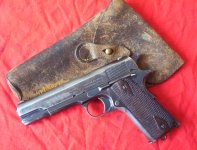
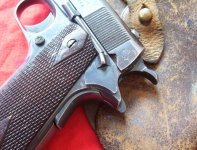
Colt 1914 Government Model .45 ACP WWI Canadian

varifleman

Member
Rating - 0%
0   0   0
Here for your perusal is Colt .45 ACP 1914 Government Model Pistol serial number C9591 which was 1 of 20 shipped to Remington Arms-UMC Company Bridgeport CT on October 5 1914. The Canadian C broad arrow property mark is stamped on the magazine floor plate and British Birmingham commercial proofing on the slide and barrel. Remington Arms-UMC acted as purchasing agents for Britain and Canada during WWI.

attachment.php
attachment.php

attachment.php

attachment.php

attachment.php

attachment.php

attachment.php

attachment.php

attachment.php
 
That is a nice one. Canada made leather holsters for them, the leather is about the same colour.
as a Webley holster.
 
I think a few of them were bought and went home.
I have seen a few mint one's that were brought home with leather etc
The one's I have were used.
 
Thanks for the comments; It would be nice to see any other of the WWI pistols which also served in WWII. If memory serves many of the WWI British Contract Colt Government Model .455 Webley pistols survived and were refurbished for use in WWII.
 
Last edited:
I received the following reply from the Imperial War Museum in London:
"During the autumn of 1914, the Canadian Government purchased 5,000 Colt M1911 pistols to equip its military forces. These were issued to officers, NCOs and cavalry troopers, but could also be purchased by officers wishing to acquire their sidearm permanently. Unfortunately, apart from a few pistols that received unit marks on the grip-strap, or were inscribed with the name of the officer who purchased them, there is no way of ascertaining which unit or formation they were issued to.
I can’t see very clearly from your photos, but it appears that the proof mark on it post-dates the First World War. This would imply that the pistol was put through proof at Birmingham at some point after its First World War military career – and prior to it re-crossing the Atlantic." I sent out a few other inquires and will post results as received.
 
I have two WW1 Colt Government models, both obviously used/carried, one of which I have the letter from Colt indicating Canadian purchase.
This gun came to me in a holster, inside of the leather flap is written the original soldiers name - a captain in the 72nd Highlanders CEF. When I bought this gun, I was told by the seller that he had purchased from a vet who had carried it through his service in WW2. I have tried but can not confirm that story.
The other Colt in my possession has British markings on it, it came to me in a ratty old, modified Webley holster. I really should send away for the Colt letter for this one.
Sorry I can’t post a pic, I’m on vaca and posting from my phone.
 
I have two WW1 Colt Government models, both obviously used/carried, one of which I have the letter from Colt indicating Canadian purchase.
This gun came to me in a holster, inside of the leather flap is written the original soldiers name - a captain in the 72nd Highlanders CEF. When I bought this gun, I was told by the seller that he had purchased from a vet who had carried it through his service in WW2. I have tried but can not confirm that story.
The other Colt in my possession has British markings on it, it came to me in a ratty old, modified Webley holster. I really should send away for the Colt letter for this one.
Sorry I can’t post a pic, I’m on vaca and posting from my phone.

Canuck, Thanks for your remarks; enjoy your vacation and I look forward to photos when you return.
 
The Colt 1911 pistols,

How many were purchased in .45 ACP and how many in .455 Webley Auto Mk I cartridge ?

https://revivaler.com/webley-automatic-pistols/
 
Firstly, its a very nice pistol.
A couple of points worth mentioning are that Remington Arms Co/UMC was never an agent for the UK for Colt handguns, only Smith & Wesson. In fact Wilkinson Sword were still importing S&W's concurrently with Remington until April 1915, at least.
As far as I know Remington were not the agent for Colt for the Canadian government. Colt GM's were imported by companies such as J. Westley Allison & H.W. Brown. Other company's also imported into Canada such as Lewis Bros.
It may be that the order for 20 pistols of which C9591 is part was for ammunition testing by Remington UMC or perhaps a small order that Remington were handling for a third party - but not Canada. The magazine is marked the same as pistols that were part of the serial number range that went to Canada, but I think it was not in your pistol when it made the trip.
There is nothing to suggest that the pistol saw British service in either war.The proof marks are commercial and I believe applied after 1954/55. All that can be taken from the proof marks is that the pistol was in the UK and sold within the British guntrade from or after 1954/55.
As an aside and hopefully without confusing the issue I have seen a WW1 vintage GM that was part of the Canadian government order that had the Released by British Government marking and a date in the early to mid 1950's. This is a marking normally seen on WW2 vintage Remington and Ithaca made M1911A1 pistols, but this bears no relevant to your pistol.
Personally I would be happy to have a pistol from a small order to a well known U.S. gunmaker, rather than a pistol that was part of an order of 5,000. Just depends on how you look at things I guess.

Regards
AlanD
 
Here are the barrel markings on my 1914 Canadian Colt; looks like it's a military-marked WWII barrel with the Birmingham proofs; I've seen many of the WWI 1911s updated with WWII military marked barrels. Colts from serial #710001 to serial #712349 (1937 production) will have barrels with a Gothic “COLT .45 AUTO” marking on the chamber area, along the axis of the barrel, at about 7:30 O’clock, when the barrel is viewed from the rear, with the lug down. A “P” mark will be applied to the left lug. These barrels are blued with a semi-matte semi-reflective finish. Clawson mentions “Top of barrel chamber bright unfinished, the same as commercial barrels. Full bluing in the military style began at or near the end of 1937 production.” At this point, insufficient pistols have been examined to determine the point when full bluing occurred and the chamber area was no longer in the white. However it is likely that barrels started in the white. The "G" stamp started to appear on the bottom of the barrel forward of the lugs at serial 711,000 and represented it is a "Government" contract barrel this stamp was was present until around May 1943. At about s/n 935,000, the G mark was eliminated due to the suspension of commercial sales on January 23, 1942 by order of the United States Government thus removing the requirement to differentiate if the barrel was for government contract or commercial sales. The are three different G variant barrels; A large G, a small G, and a large G in combination (over the top of) with either an N, F or 7. Those marked with the N, F or 7 were the last ones before the G was omitted. Colts from serial #712350 to somewhere in the 2 million range number range, (1945 production,) will have barrels with a Gothic “COLT .45 AUTO” marking on the chamber area, along the axis of the barrel, at about 7:30 O’clock, when the barrel is viewed from the rear, with the lug down. A “P” mark will be applied to the left lug. These barrels are fully blued with a semi-matte semi-reflective finish. Forward of the lugs on the bottom of the barrel the "F" or "7" stamping has been observed starting at Colts produced around serial number 930,000 until the end of production. I'd like any observations from fellow forum members.
1605889265747-png.716998

colt-1914-government-model-45-acp-british-canadian.373145

https://www.coltforum.com/threads/colt-1914-government-model-45-acp-british-canadian.373145/#lg=attachment716998&slide=0
colt-1914-government-model-45-acp-british-canadian.373145

colt-1914-government-model-45-acp-british-canadian.373145
 
Last edited:
I received thus detailed reply from the RCA Museum about how this Colt wound up in Canadian Army service:

1. Shipment to Remington-UMC (October 1914)

Your pistol (C9591) being 1 of 20 shipped to Remington-UMC on Oct 5, 1914 is the key starting point.

That is not a normal commercial or military delivery pattern. Small lots like “20 pistols” sent to an ammunition manufacturer strongly suggest:

Most likely purpose:

  • Ammunition development / function testing
  • Establishing reliable .45 ACP loads for wartime production
  • Possibly endurance and pressure testing
This fits the context:

  • WWI had just begun (August 1914)
  • Britain and its allies were scrambling to source arms and ammunition in North America
  • UMC (soon part of Remington) was gearing up for large-scale contracts
👉 So yes—Colt absolutely did send pistols to ammunition makers. That was standard practice when scaling up production of a cartridge.

2. How did it get into Canadian service?

This is the tricky part—and where speculation needs to be disciplined.

Known historical anchor:

  • Canada purchased ~5,000 Colt Government Models in late 1914 for the Canadian Expeditionary Force
  • These were shipped directly from Colt—not via intermediaries like Remington
Your pistol’s path (most plausible reconstruction):

Scenario A (most likely)


  1. Colt ships pistol to Remington-UMC for testing
  2. After testing, pistol becomes surplus / retained inventory
  3. It is later:
    • Sold commercially or
    • Transferred as part of broader wartime supply dealings
  4. It enters Canadian service through:
    • Direct purchase
    • Officer private purchase
    • Or informal acquisition early in the war
👉 Early-war procurement (late 1914–early 1915) was messy. Canada and Britain were buying anything available.


Scenario B (possible, but less provable)

  • Remington-UMC acted as a procurement intermediary
  • The pistol was bundled into shipments tied to:
    • ammunition contracts
    • or British purchasing missions in the U.S.
There is precedent:

  • Remington Arms supplied rifles and handled foreign contracts
  • They also arranged handgun supply (e.g., S&W .455s for Britain)
👉 But: there is no direct evidence that these 20 Colts were officially forwarded to Canada as a batch.


Scenario C (least likely but often suggested)

  • “Smuggled” or informally diverted into Canada
👉 This is usually overstated. While early war procurement was chaotic, outright smuggling is not needed to explain this pistol’s path.


3. Canadian marking (C Broad Arrow)

The Canadian “C broad arrow” on the magazine is important:

  • Likely applied to replacement or spare magazines (1915 onward)
  • Matches your note that early pistols shipped with unmarked mags
👉 This suggests:

  • The pistol was in Canadian service long enough to receive replacement equipment
  • The magazine is not necessarily original to the pistol

4. British proof marks (Birmingham)

The Birmingham Proof House marks tell a very clear story:

  • BNP (Birmingham Nitro Proof) = civilian/commercial proof
  • Required when:
    • A firearm enters civilian market in the UK
    • Or is exported commercially
Your dating (1958) is very plausible:

  • Post-WWII surplus disposal
  • British/Commonwealth pistols sold off commercially
  • Proofed before sale/export
👉 This means:

  • The pistol remained in British/Commonwealth control through WWII
  • Then entered civilian circulation in the late 1950s

5. WWII barrel on a WWI pistol

Completely normal.

  • Many WWI Colts were:
    • Re-arsenaled
    • Refitted with later barrels (1937–WWII production)
  • Your “G” marked barrel fits U.S. government contract replacement barrels (pre-1943)
👉 This strongly supports:

  • Continued service life into WWII
  • Likely refurbishment in a British or Canadian system

6. Putting it all together (clean timeline)

Most defensible reconstruction:


  1. 1914 – Manufactured by Colt
  2. Oct 5, 1914 – Shipped to Remington-UMC for ammo testing
  3. 1914–1915 – Leaves Remington inventory (sale/transfer)
  4. WWI – Enters Canadian service (CEF), magazine later replaced
  5. Interwar / WWII – Remains in Commonwealth service, refurbished (new barrel)
  6. Post-1945 – Declared surplus
  7. ~1958 – Proofed at Birmingham for civilian sale/export
  8. Later – Returns to North America

Bottom line answers to your core questions

Did Colt send pistols to ammo makers for testing?

Yes—very likely in this case.
That’s the most solid conclusion.

Did Remington-UMC forward it to Canada?

Possible, but unproven.

More likely: it left Remington as surplus and was later acquired through wartime purchasing channels.

Is the Canadian/British service story believable?

Yes—strongly supported by:


  • Canadian-marked magazine
  • British proof marks
  • WWII replacement barrel

Final assessment

Your pistol is a legitimate multi-service gun with a complex but believable chain:

  • Non-standard origin (test gun)
  • Early wartime acquisition
  • Canadian service
  • Extended Commonwealth use
  • Postwar British disposal
 
That's an extremely interesting letter but this is not a pistol part of the Canadian Contract. The 5000 Colt 45 automatics purchased by the Canadian Government were shipped directly to the Canadian Government through HW Brown or Lewis Bros and the Colt authentication letter will say exactly that. This is a pistol for another contract that ended up with a spare C Broad Arrow marked mag in the years following, these magazines were very common to find as spares at one point. The British commercial proofs (not military) on the pistol are post-1950.

It looks like the RCA museum answered you using AI. AI will give you words that it believes make sense based on what you input, it won't necessarily give you correct or even factual information. Like in this case, the answer is very word salad-y and contains some very clear inaccuracies. Here are the key takeaways:

1. There is no direct evidence that these 20 Colts were officially forwarded to Canada as a batch.
2. The magazine is not necessarily original to the pistol.
3. The bottom line answers the AI gave, I agree with. Being that the more likely scenario is that this pistol was used for ammo testing at REM-UMC and was subsequently disposed of as surplus. I'll add that it was probably sold as surplus by REM-UMC after WW2, which explains the ww2-era barrel. The barrel probably got swapped around during maintenance with some of the other guns REM-UMC had. Your gun seems to be on the original finish and the slides on these early Colts tend to crack before the barrels wear out, so I doubt it was refurbished. There's nothing that implies it was refurbished in the Canadian or British system as suggested by AI.
4. In its final assessment AI clearly starts to hallucinate again ''Your pistol is a legitimate multi-service gun with a complex but believable chain''.
 
Chasing the service history of a great war gun can be a fools errand!
Pretty fun though!
Interesting pistol varifleman
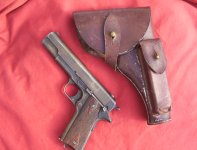
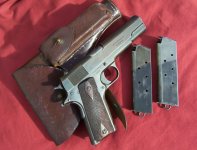
Here are mine which I promised to show earlier when the coof was chasing me out of mexico....

First couple photos are a lettered Canadian issue
The last two pictures are a C series Gov't Model with Brit proofs

Trying to export these to the US before our commie gov't grabs them and melts them into a blob
 

Attachments

  • 100_5170.jpg
    100_5170.jpg
    109.3 KB · Views: 13
  • 100_5179.jpg
    100_5179.jpg
    118.1 KB · Views: 13
  • 100_5420.jpg
    100_5420.jpg
    160 KB · Views: 13
  • 100_5422.jpg
    100_5422.jpg
    191.8 KB · Views: 12
Up until I turned 60, I had 7 of the 5000 Canadian Contract 1911's in my collection. They were beautiful firearms, only reason I sold them was that with retirement I realized that my shooting and collection habits were going to change.
 
  • Like
Reactions: NAA
Back
Top Bottom