Cordless drill adaptor for case annealing

Gyrfalcon

Member
Rating - 100%
3   0   0
Location
Alberta
I have been annealing brass necks and shoulders with a propane torch, by twirling them in my fingers in the hot part of the flame for 3 seconds, using a metronome to get consistent timing. I have seen in the past references by spinning them in the flame while in a cordless drill. None of my cordless drills will open up far enough to accept the base of a .308 case.
Can someone who uses the drill spinning method, enlighten me how to go about this properly?
Thank guys
 
3 seconds is not enough for my cases in several calibers. I am using 7.5 seconds for Lapua .260 Rem cases which are in the .308 family of case sizes. I also use a metronome app on my phone.

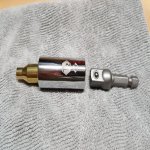
Half inch deep socket with drill bit adapter will spin .308 size cases just fine.
My rig showing a .260 Rem case in the deep socket:

Half_inch_socket_reduced-01.jpg
 

Attachments

  • Half_inch_socket_reduced-01.jpg
    Half_inch_socket_reduced-01.jpg
    67.7 KB · Views: 369
I tryed the drill method but couldn’t get it quite right.

I like the finger twisting method.
I just do what I seen a guy on you tube do.

Twirl them until they get hot enough that you feel it in your fingertips.
I don’t know how well this method works, but they look just like my new Lapua brass.

And in my mind, it works… lol

At least that’s what the you tube guy said… Eric ???
 
Last edited:
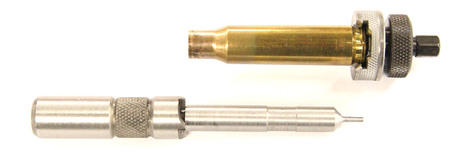
Lee case trimmer case holder works good or an old decapping rod just stick the pin through the flash hole backwards and it works fine too.
 
I machined an aluminum sleeve which fits over the case, leaving the shoulder and neck exposed. A piece of 1/4" round stock is pressed into the base of the sleeve for the drill chuck.
The aluminum sheds heat like nobody's business, so the base of the cases never get hot from contact with the sleeve, plus the sleeve protects the case body from the flame.
I've used a deep socket with a hex drill adapter also, it worked fine.
 
Lee case trimmer, comes with a sell holder and is made to be spun in a drill.

This was my preferred setup, too.

sormitrimmeri_1710_ef7.jpg
 
I’ve done the case holder and the socket method. Went back to doing them by hand. In a dark room you can watch for the colour change and feel the case temperature.
 
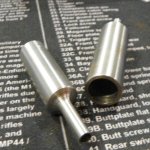
Here's the ones I use in my cordless drill. One is .223 size, while the other is large enough for 6.5x55 & 9.3x62, so it fits all of the ,30-06 sized cases as well. You used to be able to buy them at Sinclair's, which is where I shamelessly stole the idea, but, based on a search, no longer available there.

100_3309.jpg
 

Attachments

  • 100_3309.jpg
    100_3309.jpg
    115.2 KB · Views: 183
Here's the ones I use in my cordless drill. One is .223 size, while the other is large enough for 6.5x55 & 9.3x62, so it fits all of the ,30-06 sized cases as well. You used to be able to buy them at Sinclair's, which is where I shamelessly stole the idea, but, based on a search, no longer available there.

View attachment 567017

I think the commercial ones were made by Hornady. As you said, no longer available.
Probably lawyered into Unobtainia, like most things that are simple and work well but require conscious thought to be used safely.
 
I’ve done the case holder and the socket method. Went back to doing them by hand. In a dark room you can watch for the colour change and feel the case temperature.

If you are seeing any red at all in your dark room, (even very dull red), you are overheating those cases. Dave.
 
It is not a popular myth. The main body of the case will be fine, but the neck will be softer than it should be.
One needs about 700 -725ºF to anneal, whereas dull red is 900ºF + Dave.
 
Assuming five second exposures, 750°F provides only a partial stress relief in brass. 900°F is right around the completion point of stress relief. Not that it mattters, but you will get no substantial drop in hardness until you get close to 1100°F.

More importantly, brass can probably be heated to 1200°F and still hold a bullet just fine, which is of course the point. To me, unless the neck collapses on loading or doesn't have sufficient tension to hold a bullet, there is no basis to say the brass has been overheated.

So yes, myth. But lots of people believe it, therefore popular.
 
Assuming five second exposures, 750°F provides only a partial stress relief in brass. 900°F is right around the completion point of stress relief. Not that it mattters, but you will get no substantial drop in hardness until you get close to 1100°F.

More importantly, brass can probably be heated to 1200°F and still hold a bullet just fine, which is of course the point. To me, unless the neck collapses on loading or doesn't have sufficient tension to hold a bullet, there is no basis to say the brass has been overheated.

So yes, myth. But lots of people believe it, therefore popular.

You and I will have to agree to disagree, since in the practical world, I know that 750ºF definitely results in annealed necks.
I also know that it IS possible to overheat those necks, resulting in less neck tension than that desirable.
I'll leave it at that, since my observation agrees with hundreds of other reloader's experience. You have a great day! Dave.
 
I think annealing is running a close second to cleaning when it comes to contentious topics in shooting today.

Barrel break-in is likely neck-and-neck with the other two as well.
 
You and I will have to agree to disagree, since in the practical world, I know that 750ºF definitely results in annealed necks.
I also know that it IS possible to overheat those necks, resulting in less neck tension than that desirable.
I'll leave it at that, since my observation agrees with hundreds of other reloader's experience. You have a great day! Dave.

Thing is, if you look at what you wrote here, we don't have to be in disagreement at all.

I never said 750°F has no annealing effect, I said it was incomplete.
I never said it is impossible to overheat brass, I said it doesn't happen at 1200°F.

My only contention was with your statement that brass heated to a dull red was overheated. Dull red is fine, an observation that also agrees with hundreds of other reloaders experiences.
 
I heat mine to just before orange flame appears. It’s definitely getting to 750 degrees. I use dual torch heads for 5 seconds. I forget the distance the blue flame is away from the case. My case body does not get overheated. My ammo is grouping the best it ever has. I use Temp sticks. Impact deep socket, and metronome app for a timer.
 
Back
Top Bottom