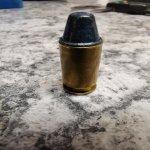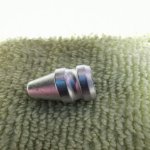
crimping cast .45acp

dearslayer

Regular
Rating - 100%
11   0   0
Location
On The Edge
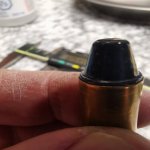
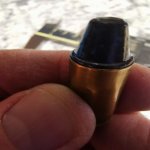
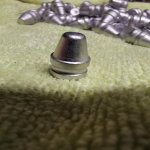
So normally when I crimped Campro Copper plated 45 acp using the Lee factory crimp die I feel only a little resistance when the case enters the die and the same when removing from the die however when I crimp with cast SWC bollits I feel like I really have to force the case and boolit into the crimp die. It's like I have to lean on the lever and then after a second it jumps into the die and the same coming out. I took the crimp die out to clean it but it's still the same. Shouldn't it go in fairly smooth and come out the same without any force. Boolits are sized to 0.452 with an OAL 1.235 and passes the Plunk test in the barrel. Is it because of the shoulder on the cast boolit perhaps. Unfortunately I don't have enough experience to diagnose the problem.
 

Attachments

  • FTRRRE.jpg
    FTRRRE.jpg
    29.5 KB · Views: 180
  • gfgftteg.jpg
    gfgftteg.jpg
    80.2 KB · Views: 182
  • qEARR.jpg
    qEARR.jpg
    37.6 KB · Views: 180
  • TRRTYTR.jpg
    TRRTYTR.jpg
    31.8 KB · Views: 184
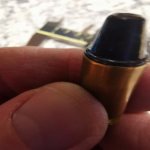
it looks like the case mouth is not taper crimped into any form of crimp grove and is resting on the shoulder of the projectile. Going in I think you might be hitting the shoulder of the projectile as it looks like some of the coating is chipped off. ( you can test this by putting white out on the projectile as it will scrape right off). Coming out, I think that case mouth is ever so slightly flared out and is catching the die.
 
I think what you are getting is Spring back from seating and crimping in one operation

You you need to do is Seat it to length in one operation (with no Crimp )

in the next operation Taper crimp it ( with the seating stem in you can double check Length) but do not seat it any deeper when crimping

its How the fancy loading machines do it
 
I think what you are getting is Spring back from seating and crimping in one operation

You you need to do is Seat it to length in one operation (with no Crimp )

in the next operation Taper crimp it ( with the seating stem in you can double check Length) but do not seat it any deeper when crimping

its How the fancy loading machines do it

I seat with the one die and crimp with another Factory crimp die. Not sure I understand what you mean.
 
Since it starts out with the correct dimensions and plunks okay, maybe the difference you're feeling is due to different hardness of the lead. Those Campro might be really soft under the copper plating. What's the hardness of these cast boolits?
 
Since it starts out with the correct dimensions and plunks okay, maybe the difference you're feeling is due to different hardness of the lead. Those Campro might be really soft under the copper plating. What's the hardness of these cast boolits?
I'll have to pencil check for BHN but its 100% COWW.
 
OP - your first and second picture - not sure if even possible to do, but is the FCD doing its thing below the rim of the case? - I mean as if the crimp in being applied lower, and the case rim actually getting squished out a smidgeon larger diameter?? I do not use FCD on cast bullets, so I do not know if even possible.
 
Are the Campro bullets also .452? The "jump" you describe is caused by the bullet/case passing through the carbine ring in the FCD. As the bullet/case combination goes through the die size ring there is resistance because you are basically compressing a solid (i.e.the bullet and case). Once the bullet/case goes past the ring it is then only sizing a tube (i.e. the case) which, because it isn't solid is easier to compress (therefore less resistance). When you withdraw the sized cartridge, as the solid part of the cartridge (i.e. the bullet/case) you again feel resistance because there is still some 'spring back' which the ring is again trying to compress.

As for the resistance difference between the Campro rounds and the COWW rounds, "alpining" may have the correct answer as the core of the Campro bullet is probably just pure lead compared to the COWW bullets which are a harder alloy and therefore more resistant to compression. Unlike actual jacketed bullets where the copper jacket is quite thick and hard, the copper 'jacket' on a plated bullet is an extremely thin layer and offers little resistance to compression.

The reason I asked about the diameter of the Campro bullets is because if they are sized to .451 (like true jacketed .45 ACP bullets) they obviously will require less compression (and therefore offer less resistance) than .452 bullets. i know it's only 1 thou difference but that can be a lot when you're talking about compressing metal.
 
Campro are advertised as .451''. Even with the PC those cast bullets are still .452"? I often experience the same thing with cast. My bullets are all .001" or more over nominal jacketed specs though.
 
Last edited:
OP - your first and second picture - not sure if even possible to do, but is the FCD doing its thing below the rim of the case? - I mean as if the crimp in being applied lower, and the case rim actually getting squished out a smidgeon larger diameter?? I do not use FCD on cast bullets, so I do not know if even possible.
Ok so is the crimp even necessary on this bullet then?
 
I do not reload for handguns, so maybe out to lunch - but some "bullet pull" needed to let the burning powder build up pressure - even in handgun cartridges? Straight cases need a shoulder (case mouth) to allow the firing pin to strike, without whole case sliding forward and away - was my impression why tapered, not rolled, crimps were used. Maybe I have that muddled up - will not be the first time ... OP is talking about a 45 ACP, which I think is a "rimless" case?
 
In your pics it looks like a roll crimp ???? In my 30 yrs. I have always used a TAPER CRIMP on .45 acp
with no issues.
 
Yes the "finger's or petals" that make the crimp. Look for any burrs, polish if necessary and use any grease. They don't move much but a little lube doesn't hurt
There is no such thing in a pistol cartridge LEE FCD.
The 'fingers' are only in the Lee rifle factory crimp dies. The Lee pistol FCD uses a carbide ring.
 
Last edited:
Back
Top Bottom