













































Daniel Goff registered his mark with the Worshipful Company of Gunmakers in London in 1779. It consists of the letters DG with a star above it and was used by Goff from 1779 until 1840. Goff began with a small shop at 39 Mansrell Street but soon expanded his manufactory to include a space at 58 Mansrell as well. By 1819 he had moved to Whitechapel, at 21 Somerset Street, and finally at Houndsditch in 1822. Goff produced a variety of pistols, muskets and shotguns for the civilian trade but worked also as a contractor for the East India Company.
Founded by a consortium of prominent English merchants, nobility and politicians in 1600, the EIC received a Royal Charter from Elizabeth I for a 15-year term, allowing it a monopoly of trade with all territories West of the Cape of Good Hope and East of Cape Hoorn. Company ships and personnel enjoyed un-challenged operations and the protection of British war ships for 150 years. Under King James I the charter was renewed indefinitely, with the caveat that it could be rescinded if the company was unprofitable for three years in a row. This kind of pressure – and the competition by the well established Dutch East India Company and various other players, forced the company to dabble in less honorable trade such as opium and slaves. By the 1750's the company had become sole “administrator” of its land holdings in India, issuing its own currency, raising an army and navy, passing laws and regulations, and levying taxes from the local population to pay for this administration. Over the years the company and its officers saw huge profits from the trade in spices, silk, gold, silver, precious woods and other Asian treasures. By the time the Industrial Revolution took hold in Britain, the East India Company took on the trade in raw materials needed to fuel British industry. The importation of saltpetre (potassium nitrate, a key ingredient in black powder) was a particularly important commodity. Various incidents of mismanagement and outright plunder caused the fortunes of the company to turn, and by 1813 it was stripped of its monopoly for India, and in 1833 for China. Deeply in debt to the Crown, the company was finally nationalized in 1858, and disbanded by an Act of Parliament in 1874. The company was revived in 2005 by an Indian businessman and today trades in luxury consumer goods such as tea and perfume.
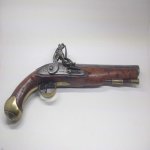
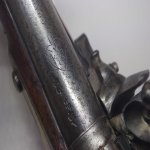
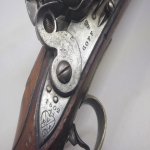
Daniel Goff’s pistol bears the company’s “bale mark”, a mark used to identify EIC property of all sorts. The mark was also used on the EIC-issued currency in India at the time. The mark is a heart divided into four quadrants by diagonal lines, each quadrant containing one of the letters VEIC. The letter “V” is used here interchangeably with the letter “U”, and the acronym stands for “United East India Company”. The number “4” above the heart is an ancient symbol signifying “Agnus Dei”, or “The Lamb of God”. The gun is also marked with visual and final proofs of the London Proof House, Daniel Goff’s mark DG under a star, and the EIC acceptance stamp of the number “4” under a crown. The lock plate is marked with the same bale mark, the name “GOFF”, “1802” and a stylized “2” under a crown. The gun is in nice, un-altered condition, showing typical handling marks for a 220 -plus year old pistol. The gun is of approximately 65 caliber, with a smooth bore. It measures about 16 inches in length, with a 9-inch barrel. It weighs a good 1.3 kilograms (2 lbs, 13 oz). The flint is wrapped in a small sheet of lead, which was customary for military weapons of the time. Repeated use could ignite a cloth wrapper and cause the powder to ignite prematurely – a “flash in the pan”. The brass furniture around the trigger guard and “skull crusher” is complete and moderately worn. The ram rod looks to be original, with brass finial and brass guide.
Founded by a consortium of prominent English merchants, nobility and politicians in 1600, the EIC received a Royal Charter from Elizabeth I for a 15-year term, allowing it a monopoly of trade with all territories West of the Cape of Good Hope and East of Cape Hoorn. Company ships and personnel enjoyed un-challenged operations and the protection of British war ships for 150 years. Under King James I the charter was renewed indefinitely, with the caveat that it could be rescinded if the company was unprofitable for three years in a row. This kind of pressure – and the competition by the well established Dutch East India Company and various other players, forced the company to dabble in less honorable trade such as opium and slaves. By the 1750's the company had become sole “administrator” of its land holdings in India, issuing its own currency, raising an army and navy, passing laws and regulations, and levying taxes from the local population to pay for this administration. Over the years the company and its officers saw huge profits from the trade in spices, silk, gold, silver, precious woods and other Asian treasures. By the time the Industrial Revolution took hold in Britain, the East India Company took on the trade in raw materials needed to fuel British industry. The importation of saltpetre (potassium nitrate, a key ingredient in black powder) was a particularly important commodity. Various incidents of mismanagement and outright plunder caused the fortunes of the company to turn, and by 1813 it was stripped of its monopoly for India, and in 1833 for China. Deeply in debt to the Crown, the company was finally nationalized in 1858, and disbanded by an Act of Parliament in 1874. The company was revived in 2005 by an Indian businessman and today trades in luxury consumer goods such as tea and perfume.
Daniel Goff’s pistol bears the company’s “bale mark”, a mark used to identify EIC property of all sorts. The mark was also used on the EIC-issued currency in India at the time. The mark is a heart divided into four quadrants by diagonal lines, each quadrant containing one of the letters VEIC. The letter “V” is used here interchangeably with the letter “U”, and the acronym stands for “United East India Company”. The number “4” above the heart is an ancient symbol signifying “Agnus Dei”, or “The Lamb of God”. The gun is also marked with visual and final proofs of the London Proof House, Daniel Goff’s mark DG under a star, and the EIC acceptance stamp of the number “4” under a crown. The lock plate is marked with the same bale mark, the name “GOFF”, “1802” and a stylized “2” under a crown. The gun is in nice, un-altered condition, showing typical handling marks for a 220 -plus year old pistol. The gun is of approximately 65 caliber, with a smooth bore. It measures about 16 inches in length, with a 9-inch barrel. It weighs a good 1.3 kilograms (2 lbs, 13 oz). The flint is wrapped in a small sheet of lead, which was customary for military weapons of the time. Repeated use could ignite a cloth wrapper and cause the powder to ignite prematurely – a “flash in the pan”. The brass furniture around the trigger guard and “skull crusher” is complete and moderately worn. The ram rod looks to be original, with brass finial and brass guide.
Attachments



Last edited:























