Defining a Grouse Gun – A Shotgun of Specialist Function
March 20, 2023

A.J. DeRosa
A.J. DeRosa, founder of Project Upland, is a New England…
Defining the attributes of the perfect ruffed grouse gun over generations of grouse hunters and authors from weight to barrel length
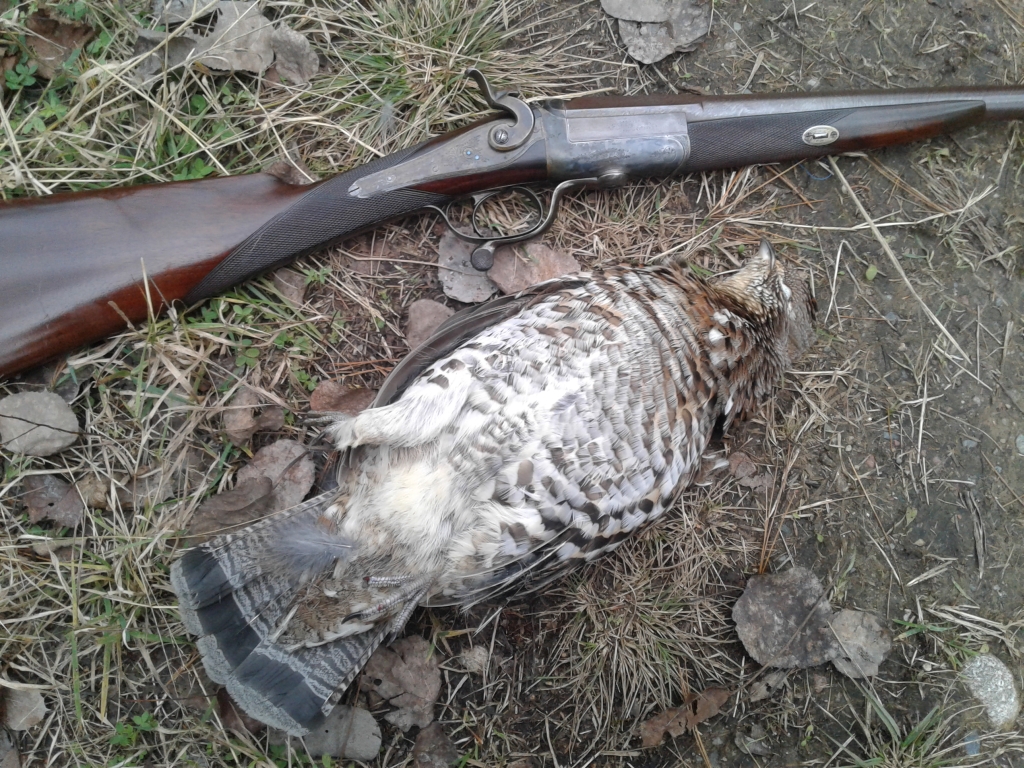
The text came through immediately: “Are those my initials?” I had just sent my dad a photo of my newest grouse gun: an Upland Gun Company, RFM-built Venus boxlock 28-gauge weighing five pounds, one ounce with 28” barrels choked skeet and skeet. Being a Junior makes my custom guns a regular lighthearted topic between us. Candidly, I owned a lot of shotguns before this one, and I’ve made many errors in judgment along the way. I am already sure I would change a couple of things on this one. However, this was my error, not Upland Gun Company’s.One of the few things my father and I bond over is guns. He’s why I started collecting guns as soon as I was old enough. I went through phases of obsession ranging from action types to unique calibers and even historical pieces. I would sell them and buy others or find one to save up for but never actually buy them. I am what someone could call “gun poor;” I own guns beyond my practical means at the expense of other things. It’s habitual, and I have no regrets. However, along the way, I learned a lot of lessons about poorly made guns, guns that didn’t fit me, and, ultimately, guns that did.
I grew up on pumps and semi-automatics. My first over/under didn’t come until 20 years ago, and my first side-by-side shotgun arrived eight or nine years after that. However, I accelerated my journey into double guns by taking many trips overseas. I toured gun factories on said trips and spent time with owners, experts, and engineers. They patiently answered my never-ending questions. Since then, some have come stateside to see the sights and even hunt grouse.
There are many strong opinions about what makes a good grouse shotgun. While I’m in line with most of them, others were more outlandish. One time, over lunch, a gun company owner told me that the weight of a grouse gun did not matter. In my typical uncensored fashion, I blurted out, “Then you haven’t truly grouse hunted.” That relationship has been rocky ever since, but I said what I said, and I meant what I said, and I would not be alone in that opinion. Honesty has to count for something.

What makes an ideal grouse gun, or what Gene Hill would call “a gun of specialist function?” Does action type matter? What about gauge? How does the environment play into it? How has the modernization of gun-making changed grouse guns? How different is a grouse gun from a clays gun? How different is a gun built for ruffed grouse hunting versus shotguns used for other wild game? While I don’t have all the answers, I do have theories. Like any evolving tradition, they’re built on the backs of those who came before me.
“An ideal grouse gun may be defined broadly as the one that a certain hunter will find most pleasant to carry to the spot where a grouse is to be shot at, and there prove most efficient when the shot is made.” Foster’s words may be the most elegant I have ever encountered when defining a grouse gun. They capture the subtleties of practical factors like weight, gauge, and gun fit while never explicitly mentioning them. Less poetically, he says, “I need to carry this gun through a mess of grouse cover and shoot when I get there.”
Gene Hill would echo that sentiment over 50 years later in Shotgunner’s Notebook:
It’s a special gun, built for snap shooting in the heavy alder and birch covers and for ease toting up and down New England hillsides . . . I think we can agree that among its special functions is that it’s easy to carry, meaning it has decent balance and doesn’t weigh more than seven pounds and preferably a bit less.
The Weight of a Grouse Gun
One can only wonder why some modern gunmakers push upland shotguns built for field applications into the eight-pound category. As Gene Hill said, let’s try and keep them under seven pounds. I argue that weight is the most relevant conversation around the ideal grouse gun.To be frank, grouse hunters do a lot of gun carrying, often one-handed, navigating thick cover, and do a lot more lugging than shooting. The weight of the gun is a centerpiece of this whole conversation. If you account for the standard good practices, like buying a gun that fits, is mechanically sound, shoots a standard load that patterns well, and you take the time to get good with that chosen shotgun, then the weight is about the only conversation left.
One’s physical build, whether towering six-plus-feet tall or a more average 5’10”, can push the weight of a gun across that five- to seven-pound spectrum. Simple things that contribute to weight can be gauge size, barrel length, quality of manufacture, and the action type. The whole conversation of a grouse gun cascades from the idea of weight.
The Double Gun Rule
Indeed, shoot whatever action type you like when grouse hunting. However, those expecting more mention of a pump or semiautomatic will be sorely disappointed. If we are talking about grouse guns in the classical sense (and we are), then we are talking about double guns.
I did not make the rules; the culture did. The double gun rule began at the dawn of modern grouse hunting. George Bird Evans called it the “gentlemen’s agreement.” It has to do with your number of shots and giving a ruffed grouse a fair chance on the wing. Being humbled is a cornerstone of the enjoyment of grouse hunting. Practice good conservation ethics and consider how your bag limits affect your local population.