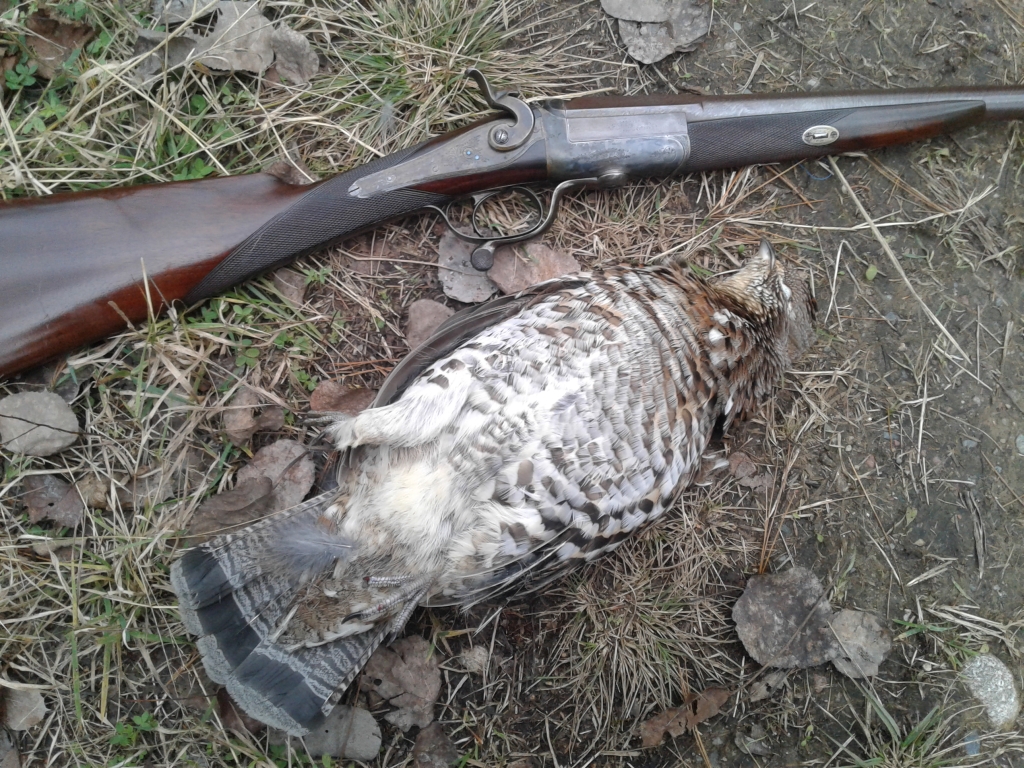
Defining the attributes of the perfect ruffed grouse gun over generations of grouse hunters and authors from weight to barrel length

Big Bad

CGN Ultra frequent flyer
Rating - 100%
1   0   0
Location
In Little Syria.

Defining a Grouse Gun – A Shotgun of Specialist Function​

March 20, 2023
A grouse hunting shotgun with a group of ruffed grouse fans

A.J.-DeRosa-180x180.jpg

A.J. DeRosa
A.J. DeRosa, founder of Project Upland, is a New England…


Defining the attributes of the perfect ruffed grouse gun over generations of grouse hunters and authors from weight to barrel length​

The text came through immediately: “Are those my initials?” I had just sent my dad a photo of my newest grouse gun: an Upland Gun Company, RFM-built Venus boxlock 28-gauge weighing five pounds, one ounce with 28” barrels choked skeet and skeet. Being a Junior makes my custom guns a regular lighthearted topic between us. Candidly, I owned a lot of shotguns before this one, and I’ve made many errors in judgment along the way. I am already sure I would change a couple of things on this one. However, this was my error, not Upland Gun Company’s.

One of the few things my father and I bond over is guns. He’s why I started collecting guns as soon as I was old enough. I went through phases of obsession ranging from action types to unique calibers and even historical pieces. I would sell them and buy others or find one to save up for but never actually buy them. I am what someone could call “gun poor;” I own guns beyond my practical means at the expense of other things. It’s habitual, and I have no regrets. However, along the way, I learned a lot of lessons about poorly made guns, guns that didn’t fit me, and, ultimately, guns that did.

I grew up on pumps and semi-automatics. My first over/under didn’t come until 20 years ago, and my first side-by-side shotgun arrived eight or nine years after that. However, I accelerated my journey into double guns by taking many trips overseas. I toured gun factories on said trips and spent time with owners, experts, and engineers. They patiently answered my never-ending questions. Since then, some have come stateside to see the sights and even hunt grouse.

There are many strong opinions about what makes a good grouse shotgun. While I’m in line with most of them, others were more outlandish. One time, over lunch, a gun company owner told me that the weight of a grouse gun did not matter. In my typical uncensored fashion, I blurted out, “Then you haven’t truly grouse hunted.” That relationship has been rocky ever since, but I said what I said, and I meant what I said, and I would not be alone in that opinion. Honesty has to count for something.
a collection of grouse guns

What makes an ideal grouse gun, or what Gene Hill would call “a gun of specialist function?” Does action type matter? What about gauge? How does the environment play into it? How has the modernization of gun-making changed grouse guns? How different is a grouse gun from a clays gun? How different is a gun built for ruffed grouse hunting versus shotguns used for other wild game? While I don’t have all the answers, I do have theories. Like any evolving tradition, they’re built on the backs of those who came before me.

“An ideal grouse gun may be defined broadly as the one that a certain hunter will find most pleasant to carry to the spot where a grouse is to be shot at, and there prove most efficient when the shot is made.” Foster’s words may be the most elegant I have ever encountered when defining a grouse gun. They capture the subtleties of practical factors like weight, gauge, and gun fit while never explicitly mentioning them. Less poetically, he says, “I need to carry this gun through a mess of grouse cover and shoot when I get there.”

Gene Hill would echo that sentiment over 50 years later in Shotgunner’s Notebook:
It’s a special gun, built for snap shooting in the heavy alder and birch covers and for ease toting up and down New England hillsides . . . I think we can agree that among its special functions is that it’s easy to carry, meaning it has decent balance and doesn’t weigh more than seven pounds and preferably a bit less.

The Weight of a Grouse Gun​

One can only wonder why some modern gunmakers push upland shotguns built for field applications into the eight-pound category. As Gene Hill said, let’s try and keep them under seven pounds. I argue that weight is the most relevant conversation around the ideal grouse gun.

To be frank, grouse hunters do a lot of gun carrying, often one-handed, navigating thick cover, and do a lot more lugging than shooting. The weight of the gun is a centerpiece of this whole conversation. If you account for the standard good practices, like buying a gun that fits, is mechanically sound, shoots a standard load that patterns well, and you take the time to get good with that chosen shotgun, then the weight is about the only conversation left.
One’s physical build, whether towering six-plus-feet tall or a more average 5’10”, can push the weight of a gun across that five- to seven-pound spectrum. Simple things that contribute to weight can be gauge size, barrel length, quality of manufacture, and the action type. The whole conversation of a grouse gun cascades from the idea of weight.

The Double Gun Rule​

Indeed, shoot whatever action type you like when grouse hunting. However, those expecting more mention of a pump or semiautomatic will be sorely disappointed. If we are talking about grouse guns in the classical sense (and we are), then we are talking about double guns.

I did not make the rules; the culture did. The double gun rule began at the dawn of modern grouse hunting. George Bird Evans called it the “gentlemen’s agreement.” It has to do with your number of shots and giving a ruffed grouse a fair chance on the wing. Being humbled is a cornerstone of the enjoyment of grouse hunting. Practice good conservation ethics and consider how your bag limits affect your local population.
a sub-gauge grouse gun out in the woods

continued next post...​

 
...concluded this post.

How Gauge Plays a Role in Grouse Shotguns​

Ruffed grouse’s difficulty is in their cunning behavior, not in their ability to take a shot. The point is it does not take much to kill a ruffed grouse. William Harnden Foster wrote, “In referring to some carefully-kept records . . . we find that the average distance at which grouse were killed throughout the seasons was in the neighborhood of twenty-three yards. These records were compiled by shooters of average reactions who use guns weighing a little under six pounds.” He advocated for pattern testing the first barrel at 25 yards and the second at 35 yards noting:

Since a missed grouse going away will travel at least ten yards before the shooter can recover his aim for the second shot and because the second bird of the rare, true double will also be ten yards farther away by the time it comes in for attention, there seems to be no more reasonable solution to the second barrel boring problem than to give it the pellet-to-the-square-inch average at 35 yards instead of 25 as was the accepted range of the first.

The 12-, 16-, 20-, and 28-gauge are acceptable gauges for ethically killing a bird, considering shots occur almost entirely under 35 yards. When choosing your gauge, you’ll find it’s very similar to the weight spectrum. The smaller you are, the more you will benefit from a lighter gauge. That applies to performance with recoil, how your hands fit on the shotgun, and the overall weight of the grouse gun.

While I often scratch my head at grouse guns that can take 3″ or greater loads, I guess it is not a bad option for those that occasionally seek waterfowl and do not have a dedicated shotgun for such an adventure.

Barrel Length on a Grouse Gun​

One of my favorite grouse guns is a wonderful 20-gauge Bernadelli with 24″ barrels and custom Briley chokes that weighs five pounds and 11 ounces. However, I have never said, “If I only had four inches less on my barrels, I would have hit that grouse.” If I had been more observant or technical, I might have learned sooner that a longer barrel makes for a better swing and, therefore, more successful shots. I know some old-school folks will send me hate mail on this, but the need for short barrels is no more than a myth in grouse hunting. Quite the opposite is true. When brush gets in the way, as it often does, it won’t matter what your barrel length is.

“When we talk of the length of the barrels we have in mind the symmetry and balance of the gun,” wrote Foster in his one-sentence elegance. The need for longer barrels often becomes more evident with the lighter gauge you shoot. Twenty-eight-inch barrels on a 28-gauge feel like a must to me. I am not sure I would ever want any shotgun with less than 28” barrels unless there were no other options. This leads to the next point of the ideal grouse gun. It is not built to win gold medals; it is meant to be hauled great distances while still being effective.
A grouse gun with 28 inch barrels after a successful grouse hunt

Always Practice with Your Grouse Gun​

“Because you lose the natural momentum that exists in a heavy (eight pounds or so) 12-gauge, you have to learn a new set of shooting habits,” wrote Gene Hill when talking about upland shotguns. Hill refined the difference between shooting on the range and upland hunting. While he pointed out differences in how these specialty guns are designed, he emphasized getting good with the hunting gun you choose. It’s that simple. A “specialist shotgun” requires a specific set of shooting skills, and if we are to hold to Foster’s simple definition, then we must be “efficient” with the grouse gun we choose.

My practical behavior in this realm began in the past five years. I made a point of sticking with the same shotgun from August until the end of the season. I keep my shotgun beside my desk, allowing me to religiously practice my gun mount, developing my muscle memory. Since that commitment, I have certainly experienced a significant change in my shooting abilities.

Final Thoughts on the Ideal Grouse Gun​

One of the greatest failures of modern grouse gun manufacturing is the need for more ability to order custom dimensions. Shooting a shotgun built to your measurements may be the greatest advantage to shooting straight. Some of us are luckier than others; they can pick up that gun rack gun, and it’ll be a close fit. They are built to fit the average person, after all. We outliers can genuinely benefit from getting measured for a custom gun fit.

My newest grouse gun, the Upland Gun Company Venus 28-gauge, meets my individual needs almost perfectly. One of the gun’s perfections is that it’s built to my dimensions. Their base model, the Zeus, starts at $2,499.00. That price tag includes custom-building it to your dimensions. As every gun collector knows, we always think of an excuse to buy that next “ideal” shotgun.

While collecting and shooting guns is a great way to learn foundational lessons in identifying good shotguns, grouse hunting is the only way to know a gun intimately enough to say it’s an ideal grouse gun. “Few sportsmen are fortunate enough to make, early in their careers as grouse hunters, their ultimate choice of a gun,” wrote Foster. “Some never settle on one with which they feel wholly satisfied, but keep on changing and experimenting, swinging like a pendulum from one extreme to the other. Fortunate and heroic indeed is the grouse hunter who can say, ‘I can think of no change that I would care to make in the gun that I have used all these years that might improve my shooting.’”

Read More
16-Gauge Shotguns – Selection, Ballistics, History, and More
How the Boxlock Shotgun Became a Standard
What is the Difference Between Demi-bloc and Monoblock Barrels?

https://projectupland.com/shotguns-...e4DzR4tBOwydryKCh4GV10yvzxiDLvN4qcf4pI.XSVPXG
 
Last edited:
I must say I agree with every point made. In particular, tha5 the gauge isn’t important……the weight is. And that the need for short barrels is a myth. My Francotte 28 gauge is near perfect but could use an extra 2-3” added to its 26” barrels. Even with 3” added to the barrels, it would still be under 5 pounds. But with 29” barrels, would swing nicely.

At the same time it’s my experience that most shots are snap shots, where that smooth barrel swing is less important.
 
I guess it all depends on where you hunt, and (in my situation at least) how you get there.
Currently, I'm very happy with a +/- 6lbs 12g in a shorter barrel (25"-26"). It"s nice to wield in the bush and to carry on the motorcycle/bicycle
And while I love my current grouse-gun, if I was to have the opportunity to describe the perfect grouse gun....

It would probably be a single shot break barrel, 26" under 6lbs would be nice.
- In the woods where I'm hunting, I can probably count on one hand the number of times when I was able to take a 2nd shot on a bird... and forget the idea of trying to do a double and knock two bird one after another. Without a dog, finding one downed bird can be challenging enough. Two, forget about it.

And if I ever find myself with more $ than brain, I'd love a nice combination gun like a TsKIB SOO MTs-05. This would give me the single-shot shotgun (to deal with the flushing bird) and a 22lr (for the odd squatting one).
- 20 or 30 years ago... and I kind of passed on one, because silly me thought that the idea of a 16g was foolish... But then again, that was many years ago... and I don't know if a new one could be made, in the 6lbs range...

And lets not forget to add a mention about it looking pretty. I know engraving and nice walnut won't make you a better shot... but still...
 
I thought that I had it figured out in 1965. I had a Birmingham hammer double with 30 inch barrels. If only I had a Churchill XXV, I would be much more successful.
I think that I have probably hunted Grouse with with more than 30 different shotguns since then, some with barrels as short as 26 inches. I no longer want a Churchill XXV, though I could have had one.
Weight is a significant criterion. I think that 6.5 pounds is just about my ideal weight for carrying across hill and dale.
I like 28 inch barrels as a reasonable compromise for swinging momentum.
I am currently carrying a FAIR Jubilee 16 gauge with 28 inch barrels, for no other reason than to be different. I have several 20 gauge guns that would do as well. One ounce of shot is plenty for Sharptails and Hungarian Partridge. Choosing a Grouse gun comes down to personal taste in the end.
 
I guess it all depends on where you hunt, and (in my situation at least) how you get there.
Currently, I'm very happy with a +/- 6lbs 12g in a shorter barrel (25"-26"). It"s nice to wield in the bush and to carry on the motorcycle/bicycle
And while I love my current grouse-gun, if I was to have the opportunity to describe the perfect grouse gun....

It would probably be a single shot break barrel, 26" under 6lbs would be nice.
- In the woods where I'm hunting, I can probably count on one hand the number of times when I was able to take a 2nd shot on a bird... and forget the idea of trying to do a double and knock two bird one after another. Without a dog, finding one downed bird can be challenging enough. Two, forget about it.

And if I ever find myself with more $ than brain, I'd love a nice combination gun like a TsKIB SOO MTs-05. This would give me the single-shot shotgun (to deal with the flushing bird) and a 22lr (for the odd squatting one).
- 20 or 30 years ago... and I kind of passed on one, because silly me thought that the idea of a 16g was foolish... But then again, that was many years ago... and I don't know if a new one could be made, in the 6lbs range...

And lets not forget to add a mention about it looking pretty. I know engraving and nice walnut won't make you a better shot... but still...
You’d probably like my 5 pound single barreled open choke J & W Tolley. And you are right IMHO, a second immediately available shot is just about always useless.
 
I agree with the article, a SxS is a classic grouse gun. As important as weight, barrels, etc., is the gun itself; it has to give me great pleasure to own, carry, and shoulder, and for that, it has to ooze history -- the more the better. So it's a hammer gun for sure, and Old World craftsmanship. And while I enjoy a good double, like Canvasback says, a single is usually enough:
VwenvxF.jpg


Sadly, no grouse season for me this year, having just come out of 8 days in hospital, and lacking the strength for days of walking.
 
Feel like good boots get you more grouse than good guns

A long time ago I limited out on ruffs using a chopped down Cooey 840 12g
Sometimes wish I still had that one for the real thick stuff.
But yes the “ideal” I’m coming around to is that sxs 20 with English stock and double triggers that handles like some kind of magic wand…. Now to find it…
 
Feel like good boots get you more grouse than good guns

A long time ago I limited out on ruffs using a chopped down Cooey 840 12g
Sometimes wish I still had that one for the real thick stuff.
But yes the “ideal” I’m coming around to is that sxs 20 with English stock and double triggers that handles like some kind of magic wand…. Now to find it…

Not an either/or situation. More one of optimization. Get the right boots and use them. Get the right gun and use it.


This thread happens to be about the gun.
 
Sadly, no grouse season for me this year, having just come out of 8 days in hospital, and lacking the strength for days of walking.

Hope you get back on your feet quickly enough!
(pun intended)

Oh, I'm sure that J & W Tolley is nice to hunt with!
- Agree that barrel length is actually not much of a hindrance, unless you're in the real thick stuff. And even then, you simply adapt to it (and your gun mounting changes over the year)... as in when I was a teenager, the whole gun would be raised simultaneously (and the barrel would often get caught on branches and other what not) VS now where (consciously or not) the leading hand will point the barrel at the target while the butt make its way to the shoulder...

*-*-*

As far shotgun? I think I'd enjoy hunting grouse with just about anything and everything, really. I love walking the woods, being lost in my thoughts while watching for some movement or try hear them shuffling their feet on leaves... and when it's my lucky day, one of them will drum it up! to draw my attention :)
 
I feel for you, Steve. I tore a tendon in my left ankle on opening day this year. For me, the annual upland bird season is my decompression zone. I wait impatiently all year for those precious months. So much so that I'm still going out once a week wearing the "Aircast" boot they put on at the hospital (needless to say, I don't get far).

I think I speak for all your fans on CGN and abroad when I say that we love your well researched and informative articles whenever and wherever they are published. A speedy recovery to you, sir, and many more seasons in the field.

Regarding the second shot:

Having cut my teeth on a 16 ga Cooey, I can't deny that a single shot is enough. However, the second shot has resulted in a bird in the bag more often than I can count. With ruffed grouse, that second shot is not likely at the same bird, but surprises happen.

An extreme example: While hunting grouse with my hunting partner one day, a bird flushed and he dropped it cleanly with a fine shot. As he was collecting his prize and we chatted, a second bird came up, catching us both off guard. We were busy bemoaning the fact that we made a stupid assumption by ignoring the possibility of a second bird, when the third burst off behind cover.

More as a joke than a serious comment, I said we'd best be ready for the next one. And I was, when the fourth bird tore out of there like he was on fire. I dropped him as well as the fifth bird that rose up before I could even secure the fourth. Two more birds came out of there before it was all over, making a total of seven. My partner likely would have had two as well, if he hadn't put his gun down while bagging his bird.

As I said, this is an extreme example, but any experienced grouse hunter knows all too well that early season grouse are often still paired up.

Starting the learning curve with a single makes for a better shooter, IMO. But, for me, it's side-by-side doubles in the uplands every time.
 
Last edited:
Must be under 6lbs !
Two barrels, two different chokes.
28" preferred, but 26" can work depending on the gun.
I most definitely would never use a 12ga on grouse, and would not hunt with someone that did.
28ga, 410, 20ga. Depending on the bird and pressure.
It's all about feel and enjoying the hunt, lots of walking!
 
Well, if you subscribe to Gough Thomas' [G.T. Garwood] axiom that a gun should weigh 96 times the weight of the shot load, then my 27" barrelled J. Blanch Sidelock 12 bore is right on track at a smidge under 6.8 #'s, given that my favourite grouse load is 1 1/8 oz. of lead; 7 1/2's in the right barrel & #6's in the left barrel.

I had a Wm. Richards XXV, but could never get used to its stubby barrels.
 
Second shots... in what I consider good grouse country from the old days, the birds are smart and crafty and if they're approached properly, wing shots abound. The cover is also usually thick and I developed the habit of doing a double tap with the second barrel whenever possible, to ensure a hit bird came straight down and wasn't lost- it may have been good country but there was still a heck of a lot of walking involved. Then there are double flushes or flushes when I was walking up to a hit bird, it all meant I wouldn't have gone out using anything but a double barrel, and still won't.

Edit: I forgot to mention the possibility of a very quick and smooth second shot on a clear miss. Yeah, that happens.
 
Last edited:
Steve, I missed that bit about no season for you. Hope you are feeling better and your recovery goes well. My season is also on hold……I have a relatively sudden significant problem with my right (was the dominant) eye. Have lost a significant amount of vision in it and it’s not coming back. At my age switching to left handed seems a bit daunting. I’m still trying to figure out what to do.
 
As I get older I'm drawn to trimmer sleeker lighter guns. I've mostly switched to a 20ga or 410 for my upland birds hunting. They're just nicer to carry. Not so much the weight as I have heavier 12s that balance just as well. It's the diameter of the gun. This has also led me to be drawn to single shot rifles over my bolt actions. Smaller action and proper balance make the gun ride on the fingers while walking the woods as opposed to trying to grasp and hold a wider double 12
 
I guess it all depends on where you hunt, and (in my situation at least) how you get there.
Currently, I'm very happy with a +/- 6lbs 12g in a shorter barrel (25"-26"). It"s nice to wield in the bush and to carry on the motorcycle/bicycle
And while I love my current grouse-gun, if I was to have the opportunity to describe the perfect grouse gun....

It would probably be a single shot break barrel, 26" under 6lbs would be nice.
- In the woods where I'm hunting, I can probably count on one hand the number of times when I was able to take a 2nd shot on a bird... and forget the idea of trying to do a double and knock two bird one after another. Without a dog, finding one downed bird can be challenging enough. Two, forget about it.

And if I ever find myself with more $ than brain, I'd love a nice combination gun like a TsKIB SOO MTs-05. This would give me the single-shot shotgun (to deal with the flushing bird) and a 22lr (for the odd squatting one).
- 20 or 30 years ago... and I kind of passed on one, because silly me thought that the idea of a 16g was foolish... But then again, that was many years ago... and I don't know if a new one could be made, in the 6lbs range...

And lets not forget to add a mention about it looking pretty. I know engraving and nice walnut won't make you a better shot... but still...
Well if you don't mind a gun with a lil character, money shouldn't be too big an obstacle to pick up a good combo gun!

Intersurplus and I believe Great North Guns have a bunch of combo guns at a reasonable price.

Lots of older Brno/CZ and Tikka combos. Granted, I don't think I've ever seen one in .22 LR, but lots of.22 CF.

I picked up a nice Tikka 12g over .222 Remington. Easy to load for and fun. Kind of a great survival gun in my mind or ultimate grouse gun. Has a flip up rear site, dovetails for scope mounting and came with rings. Would like to try a very low power variable on it, or red dot.

I appreciate the exposed hammer on this one, as I don't like the idea of a rifle being cocked as soon as it's closed up.
 
My buddy grew up hunting in near north Ontario (Haliburton area) and learned to use whatever he had which at that time was a 12 ga. Remington 870 with 30" full choke barrel which he also used for duck. Fast forward many decades later and that guy bought a 20ga. Stoeger SXS. After you guys with deeper pockets stop laughing, I can't tell you how many grouse and Hungarian partridge he's taken with that. I put a Tru-Glo fire sight bead on it for him since he mostly hunts thick brush and woods and he loves that shotgun. Would a high-end beautiful quality shotgun do better? I love and appreciate beautiful firearms, but my first hunting rifle was a Lee Enfield surplus .303. Me and another buddy got him a Stoeger O/U and as much as he loves it, he still goes with SXS. BTW, both have 26" barrels which swing easier in the bush and woods, according to him.
 
Back
Top Bottom