Delete please

coldblood

Regular
Rating - 100%
3   0   0
Location
Alberta
I wasn't sure where to ask this. If this is not a right forum, please let me know and I will re-post it where it belongs. :p

Could somebody explain to a n00b (me):

1. What is a co-witness system?
2. Co-witness purpose/application?
3. What firearm requires such a system? why?
4. How to build a co-witness system? what optics, mounts, rails and other accessories one needs to build it?
5. Any relevant information to the subject?

Thank you in advance. :)
 
Aimpoint_Perfect_Co-Witness_Cantilever_Spacer-A.jpg


T-1SightPicture.jpg

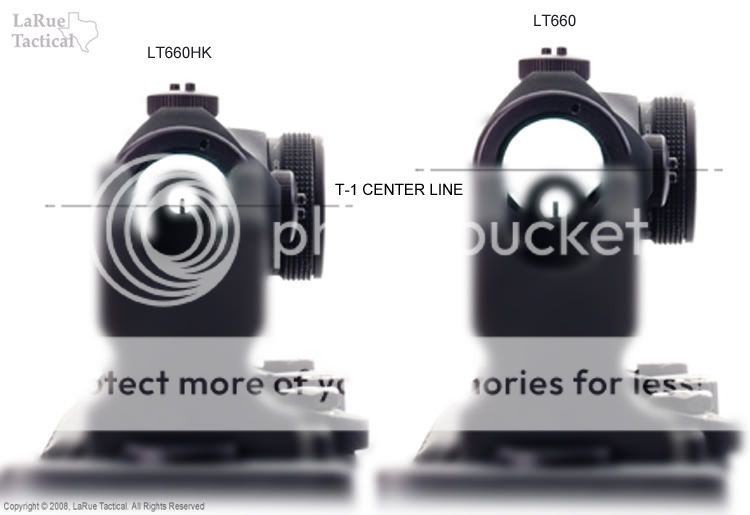
left is absolute, right is lower 1/3

eotech_view_1.JPG
 
If you can't see one, maybe you'll still be able to see the other. If one fails, maybe the other will still serve.

It's to provide you with a redundant back-up, all ready for immediate use.
 
Also if your transfering from a dark to light environment, you may want to have a constant co-wittness as your reticle may not be visable as your eyes adapt to the lighting conditions.
 
Well a cowittness really depends on what kind of sight you are using. I run an Aimpoint H1 in a 39mm riser which sits at a lower 1/3 wittness. Any model of Aimpoint you can buy mounts specifically designed for a 1/3 wittness.

If you are using Eotech then (depending on the model) you may need to buy a riser. I know for the 552/512/551/511 and XPS models you would need a riser for a 1/3 (they come standard as an absolute cowittness) but for the 553 model it should already at the correct height.

I would suggest a Larue mount (cash permitting) for any of the above. I cant personally speak to any other sights out there but those are the ones I have some experience with.
 
Sorry I only answered half the question. There are a number of ways to zero a cowittness.

Personally I prefer sighting in the iron sights and then zeroing the optic. Shoot groups with each seperatly to make sure they are both on, and then fire a confirmation group with irons and optics on. It is an extra step, but what the hell.. could be handy someday.

A couple of notes... Once you have cowittness, you should be able to confirm your sights after travel. Also, I would try and not remove the optics as much as possible as you may get some play in the zero when messing with that. Finally.. there is no consensus on if you should always use cowittness, so dont get freaked out when you see other people doing it or not doing it.. personal preference.

Hope that helps
 
Well a cowittness really depends on what kind of sight you are using. I run an Aimpoint H1 in a 39mm riser which sits at a lower 1/3 wittness. Any model of Aimpoint you can buy mounts specifically designed for a 1/3 wittness.

If you are using Eotech then (depending on the model) you may need to buy a riser. I know for the 552/512/551/511 and XPS models you would need a riser for a 1/3 (they come standard as an absolute cowittness) but for the 553 model it should already at the correct height.

I would suggest a Larue mount (cash permitting) for any of the above. I cant personally speak to any other sights out there but those are the ones I have some experience with.

Thank you so much. I wonder what are advantages and disadvantages of two methods - lower 1/3 vs absolute?
 
Sorry I only answered half the question. There are a number of ways to zero a cowittness.

Personally I prefer sighting in the iron sights and then zeroing the optic. Shoot groups with each seperatly to make sure they are both on, and then fire a confirmation group with irons and optics on. It is an extra step, but what the hell.. could be handy someday.

A couple of notes... Once you have cowittness, you should be able to confirm your sights after travel. Also, I would try and not remove the optics as much as possible as you may get some play in the zero when messing with that. Finally.. there is no consensus on if you should always use cowittness, so dont get freaked out when you see other people doing it or not doing it.. personal preference.

Hope that helps

Definitely helps! Thank you again! :)

I think I misunderstand the purpose of the co-witness system. Let me explain. I initially thought that I need a system that will allow me to shoot a target 300m away and if I didn't kill a target from the first shot and target now approaches toward me quick, I will be able to use my irons for short distance. Imagine hunting wild boar.

My neighbor has his rifle scope mounted on a swing over mounts that allow him to unlatch the scope and swing it aside and to use irons for the scenario above or in other scenario, for example, he was watching a target at 400m and suddenly another target showed up at closer (iron sights) range. In this case, he can swing the scope aside and use irons.

Since such mounts are not manufactured anymore, I thought that co-witness system will do exactly what the scope swing-aside system was doing...
 
Co-witness is for unmagnified optics. Your irons will not have any advantage over a red dot, they are a backup system.
 
Co-witness is for unmagnified optics. Your irons will not have any advantage over a red dot, they are a backup system.


If this is the case (unmagnified optics only), then it makes co-witness system useless for my application (examples I provided in my previous post). :redface: I do, however, see the benefits as a back up when magnification for distance is not required.
 
you wont see your irons very well through a magnified optic. for a back up in this case, there are three options that i know of.

1. a "peek" through mount which allows you to see your irons by mounting the scope a little high and with little tunnels under the mounts.

2. quick detachable or swing mounts as you described.

3. an interesting solution that i have seen is to have front and rear sights actually mounted on top of the scope. there is a very short sight radius, and the ones i have seen are not adjustable, but they could serve as a quick backup for very close shots.

most people would solve your problem by estimating holdover/under when shooting much closer/further that their sights are zeroed for.
 
you wont see your irons very well through a magnified optic. for a back up in this case, there are three options that i know of.

1. a "peek" through mount which allows you to see your irons by mounting the scope a little high and with little tunnels under the mounts.

2. quick detachable or swing mounts as you described.

3. an interesting solution that i have seen is to have front and rear sights actually mounted on top of the scope. there is a very short sight radius, and the ones i have seen are not adjustable, but they could serve as a quick backup for very close shots.

most people would solve your problem by estimating holdover/under when shooting much closer/further that their sights are zeroed for.

Thank you for your post. :) This puts things in order.

I think I either will mount a scope as option #1 or will find a swing-over mounts (either OEM or will ask my husband to fabricate it).

As for co-witness system, I probably will install it on my Rem 597VTR (still waiting...) for small game hunting and target practicing.
 
Back
Top Bottom