I am usually careful with my cases but occasionally ill bounce one off the concrete and dent my case neck, I like to neck size without the expander ball in my type S die, but this does not take out the kink in bad neck dents, solutions?













































You are using an out of date browser. It may not display this or other websites correctly.
You should upgrade or use an alternative browser.
You should upgrade or use an alternative browser.
dented case necks
- Thread starter Camoman1
- Start date


BiggerDigger
Member
- Location
- The Wild Wet Coast
Hahahaa
That's Fantastic
That's Fantastic

...Put the expander ball back in...?
Good think'in 99.
Why do you use a bushing die without the expander? The way I see it, with the ball removed, the outside of the neck is perfectly circular after being sized by the bushing. This means any variations in neck thickness will show up on the inside of the neck. Using the expander, any variation will be pushed to the outside of the neck. A more consistent inside diameter will mean less runout, no?


I am usually careful with my cases but occasionally ill bounce one off the concrete and dent my case neck, I like to neck size without the expander ball in my type S die, but this does not take out the kink in bad neck dents, solutions?
Use the expander ball. It is what it is for. As an aside, expander balls should never touch the neck unless there is some sort of major defect. I have yet to measure one of my various expanders used in various dies and makes that is not in the range of 0.002 to 0.003 inches smaller than bullet diameter. If it is touching the neck and expanding it on a regular basis you are undersizing the neck or the neck has concentricity and/or wall thickness problems.
Use the expander ball. It is what it is for. As an aside, expander balls should never touch the neck unless there is some sort of major defect. I have yet to measure one of my various expanders used in various dies and makes that is not in the range of 0.002 to 0.003 inches smaller than bullet diameter. If it is touching the neck and expanding it on a regular basis you are undersizing the neck or the neck has concentricity and/or wall thickness problems.
Maybe I have a bad batch of brass or an oversized expander.

BattleRife
CGN Ultra frequent flyer
- Location
- of No Fixed Address
Use the expander ball. It is what it is for. As an aside, expander balls should never touch the neck unless there is some sort of major defect. I have yet to measure one of my various expanders used in various dies and makes that is not in the range of 0.002 to 0.003 inches smaller than bullet diameter. If it is touching the neck and expanding it on a regular basis you are undersizing the neck or the neck has concentricity and/or wall thickness problems.
I fear your understanding of the mechanism is poor.
The die deliberately makes the case neck well undersize. The expander ball then expands the neck back up so that it is just a couple of thousandths smaller than the bullet, which provides proper neck tension. The ball should contact the neck each and every time to produce a consistent internal diameter on the neck.
Surely anybody who has run a case into and out of a resizing die has noticed that there is some friction as the expander ball goes through the neck?
Maybe I have a bad batch of brass
Do you?
or an oversized expander.
Unacceptable. I'd be calling the manufacturer and demanding a new one.
Cameron SS
CGN Ultra frequent flyer
- Location
- Ground Zero
Surely anybody who has run a case into and out of a resizing die has noticed that there is some friction as the expander ball goes through the neck?
No friction on the way in (because the neck hasn't been sized down yet), friction on the way out.
Using a bushing die with the correct sized bushing accomplishes the same result without the oversizing and then expanding, reducing the amount of work being done on the brass.
Sounds to me like the OP isn't using a bushing die, but is simply using a standard sizing die with no expander. Me thinks that would be over sizing the dies, without expanding, which I would expect to cause a series of other possible problems.
In any event, to the original question, the answer was provided in point #2.
IF he wants to, he can grab any other die, throw the correct sized expander in it, wind it all the way in so the expander can reshape the case neck without the die body contacting the brass. The fired brass Inside Diameter (Ignoring the dent) should be larger than the bullets he wants to load, so it should be a simple matter of using the expander only to reshape the case neck into a circle, (which when finished should still be larger than the bullet and/or expander), and then he can go on to resize as per his preferred method.

Unless it is match ammo, I would just load and shoot it. That will iron out the dent.
If it is match ammo, load it and test to see if it makes any difference. Probably won't. If it does, put dented case ammo aside for things like scope zeroing, warm up shots, barrel foulers.
If you use an expander, use it on all the dented cases, take it off and re-size with the bushing die, so all the cases are uniform with just a bushing siziing.
If it is match ammo, load it and test to see if it makes any difference. Probably won't. If it does, put dented case ammo aside for things like scope zeroing, warm up shots, barrel foulers.
If you use an expander, use it on all the dented cases, take it off and re-size with the bushing die, so all the cases are uniform with just a bushing siziing.
And if you really what to be anal an elegant solution when combined with a bushing die to maximize case life and get precise neck tension...messing with one now..whether any really observable increase in accuracy will see.
Whidden Expander ball kit
The Whidden Gunworks Expander Balls typically allow the shooter the opportunity to adjust the neck tension from .001″ to .005″. The Expander Ball Kit comes with five Expander Balls. Each kit includes an Expander of the chosen caliber and decreases in size by .001″. Example: If an Expander Ball Kit for .243 caliber is ordered, the kit would include Expander Ball sizes .243, .242, .241, .240 and .239.
Whidden Expander ball kit
The Whidden Gunworks Expander Balls typically allow the shooter the opportunity to adjust the neck tension from .001″ to .005″. The Expander Ball Kit comes with five Expander Balls. Each kit includes an Expander of the chosen caliber and decreases in size by .001″. Example: If an Expander Ball Kit for .243 caliber is ordered, the kit would include Expander Ball sizes .243, .242, .241, .240 and .239.
Last edited:
I did some sizing last night with a Type S die and found a couple dinged necks in my cases. How I did it:
1. Install Expander in die
2. Run case up into die, just enough to get the expander in the case mouth and then run it back out. This removes the imperfections on the inside of the mouth without sizing the case.
If the case is brand new and I don't want to FL size it, I stop there.
3. Remove Expander and FL size with the bushing die.
This is just what I did... I read another article this morning talking about how you should always size with an expander, regardless of what die you use as long as the expander is the proper size (ie. only .002 smaller than the bullet diameter).
1. Install Expander in die
2. Run case up into die, just enough to get the expander in the case mouth and then run it back out. This removes the imperfections on the inside of the mouth without sizing the case.
If the case is brand new and I don't want to FL size it, I stop there.
3. Remove Expander and FL size with the bushing die.
This is just what I did... I read another article this morning talking about how you should always size with an expander, regardless of what die you use as long as the expander is the proper size (ie. only .002 smaller than the bullet diameter).
Some posters with serious knowledge have already weighed in so not sure I have much to add, but here goes. I generally use a neck size die that squeezes the neck on a mandrel. Deals with dents for me. Every 4-6 reloads I use a f/l die. I don’t have the rifle to shoot better than .7-9 MOA so maybe I can’t tell the difference in results though.
I fear your understanding of the mechanism is poor.
The die deliberately makes the case neck well undersize. The expander ball then expands the neck back up so that it is just a couple of thousandths smaller than the bullet, which provides proper neck tension. The ball should contact the neck each and every time to produce a consistent internal diameter on the neck.
Surely anybody who has run a case into and out of a resizing die has noticed that there is some friction as the expander ball goes through the neck?
My understanding is correct. The OP is discussing a Type S die, which is a neck bushing style die. If you are using a bushing die to size the neck, it should NEVER undersize the internal diameter of the neck more than bullet size -0.002 inches to provide proper tension. Any additional undersizing via using a smaller than necessary neck bushing is just working the neck excessively which will lead to eventual neck cracking. If the neck is undersized then the sizing ball will have to expand the case and pulling it through also pulls the case, lengthening it slightly which will mean trimming will be required more often. I have measured my expander balls and they are all 0.002 to 0.0025 inch smaller than the corresponding bullet size. If one wants to dispense with concentricity checking followed by proper neck turning prior to using neck bushing dies and just reload, I suggest using the Lee collet neck die. It squeezes the brass from the outside onto a mandrel sized 0.002 inch smaller than bullet size and will work on pretty much all brass. It expands any neck dents and dings as well.
If one is using a standard full length sizing die which resizes the entire case, please recognize that it is a median tool designed to work on multiple makes of brass and which relies on neck wall thicknesses to be within a certain range. Brass neck hardening is ignored. They always seem to undersize the neck excessively, at time up to 0.004 inch as they have to 'work' on all makes of brass, and yes, when the expander is pulled back through it can be more than interesting if one hasn't lubed both the inside of the neck as well. At any rate, it doesn't take long to recognize that really is a poor way to get long life out of expensive brass and one starts looking for the equipment within their budget to do it 'properly'.
Last edited:

In the Redding FAQ they recomend using the expander if you do not turn your necks.
Tech Line & Tips (FAQs)
http://www.redding-reloading.com/tech-line-a-tips-faqs/132-faqs1
Question: Do I need to use the expander button that came with my Type "S" Die?
Answer: It is advisable to use an expander button to maintain consistent neck tension if the case necks have not been turned to a uniform wall thickness. However, the expander button can be replaced with the Decapping Pin Retainer (included with your Type "S" Die) if the user does not wish to use an expander button.
Tech Line & Tips (FAQs)
Bushing Selection
If the neck wall thickness varies more than 0.002", it may be necessary to use a bushing a couple of thousandths smaller than your calculations indicate, and then use a size button in the die to determine the final inside neck diameter.
You can also buy a expander die and straighten the case neck and then size with a bushing die.
Note, bushing dies work best with custom rifles with tight neck chambers. The bushing floats and if you reduce the neck diameter .004 or more when sizing it can induce neck runout. This is why Redding recommends sizing the neck in two operations if reducing the neck diameter .004 or more. And this is with turned necks and with necks that are not turned the neck runout will be more because of the variations in neck thickness
At the Whidden custom die website they tell you they get the most concentric cases using non-bushing full length dies. They also sell expander kits with five expanders from bullet diameter to .004 under bullet diameter.
I perfer non-bushing Forster full length benchrest dies with their high mounted floating expander. And these dies produce the least neck runout with my off the shelf factory rifles.
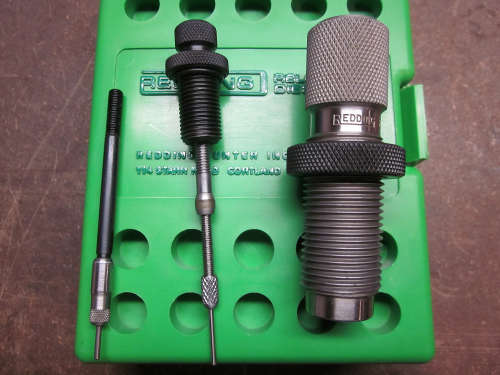
Below my Redding .243 full length die equipped with a modified Forster expander and spindle assembly. This greatly reduces neck runout and you are not dragging the longer Redding expander through the case neck.
You can also buy a floating Redding carbide expander ball.
Redding Carbide Size Button Kit
https://www.midwayusa.com/product/1012424426/redding-carbide-size-button-kit
The Redding Carbide Size Button Kit makes inside neck sizing smoother and easier without lubrication. Now you can upgrade any Redding Full Length, Neck or Type S sizing die. Available for bottle neck cartridges 20 thru 338 cal. The carbide size button is free floating on the decapping rod allowing it to self-center in the case neck.
To many reloaders think using a expander is the end of the world because of what is said and spread on the Internet. And if the inside of the case neck is lubed with the proper size expander you have nothing to worry about.
FL Bushing Dies vs. Honed FL Dies
http://www.accurateshooter.com/technical-articles/reloading/fl-bushing-dies-vs-honed-fl-dies/
Below Forster will hone the neck of your Forster dies to your desired diameter. And there is a reason why reloaders anneal their cases and make their cases last longer. I have never had to hone any of my Forster dies because they do not over resize the case necks when using unturned brass.
Weekly Gear Update – Forster Honed Dies
Posted by 65guys
http://www.65guys.com/weekly-gear-update-forster-honed-dies/
Tech Line & Tips (FAQs)
http://www.redding-reloading.com/tech-line-a-tips-faqs/132-faqs1
Question: Do I need to use the expander button that came with my Type "S" Die?
Answer: It is advisable to use an expander button to maintain consistent neck tension if the case necks have not been turned to a uniform wall thickness. However, the expander button can be replaced with the Decapping Pin Retainer (included with your Type "S" Die) if the user does not wish to use an expander button.
Tech Line & Tips (FAQs)
Bushing Selection
If the neck wall thickness varies more than 0.002", it may be necessary to use a bushing a couple of thousandths smaller than your calculations indicate, and then use a size button in the die to determine the final inside neck diameter.
You can also buy a expander die and straighten the case neck and then size with a bushing die.
Note, bushing dies work best with custom rifles with tight neck chambers. The bushing floats and if you reduce the neck diameter .004 or more when sizing it can induce neck runout. This is why Redding recommends sizing the neck in two operations if reducing the neck diameter .004 or more. And this is with turned necks and with necks that are not turned the neck runout will be more because of the variations in neck thickness
At the Whidden custom die website they tell you they get the most concentric cases using non-bushing full length dies. They also sell expander kits with five expanders from bullet diameter to .004 under bullet diameter.
I perfer non-bushing Forster full length benchrest dies with their high mounted floating expander. And these dies produce the least neck runout with my off the shelf factory rifles.
Below my Redding .243 full length die equipped with a modified Forster expander and spindle assembly. This greatly reduces neck runout and you are not dragging the longer Redding expander through the case neck.
You can also buy a floating Redding carbide expander ball.
Redding Carbide Size Button Kit
https://www.midwayusa.com/product/1012424426/redding-carbide-size-button-kit
The Redding Carbide Size Button Kit makes inside neck sizing smoother and easier without lubrication. Now you can upgrade any Redding Full Length, Neck or Type S sizing die. Available for bottle neck cartridges 20 thru 338 cal. The carbide size button is free floating on the decapping rod allowing it to self-center in the case neck.
To many reloaders think using a expander is the end of the world because of what is said and spread on the Internet. And if the inside of the case neck is lubed with the proper size expander you have nothing to worry about.
FL Bushing Dies vs. Honed FL Dies
http://www.accurateshooter.com/technical-articles/reloading/fl-bushing-dies-vs-honed-fl-dies/
Below Forster will hone the neck of your Forster dies to your desired diameter. And there is a reason why reloaders anneal their cases and make their cases last longer. I have never had to hone any of my Forster dies because they do not over resize the case necks when using unturned brass.
Weekly Gear Update – Forster Honed Dies
Posted by 65guys
http://www.65guys.com/weekly-gear-update-forster-honed-dies/
Last edited:





















