












































You are using an out of date browser. It may not display this or other websites correctly.
You should upgrade or use an alternative browser.
You should upgrade or use an alternative browser.
dented case necks
- Thread starter Camoman1
- Start date
I did some sizing last night with a Type S die and found a couple dinged necks in my cases. How I did it:
1. Install Expander in die
2. Run case up into die, just enough to get the expander in the case mouth and then run it back out. This removes the imperfections on the inside of the mouth without sizing the case.
If the case is brand new and I don't want to FL size it, I stop there.
3. Remove Expander and FL size with the bushing die.
This is just what I did... I read another article this morning talking about how you should always size with an expander, regardless of what die you use as long as the expander is the proper size (ie. only .002 smaller than the bullet diameter).
this is good advice
In the Redding FAQ they recomend using the expander if you do not turn your necks.
Tech Line & Tips (FAQs)
http://www.redding-reloading.com/tech-line-a-tips-faqs/132-faqs1
Question: Do I need to use the expander button that came with my Type "S" Die?
Answer: It is advisable to use an expander button to maintain consistent neck tension if the case necks have not been turned to a uniform wall thickness. However, the expander button can be replaced with the Decapping Pin Retainer (included with your Type "S" Die) if the user does not wish to use an expander button.
Tech Line & Tips (FAQs)
Bushing Selection
If the neck wall thickness varies more than 0.002", it may be necessary to use a bushing a couple of thousandths smaller than your calculations indicate, and then use a size button in the die to determine the final inside neck diameter.
You can also buy a expander die and straighten the case neck and then size with a bushing die.
Note, bushing dies work best with custom rifles with tight neck chambers. The bushing floats and if you reduce the neck diameter .004 or more when sizing it can induce neck runout. This is why Redding recommends sizing the neck in two operations if reducing the neck diameter .004 or more. And this is with turned necks and with necks that are not turned the neck runout will be more because of the variations in neck thickness
At the Whidden custom die website they tell you they get the most concentric cases using non-bushing full length dies. They also sell expander kits with five expanders from bullet diameter to .004 under bullet diameter.
I perfer non-bushing Forster full length benchrest dies with their high mounted floating expander. And these dies produce the least neck runout with my off the shelf factory rifles.
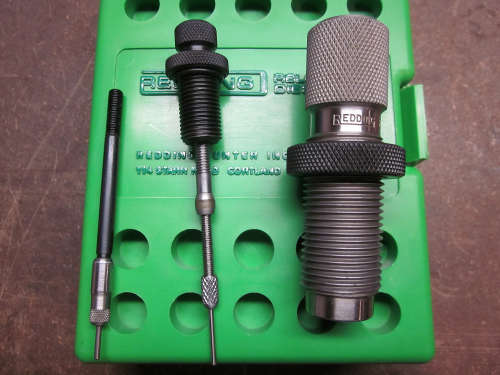
Below my Redding .243 full length die equipped with a modified Forster expander and spindle assembly. This greatly reduces neck runout and you are not dragging the longer Redding expander through the case neck.
You can also buy a floating Redding carbide expander ball.
Redding Carbide Size Button Kit
https://www.midwayusa.com/product/1012424426/redding-carbide-size-button-kit
The Redding Carbide Size Button Kit makes inside neck sizing smoother and easier without lubrication. Now you can upgrade any Redding Full Length, Neck or Type S sizing die. Available for bottle neck cartridges 20 thru 338 cal. The carbide size button is free floating on the decapping rod allowing it to self-center in the case neck.
To many reloaders think using a expander is the end of the world because of what is said and spread on the Internet. And if the inside of the case neck is lubed with the proper size expander you have nothing to worry about.
FL Bushing Dies vs. Honed FL Dies
http://www.accurateshooter.com/technical-articles/reloading/fl-bushing-dies-vs-honed-fl-dies/
Below Forster will hone the neck of your Forster dies to your desired diameter. And there is a reason why reloaders anneal their cases and make their cases last longer. I have never had to hone any of my Forster dies because they do not over resize the case necks when using unturned brass.
Weekly Gear Update – Forster Honed Dies
Posted by 65guys
http://www.65guys.com/weekly-gear-update-forster-honed-dies/
Thanks for the great info!
My understanding is correct. The OP is discussing a Type S die, which is a neck bushing style die. If you are using a bushing die to size the neck, it should NEVER undersize the internal diameter of the neck more than bullet size -0.002 inches to provide proper tension. Any additional undersizing via using a smaller than necessary neck bushing is just working the neck excessively which will lead to eventual neck cracking. If the neck is undersized then the sizing ball will have to expand the case and pulling it through also pulls the case, lengthening it slightly which will mean trimming will be required more often. I have measured my expander balls and they are all 0.002 to 0.0025 inch smaller than the corresponding bullet size. If one wants to dispense with concentricity checking followed by proper neck turning prior to using neck bushing dies and just reload, I suggest using the Lee collet neck die. It squeezes the brass from the outside onto a mandrel sized 0.002 inch smaller than bullet size and will work on pretty much all brass. It expands any neck dents and dings as well.
If one is using a standard full length sizing die which resizes the entire case, please recognize that it is a median tool designed to work on multiple makes of brass and which relies on neck wall thicknesses to be within a certain range. Brass neck hardening is ignored. They always seem to undersize the neck excessively, at time up to 0.004 inch as they have to 'work' on all makes of brass, and yes, when the expander is pulled back through it can be more than interesting if one hasn't lubed both the inside of the neck as well. At any rate, it doesn't take long to recognize that really is a poor way to get long life out of expensive brass and one starts looking for the equipment within their budget to do it 'properly'.
Thanks!

If you are planning on getting the Lee Collet Neck Die, be forewarned that some people have a bit of trouble with them. They do require maintenance which means that every 250 to 500 cases or so one should take them apart, clean with a soft rag, re-lube with light oil and put them back together. They are dead simple to disassemble and reassemble, taking no more than 5 or 10 seconds to take apart and put back together without any tools required. One caveat is to NEVER close the press on one that does NOT have a piece of brass in it. That can permanently damage the die if done with enough force. Normally it will just close up the collet fingers slightly which will have to be carefully opened so that they let the case neck in on the upstroke. I have at least 5 in different calibers for my bottleneck cases which I use regularly and only one really gives me any grief. It tends to start 'sticking' after about 100 rounds, not releasing the case easily. I have to go through the cleaning process far more regularly with it. I have looked at it carefully and I cannot see where it is any different than any of the other ones. It is newer but I have used it at least 1000 times. Might have to polish up the collet contact area, but I keep hoping it will get better with more use. Some people have also posted that the quality control is not as good as could be and that the interior collet surface is not as polished as it should be. For now, as soon as I start to feel that 'grabbing' on the upstroke indicating the sticking is starting, I quickly clean it as above and it goes back to working so smoothly one can't tell it is really doing anything at all. If I decided to go about polishing the collet surface, it would take me a half hour or more to do properly, and I would end up with a die which would still require about 60 seconds to clean every 250 to 500 cases anyway.





















