












































You are using an out of date browser. It may not display this or other websites correctly.
You should upgrade or use an alternative browser.
You should upgrade or use an alternative browser.
Determining Beretta fixed chokes?
- Thread starter Thinking
- Start date

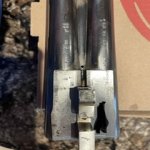

There is not enough resolution in your picture to read the numbers with confidence.
Bore and choke diameter will be stamped in millimeters.
If the gun is 12 gauge you expect a bore diameter of about 18.4 mm and choke is the difference between bore diameter and choke diameter.
0.1 mm is about .004 choke.
Bore and choke diameter will be stamped in millimeters.
If the gun is 12 gauge you expect a bore diameter of about 18.4 mm and choke is the difference between bore diameter and choke diameter.
0.1 mm is about .004 choke.


Falconflyer
CGN Ultra frequent flyer
.40 inches usually defines "extra full" and .35 is "full". Those older Beretta's were choked pretty tight!
.40 inches usually defines "extra full" and .35 is "full". Those older Beretta's were choked pretty tight!
Thanks I was not sure . I was under the impression that . .030" got you to full . would I be wrong in thinking nominal bore diameter for vintage north american guns would be .729" with full being around .700" . I would think the gun would likely throw some tremendously tight patterns .with some of the newer felt wad loads available from game bore and the like .
Thanks I was not sure . I was under the impression that . .030" got you to full . would I be wrong in thinking nominal bore diameter for vintage north american guns would be .729" with full being around .700" . I would think the gun would likely throw some tremendously tight patterns .with some of the newer felt wad loads available from game bore and the like .
Falconflyer
CGN Ultra frequent flyer
.729 give or take is a pretty good asumption on older guns but I've seen lots of them marked "full' and measuring .690
Traditional 12 gauge full choke was 0.040, but recently lesser constriction is the norm.
ht tp://www.hallowellco.com/choke_chart.htm
Fix the http
This is correct to a point. The actual amount of choke in a given barrel is truly measured by pellet count in a 30 inch circle at 40 yards with a particular load. Many things can vary this percentage count up or down so true choke degree is not constant in all instances in a barrel. .040 was the generally accepted degree of constriction by most makers for 12 gauge before plastic wads with shotcups became standard but modern ammo requires less constriction (.035 typically or less) to achieve the same results. Different gun and choke manufacturers use slightly different constrictions to achieve any given degree of choke, depending on among other things the type of ammo and type of barrel and choke boring methods. For example, a choke tube marked FULL can have a different internal dimension for Beretta, Browning, Briley, Blaser, Carlson, etc. All marked FULL but different bore sizes. And then just to complicate things the smaller gauges need less constriction to achieve the same amount of choke. It’s a very imprecise and complicated subject.

Falconflyer
CGN Ultra frequent flyer
Groan...... 





















