












































Detrimental to accuracy??? Case neck thickness, burr.

Kelly Timoffee

BANNED
BANNED
BANNED
EE Expired
Rating - 100%
52   0   0
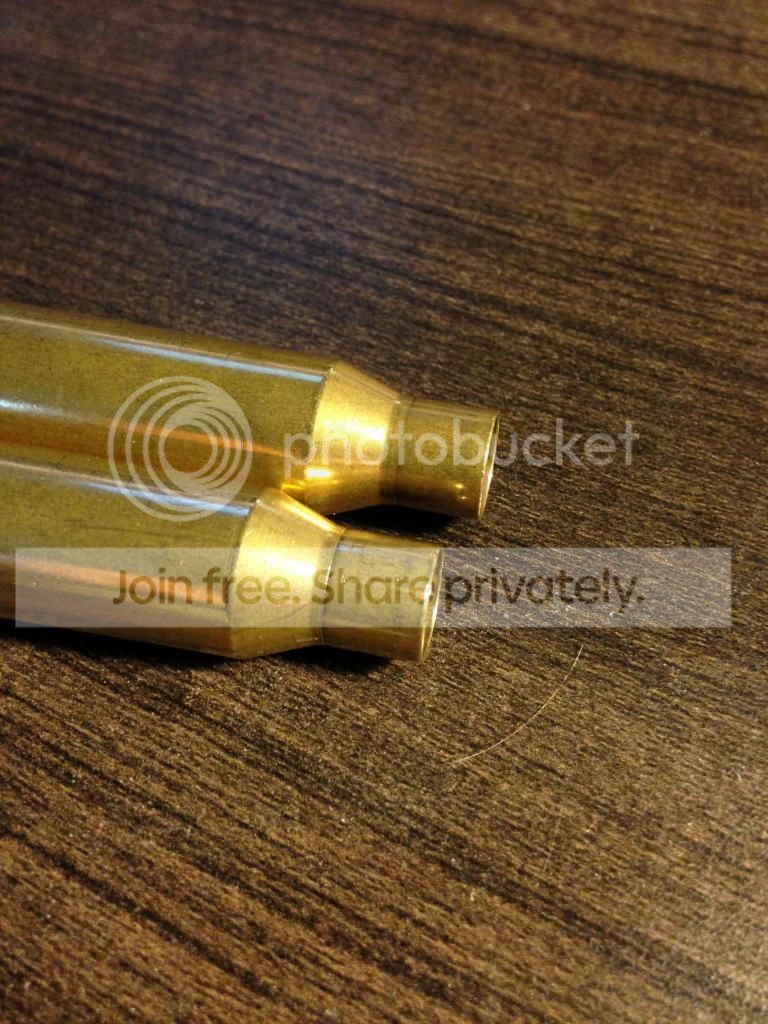
These cases have been neck sized(bushing), fired and cleaned.

I have them sized to give me about 0.0015" interference.

After sizing I cycled the brass to ensure smooth function, and did not have issues with chambering loaded rounds for shooting during load development.

I am wondering if the more experienced loaders out there feel that pushing this extra brass down the neck will effect accuracy much or if I am over evaluating my process.

FYI, I will be neck turning the brass once I receive the proper pilot for my equipment.


You do not say what cal, match barrel or just a factory rifle
Far from a expert, but the way I see it

Looking at Brass -- where the neck meets the shoulder I see a line ---- a sharp transition is a stress riser--- your brass will most likely fail there

Brass in the neck is too thick when you fire a round and when you try to insert a new bullet in the fired / unsized brass the bullet will not go in
thick brass and a very tight chamber = Problems
 
Just a factory chamber/barrel. The line is above the neck/shoulder junction I stopped before the transition, I am hoping to turn the necks and defect down.The photo does exaggerate the line quite a bit though.

A bullet pretty much drops right in, just a slight touch to get it aligned, and down it goes.

You do not say what cal, match barrel or just a factory rifle
Far from a expert, but the way I see it

Looking at Brass -- where the neck meets the shoulder I see a line ---- a sharp transition is a stress riser--- your brass will most likely fail there

Brass in the neck is too thick when you fire a round and when you try to insert a new bullet in the fired / unsized brass the bullet will not go in
thick brass and a very tight chamber = Problems
 
That "sharp transition" is not what it seems. This is simply where the bushing stops sizing the neck and will cause no problem at all.....ever. If the brass eventually forms a doughnut, sizing with an expander button will push most of the doughnut to the outside where you can turn both the doughnut and the unsightly bushing ring off until the next sizing session. The short space below the line (and above the shoulder/neck junction) where the bushing ends its stroke is just the fire formed diameter of the neck - visible due to the slightly smaller diameter of the newly sized portion.

Thick necks is not the only reason for a tight neck after firing. Work hardened brass that has lost its 'spring' is another reason.

How many times has this brass been fired? When you turn the necks, don't be afraid to cut into the shoulder a very slight amount. This helps down the road with doughnuts by thinning out the portion of the shoulder (thicker material in the shoulder) that will eventually flow into the neck. You should just barely feel the cut on the shoulder - slight enough that you wonder if it's just your imagination. And when you set up your cutter, don't make it so it cleans up 100% around the neck. This will help you see thickness variations if you don't have an accurate tool to measure it with.

Go at it slowly and deliberately. I've never seen the benefit to cleaning up any more than about 75% around the OD, as the difference in the remaining uncut portion is usually less than .0005".

Have fun!
Rooster
 
These are new Lapua cases, I will just now be getting into the 1F of brass.They were factory annealed, I will like do them again at 3 or 4 firings.

Usually when I turn necks I do almost exactly as you state Rooster, 50 - 75% of the surface is trued/cleaned up.
 
Honestly Kelly, I wouldn't bother with turning that brass unless you start to see something happening with the necks. I truly doubt you'll see any benefit whatsoever - especially in a factory chamber. It's entirely up to you but personally, I've found more value in analyzing my diet prior to a shooting session than to fuss with Lapua brass until about the fifth or sixth firing.

Rooster
 
When you start to outside neck turn, you will quickly see how wonky the necks actually are and how much brass will flow into the base of the neck.... after every firing.

Bushing neck dies demand that the thickness of the case neck be consistent and concentric. Otherwise you are creating a wonky hole for the bullet to seat into.

I prefer to size to the base of the neck and avoid leaving a ridge. That area will thicken and very quickly you will create donuts. It might happen in a firing or two. When you size, you push that ridge into the inside of the case neck forming a tight spot which can really affect not just seating but bullet release.

Then proper annealing.

This extra care will not make an MOA barrel into a 1/4 min barrel but it will stop good barrel from shooting poorly. A big area for resolving flyers.

Jerry
 
When my tools arrive I will tune up the necks and see what happens.

Should a fellow turn until that bushing die doesn't create that ridge when sizing?

I don't seem to get this happening(ridge) on other cases I size.
 
Ok, finally got around to checking the necks, average run out on the necks was .003"-.004" with the very odd one being as far as .008".

Not sure what one deems as reasonable in this area.

I am turning necks right now, will load some charges based on my last ladder test and hope for the best.
 
Ok, finally got around to checking the necks, average run out on the necks was .003"-.004" with the very odd one being as far as .008".

Not sure what one deems as reasonable in this area.

I am turning necks right now, will load some charges based on my last ladder test and hope for the best.

That much variance in neck thickness seems pretty odd for new Lapua brass. Are you using a proper tube micrometer to measure it?

In any event, if it is a factory chamber you probably won't have any issues with the neck being too thick as the chamber will probably be a little on the loose side. If you can't meaure the neck wall thickness with high enough resolution I would just keep skim-turning enough to clean up 80-90% of the neck. Mystic hit it on the head that the goal when turning is to make the neck wall thickness consistent so the bushing can do its job properly. How thick you make the neck would normally depend on how you spec'd your chamber neck diameter, but you can't change that here.

Make sure you are using a properly matching mandrel to expand the neck prior to turning. An expander from your sizing die "might" by coincidence match the pilot on the turner but check to be sure. You don't want the ID of the neck too big for the pilot when you go to turn. My K&M expands the ID of the neck to about 1/2 thou larger than the pilot on the turner.

Great article here on case prep.

h ttp://www.accurateshooter.com/technical-articles/reloading/complete-precision-case-prep/
 
Simple solution to all of it,,,first use a Lee collet die, then a redding body die for .001-.002 shoulder bump,,,,
 
I would love to get a collet die but it isn't very easy.

Gotta ship brass and bullet to Lee and they will make it, which I have no problem doing but highly doubt that it would get there or back to me over the border.

Been started first stage of turning, ).016" to 0.017" thickness after first turning.This still left some untouched.

Going to try go to remove another thou. or so see where that gets me.


Same case at about 0.015" thickness.

Nice focus on counter top!! frick!!
 
Last edited:
Ok, here is what is the final findings.

My neck round out now would likely average around 0.002" to 0.003". I think one was 0.005"

For ####s and giggles I checked the body , Didn't see it go over 0.0015" on any of the cases.

Neck thickness is from 0.0125" to 0.0135" .

I will take these cases now and use them for my next batch of tests, thanks for the input from everyone.

I tried to check bullet run out but the loaded shell is too long for the tool.
 
A couple replies suggest there is no reason to outside neck turn Lapua brass. I have 400 rounds of 6.5X47L and case thickness varied as much as .004" and that's enough to destroy the "zero" bullet run out everyone is trying to achieve. I turned the necks to .011" to give loaded rounds .004" neck/chamber clearance. Turning the necks didn't end all my problems. Still had bullet run out. Turns out the Redding coated bushing was reamed crooked. Replaced that with a Wilson bushing that was straight. Lapua brass is not perfect. Redding bushings may be crooked.
 
^^^^This^^^^

I just struggled with a new custom 260, and was using 1-3x fired Lapua brass. The chamber was cut to 0.296, bullet was 0.264, and brass was .016 - 0.02 neck thickness.... so simple math, I was (on average) pushing 0.30" loaded rounds into a 0.296" chamber...no wonder I had pressure signs, fliers, and couldn't get it to shoot!
Turned the necks to 12.5 - 13 thou and all is good. Lee collet neck sizer, and a Forster comp seater, is giving me 1-2 thou runout.
So NO, some Lapua brass DOES need some lovin' before its at its best, at least in some rifles - best to check it!
 
Back
Top Bottom





















