
I haven't found a general consensus one way or another. I'm still hoping someone can point me in the right direction. I'm starting to reload and have a Rem 700 in a choate stock, .308, 20" heavy barrel. I've been told bedding is more for wooden stocks and it's a waste of time in a modern composite stock that already has aluminum bedding blocks. Hoping for some answers. Thanks guys













































You are using an out of date browser. It may not display this or other websites correctly.
You should upgrade or use an alternative browser.
You should upgrade or use an alternative browser.
Do all rifle stocks need to be bedded to achieve good consistency?
- Thread starter Willerton
- Start date
I would say it depends on the rifle.
I have a Weatherby Vanguard II, synthetic stock, NOT free floated or bedded and it shoots 1/2 groups @ 100 yards (from a shooting vice) with Federal Blue box ammo (80 grain soft points).
My wood stocked Sporter model (another Vanguard II in 7.08) shoots 5/8" to 3/4" groups with Fed Fusions (120 or 140 grain respectively) - it likewise is NOT free floated or bedded.
I can't imagine "messing" with either rifle. If I take them out of the vice and shoot front supported only, because I'm a little shaky, the groups open up to a little over an inch so if there is anything to improve it's my shooting technique, not reworking the rifle.
You will get varying views, some for, some against.
Personally I would work with the rifle first and if you can't get acceptable accuracy varying the loads, brands etc and you are positive its not your shooting skills that are the issue, then consider working on the stock.
If it isn't broke, don't fix it until you are sure it's a problem.
I have a Weatherby Vanguard II, synthetic stock, NOT free floated or bedded and it shoots 1/2 groups @ 100 yards (from a shooting vice) with Federal Blue box ammo (80 grain soft points).
My wood stocked Sporter model (another Vanguard II in 7.08) shoots 5/8" to 3/4" groups with Fed Fusions (120 or 140 grain respectively) - it likewise is NOT free floated or bedded.
I can't imagine "messing" with either rifle. If I take them out of the vice and shoot front supported only, because I'm a little shaky, the groups open up to a little over an inch so if there is anything to improve it's my shooting technique, not reworking the rifle.
You will get varying views, some for, some against.
Personally I would work with the rifle first and if you can't get acceptable accuracy varying the loads, brands etc and you are positive its not your shooting skills that are the issue, then consider working on the stock.
If it isn't broke, don't fix it until you are sure it's a problem.
Last edited:

How much improvement, if any depends heavily on how bad it was to begin with. Most of my rifles end up getting bedded, but sometimes there's no difference that can be detected. Bedded rifles are less likely to change zero when the stocks are removed and replaced, and we like to think are a little less likely to move in the first place. That's a hard thing to prove unless there was a existing and known problem to get rid of.
Vanguard 11s may just be bedded with hot melt glue, but they are still bedded and they meet their 1 MOA warranty with weatherby factory ammo. I've got a couple that I'll never mess with because there are times to leave well enough alone.
Vanguard 11s may just be bedded with hot melt glue, but they are still bedded and they meet their 1 MOA warranty with weatherby factory ammo. I've got a couple that I'll never mess with because there are times to leave well enough alone.
My reason for asking is I've been told to not bother working up any load unless you're bedded. I've done up a few hand loads and it shot better than the factory stuff I was using but a far far cry from MOA, never mind sub. If I do keep it as is and find a load that performs well, but just not quite good enough, and I bed my rifle later, I have to start all over again, right?

My reason for asking is I've been told to not bother working up any load unless you're bedded. I've done up a few hand loads and it shot better than the factory stuff I was using but a far far cry from MOA, never mind sub. If I do keep it as is and find a load that performs well, but just not quite good enough, and I bed my rifle later, I have to start all over again, right?
Groups that are a "a far cry from MOA," are often the cause of the shooter.
A 20 inch heavy barrel in a 700 action should easily be capable of MOA groups off the bench.
Also, while some rifles shoot best with free floating barrels, many others shoot best with pressure under the barrel at the front of the stock. Your short, heavy barrel is of the type that likely will shoot best free floated.
If you want to use your hand loaded cartridges, get a well known load of something like varget, with a normal, 165 grain bullet and load the exact same load while you figure out your rifle. You could shoot a couple at a lighter load, but go to maximum load in a mainstream manual as soon as you can, then stick to that load, without varying anything, until you decide if it is you or the rifle that needs working on.
there are any number of fellow that bed every rifle they own. I have never had one bedded yet. I suppose I have been fortunate enough to work at finding loads that my rifles shoot well. Now I have never tried using an after market stock on any of my rifles, that could make a difference?
I have found in my personal experience that trigger weight has played the most improvement in my shooting. at about 30 to 34 ounces of pull I do my best work at the range, although many will say this is too light for a hunting rifle. FS
I have found in my personal experience that trigger weight has played the most improvement in my shooting. at about 30 to 34 ounces of pull I do my best work at the range, although many will say this is too light for a hunting rifle. FS
H4831- I'm sure I can improve my technique. Especially because I haven't really established much of a routine yet, but I'm also only shooting 200 yds right now. I was using hornady 150 gr but I couldn't get anything to group worth a darn. That's what got me on the whole bedding thing. I am going to switch to Speer target/match 168gr bthp and try that. And start over. Another thing, I also wasn't crimping my rounds and a guy I talked to said you have to crimp all the target rounds to get consistent neck tension, yielding more consistent pressures. Makes sense I suppose. I know I have a lot of variables right now!

I bed every rifle that I want to shot well.
There are two elements to accuracy. Most guys look at group size. That tells you how those 5 or 10 shots grouped, but does not predict where they will group, next time.
If you want a rifle to group well and to shoot to the same POA one day to the next, bedding becomes even more important.
For your Remington, make sure the barrel is floating. A light bedding on the bottom of the action, front to rear, will help both accuracy and consistency.
If it has metal pillars, use 65 in/pounds of torque. Rifles in wood should not use more than 32.
There are two elements to accuracy. Most guys look at group size. That tells you how those 5 or 10 shots grouped, but does not predict where they will group, next time.
If you want a rifle to group well and to shoot to the same POA one day to the next, bedding becomes even more important.
For your Remington, make sure the barrel is floating. A light bedding on the bottom of the action, front to rear, will help both accuracy and consistency.
If it has metal pillars, use 65 in/pounds of torque. Rifles in wood should not use more than 32.
Here is a demonstration of exactly what we are talking about on this thread.
A while ago I acquired a 30-06 with a FN Supreme action, with Sako trigger, made into a rifle by Marlin about 1952, who put a 22 inch micro groove barrel on it. I guess they allotted a batch for Eaton's to sell, because this one is marked into the barrel, "EATONS OF CANADA TRUELINE MODEL 100."
I took a very well known load for a 30-06, 57 grains of 4350 behind a good, standard hunting bullet of 180 grains.
As soon as I got on the paper I fired five shots, one after the other, so the barrel will heat up. That group is shown in the first picture. I was sure the rifle was capable of better than that, so took it home and went to work on it.
I tweaked up the seating of the recoil lug, with a hardening glue, sanded a bit in the barrel chamber and tried again. Picture 2, not good enough.
Pressure under the barrel, Still not good.
So I sanded out the barrel channel and my pressure point, making sure it free floated.
Got the five shot group that probably my built in wobbles moved one less than have a hole out of MOA. picture 3.
I then changed powder to 60 grains of Norma MRP and made MOA, but only fired four shots. I feel the rifle will now shoot any descent ammunition just fine.
By the way, the rifle barrel is thin at the muzzle, but has quite a taper to it, so that would indicate free floating would work fine.


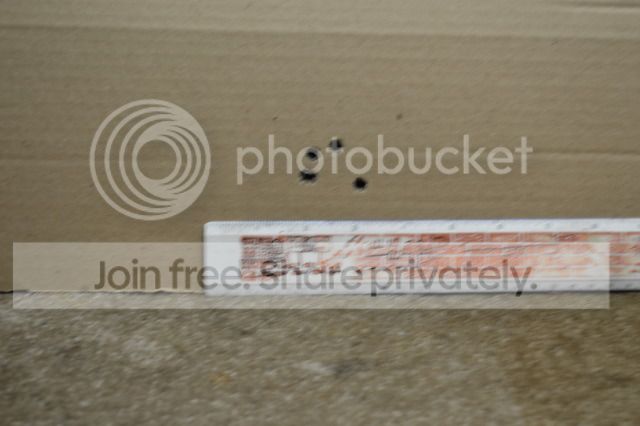
A while ago I acquired a 30-06 with a FN Supreme action, with Sako trigger, made into a rifle by Marlin about 1952, who put a 22 inch micro groove barrel on it. I guess they allotted a batch for Eaton's to sell, because this one is marked into the barrel, "EATONS OF CANADA TRUELINE MODEL 100."
I took a very well known load for a 30-06, 57 grains of 4350 behind a good, standard hunting bullet of 180 grains.
As soon as I got on the paper I fired five shots, one after the other, so the barrel will heat up. That group is shown in the first picture. I was sure the rifle was capable of better than that, so took it home and went to work on it.
I tweaked up the seating of the recoil lug, with a hardening glue, sanded a bit in the barrel chamber and tried again. Picture 2, not good enough.
Pressure under the barrel, Still not good.
So I sanded out the barrel channel and my pressure point, making sure it free floated.
Got the five shot group that probably my built in wobbles moved one less than have a hole out of MOA. picture 3.
I then changed powder to 60 grains of Norma MRP and made MOA, but only fired four shots. I feel the rifle will now shoot any descent ammunition just fine.
By the way, the rifle barrel is thin at the muzzle, but has quite a taper to it, so that would indicate free floating would work fine.


Yes the barrel is fully free floating. And it has a full aluminum bedding block. I took the action out about 3 hours ago and the wear marks seem to indicate good contact front and back and along both sides. I bought an in-lb torque wrench just last wknd for this very reason. 65 in-lbs it will be then. I'm starting to think the bedding thing will have to wait. I'll see what I can accomplish as is. Back to a comment I made earlier, is crimping a requirement? The theory behind it makes sense to me.
Yes the barrel is fully free floating. And it has a full aluminum bedding block. I took the action out about 3 hours ago and the wear marks seem to indicate good contact front and back and along both sides. I bought an in-lb torque wrench just last wknd for this very reason. 65 in-lbs it will be then. I'm starting to think the bedding thing will have to wait. I'll see what I can accomplish as is. Back to a comment I made earlier, is crimping a requirement? The theory behind it makes sense to me.
Well, the enlarged groups are most likely caused by either, or both, of you or the rifle and you are making the rifle sound better all the time!
Do you have a friend who is a known good shot who would shoot it for you, then go from there?
Oh oh. I'm glad at least the rifle is sounding good. Well, I'm not exactly a slouch at shooting. I've been shooting since I was a boy, even have some medals from back then, just local Boy Scout stuff. Just this rifle and the whole reloading thing is bit newer to me. And no, I don't have any friends who are a better shot than I. Not sure if I don't have any friends or if they just can't shoot lol! Just kidding of course
Well, it does take some effort to get the rifle properly tuned. What I have told on mine here is quite condensed, it happened over a period of a couple of weeks, required several trips to the range and I even changed scopes during the trials, just in case it was the scope.
As it turned out it wasn't the scope, because I put the suspected scope on my very accurate 243 and the scope shot and adjusted properly. But I put my old faithful, a Texas Weaver steel tubed K6 which I bought in the 1970s to go on a custom built 243, to use in a specialty shooting competition that was all the rage in BC and Alberta at the time. That scope has never let me down, so I could concentrate on the rifle.
I also never considered changing the load.
So stick with it, eventually you will be showing us groups in the MOA range and it will be a great satisfaction for you.
As it turned out it wasn't the scope, because I put the suspected scope on my very accurate 243 and the scope shot and adjusted properly. But I put my old faithful, a Texas Weaver steel tubed K6 which I bought in the 1970s to go on a custom built 243, to use in a specialty shooting competition that was all the rage in BC and Alberta at the time. That scope has never let me down, so I could concentrate on the rifle.
I also never considered changing the load.
So stick with it, eventually you will be showing us groups in the MOA range and it will be a great satisfaction for you.
- Location
- Western Manitoba
Just a general observation about threads like this - every rifle is "bedded"! "Bedding" is the fit (done well or not) between the metal and the wood - particularly between the recoil lug and the barrel tension. As per people like Ross Seyfried and others, there are rifles from 1890's that have full barrel contact, that shoot exactly to their sights, with the proper loads, today. Lee Enfield No. 4's were designed to have "up" pressure from the fore-stock to the barrel, not to be "free floated". Asking if a rifle should be "bedded" is pretty much a non starter - if it is bolted together, it is bedded. So the proper question is about actually about improving or modifying bedding. And I can pretty much guarantee that if you are having issues on target with an original Daniel Fraser, it is you, not the rifle ...

Was on the Thread To Bed Or Not To Bed the other day, as I was asking questions about Bedding as well and Free Floating barrels. Found this video which I thought was very well done and now I am definitely getting my rifle glass bedded and will have the stock modified so that the barrel is free floating!
Go to:https://www.youtube.com/watch?v=yqQlYCTw78Y
Go to:https://www.youtube.com/watch?v=yqQlYCTw78Y

No. I own a Ruger M77 in 7MM Rem Mag and it is dead on from day one. And others, yes it helps, solely depends on the rifle and how the harmonics are running. If you have one that just won't tune easily, it's well worth giving it a try. It's very easy to do, watch some You Tube vids, like I did. It helped my restocked SKS big time! IMHO
I also bed all my rifles at least ensure that the rear of the recoil lug is a perfect fit against the stock. A couple of other things could be causing the problem. Make sure the recoil lug is not bottoming out in the recess. Check your crown and you can also check to see if both locking lugs are evenly contacting the receiver. There will be wear marks on them by now and both lugs should show even contact. Try flat base bullets to see if that helps.
Neil
Neil
^^ Like he said.
Sometimes I bed a rifle with a "skim coat" of bedding compound if it is shooting well and I just want it to be more stable, day to day.
I would use a chisel to remove a little wood along the action area, to give the goop some bite. I use Devcon F putty (aluminum) but you could buy a tube of metal powder epoxy for the job and smear about 3 mm of goop along the stock action area. Use mold release or buffed paste wax as a release agent.
Sometimes I bed a rifle with a "skim coat" of bedding compound if it is shooting well and I just want it to be more stable, day to day.
I would use a chisel to remove a little wood along the action area, to give the goop some bite. I use Devcon F putty (aluminum) but you could buy a tube of metal powder epoxy for the job and smear about 3 mm of goop along the stock action area. Use mold release or buffed paste wax as a release agent.





















