Do Not Neck Size!?

Boomer686

Northern Mod
Moderator
Rating - 100%
550   0   0
Location
The Big Land
I was reading an article last week (damned if I could find it again) written by either a Lapua employed pro shooter or Lapua sponsored pro shooter that absolutely recommends against neck sizing. It went on to say that in extensive testing no advantage was found by neck sizing alone and that full length resizing pretty much always yielded better accuracy.

Trying to find this article again for a point of reference for a buddy of mine: anyone else come across it anywhere?
 
...but FL resizing will shorten case life most of the time.

So it's not really so surprising that a brass manufacturer recommends FL resizing if it means they get to sell you more brass. :)
 
I have found that neck sizing does give better results in all my rifles. Keeping the case perfectly formed to the chamber and only allowing the neck to hold the bullet is a sensible way to do it. As far as full length resizing giving better accuracy, if that were true, why do all the bench rest shooters neck size only? My 30+ years of reloading experience tells me neck sizing is superior. Hunting loads are different as you need them to chamber in any circumstances and that rules out tight fitting neck sized ammo.
 
Last week my brother tried to tell me you can't use neck sized brass in the field, because a bit of dust would be enough to impede chambering.

Now Lapua says FL is best for accuracy.

Who is a guy to believe!?

(for the record I told my bro whoever told him that is wrong...)
 
...but FL resizing will shorten case life most of the time.

So it's not really so surprising that a brass manufacturer recommends FL resizing if it means they get to sell you more brass. :)

You don't have to over size the brass. Bumping the shoulder 2 thou brass will last a long time. I have experienced this myself
 
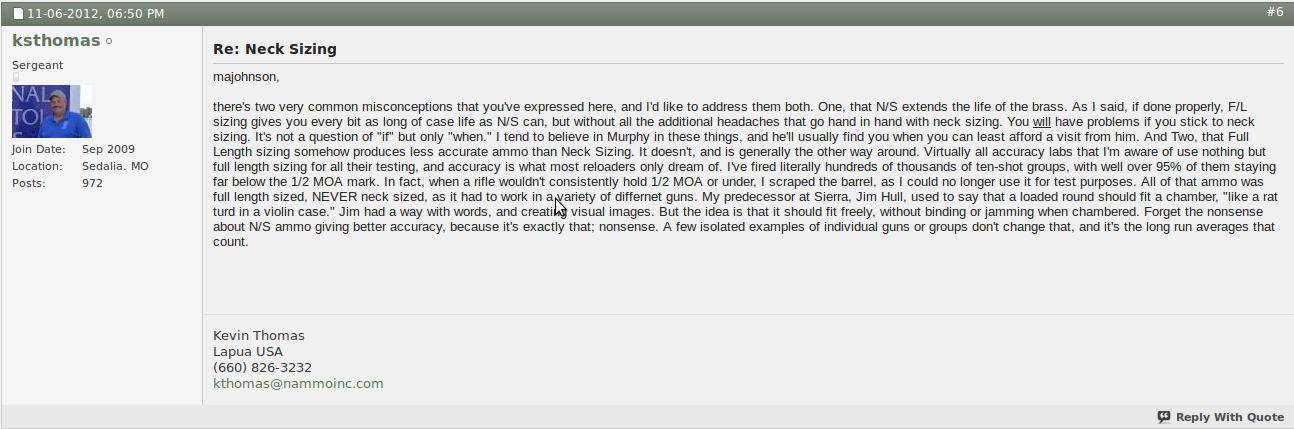
Below Kevin Thomas worked in the Sierra ballistic test lab and now shoots for Team Lapua USA.
And Kevin Thomas is a member of "The cartridge should fit the chamber like a rat turd in a violin case" club. (meaning he full length resizes all his cases)

Y3IiYL5.jpg


Below German Salazar is answering a question about "Partial Full Length resizing" from his website "The Rifleman's Journal". Mr. Salazar also knew and shot with Jim Hull and full length resized all his cases. Below he explains that full length resizing gives the bullet "wiggle room" to be self aligning with the bore.

Reloading: Partial Neck Sizing
by German A. Salazar
http://riflemansjournal.########.com/2010/06/reloading-partial-neck-sizing.html

"Now the last scenario, a full-length sized case in which the neck is also fully sized. There is clearance at the neck and in the body of the case, the closest fit anywhere is the bullet in the throat. If the neck to bullet concentricity is good (although it needn't be perfect), then the bullet will find good alignment in the throat and the case body and neck will have minimal influence. Let's not forget that the base of the case is supported by the bolt face or the extractor to a certain degree as well; this is yet another influence on alignment. As you can see, there are several points from base to bullet that can have an effect. My procedure is to minimize the influence of those that I can control, namely the case bodngy and neck, and let the alignment be dictated by the fit of the bullet in the throat and to some extent by the bolt's support of the base. Barring a seriously out of square case head, I don't think the bolt can have a negative effect on alignment, only a slightly positive effect from minimizing "case droop" in the chamber. Given that a resized case will usually have a maximum of 0.001" diametrical clearance at the web, this isn't much of a factor anyway."


Bottom line, if the case has unequal case wall thickness the thin side will expand more when fired and warp and become banana shaped. And by full length resizing you reduce the guiding effects of the case body with bullet alignment in the bore. On a full length resized case the only part of the case that contacts the chamber is the shoulder. And the body and neck of the case does not touch the chamber walls. You will also find that the majority of competitive shooters are full length resizing. ;)

NOTE, at the Whidden custom die website they tell you that non-bushing full length dies produce the most concentric ammunition. When reducing the neck diameter .004 or more with a bushing die it will induce neck runout. This is because the bushing floats and can move from side to side and even tilt when sizing the case neck. Bushing dies work best with custom tight neck chambers with neck turned brass. So the average shooter with a off the shelf factory rifle with a SAAMI chamber is better off full length resizing with Remchester brass.

The only rifles I neck size for are my old milsurp rifles like the .303 British Enfield with their long fat chambers that do not conform to SAAMI standards.

NECO CONCENTRICITY, WALL THICKNESS AND RUNOUT GAUGE (and yes there is such a thing as a warped banana shaped cases and gauges that check for this)

NEWDIAL2.JPG


1) The curved "banana" shape of the cartridge case;
2) The relative wall thickness variation of a cartridge case;
3) The cartridge case head out-of-squareness;
4) Individual Bullets - out-of-round "egg shape" and/or
curved "banana" shape (excepting very small bullets);
5) The seated bullet and cartridge runout of loaded rounds. The accuracy of any firearm is determined -- and limited -- by the quality of the ammunition shot in it. The effect of imperfections in ammunition is cumulative; each flaw adds to the influence of all others. Precision shooters spend much time and effort "uniforming" cartridge cases, using advanced techniques to eliminate variation. Yet until recently, one of the most important of these variations has not been susceptible to detection by any device readily available to marksmen.


Normal manufacturing tolerances cause brass cartridge cases to vary in wall thickness around the circumference of their bodies. Under the stress of firing, a case with such variation stretches more readily along its thin side, transferring more pressure to the bolt face at that point and introducing an unbalanced force which contributes to bolt whip and vibration of the barreled action in its bedding. This whip and vibration varies from one shot to the next as cartridges are fired with their thin sides randomly oriented at different angles, causing reduced accuracy. The problem is made even worse if the brass is too hard or springy to completely fireform to the shape of the chamber, in which event the greater stretching of the case's thin side will cause it to develop a curve along the length of its body. These "banana" cases cannot hold a bullet aligned with and centered in the bore, undercutting the effectiveness of the handloader's careful case preparation.

Fortunately the accuracy problems caused by wall-thickness variation can be minimized, or perhaps eliminated, if all cases are "indexed" -- fired with their thin sides always oriented the same direction in the chamber. This causes bolt whip to be minimized and consistent, and, while bullets will still be misaligned, they will all be misaligned the same way, which often produces accuracy like that of perfectly aligned and concentric ammunition.
 
I can't see neck sizing giving better brass life than full lenght resize.
As when full lenght resize for a bolt action, you only set shoulders back 2 thous, and when neck sizing right now, i do have a body die which sets shoulders back 2 thous.

That's a good read Ed, now i'm really confused on what to do.
 
If you have your dies custom cut with the same reamer used to make your chamber....like professional sponsored shooters do, then you can FL size everytime no worries.
We are not so lucky, we have to deal with production barrel chambers, and production dies. So in order to safely FL size repeatedly you need to buy gauges and tools to make sure you are only sizing the brass a minimul amount each firing.... basically mimicking neck sizing, but at an additional cost and risk.
 
It boggles the mind that something that has been 'sorted' out for years continue to pop up.

When you SIZE your brass, you are trying to make it smaller by a very specific amount to fit into a chamber AND the type/style of firearm. Dimensions in rifles vary, especially the chamber... like shoes, not all Size 10 shoes fit the same.

For competition work and bolt action rifles, a headspace shorter by 2 to 3 thou vs the chamber is ideal. Web diameter should be a slip fit into the chamber. Clearance of 3 thous in the upper case near the shoulder is plenty. HOW you get there will depend on the brass, the action style, Chamber, and pressures you intend to run.

So the sizing die(s) and process you choose will depend on the firearm and the tolerances of that system.

Erik's beef is when ammo loaded to high pressure is only neck sized... yes, the fired case will expand eventually causing stiff chambering. That is very bad in a match or hunting situation. BUT I am unaware of any competitor that neck sizes alone... apparently some do.

Most competition shooters will break down the sizing into 2 steps - neck and body - so that we can precisely control what gets sized and by how much.

We will use a die to size the case body and bump the shoulder so that proper chambering is possible.

We will then size the neck so that we get adequate neck tension for load tuning. YES, it is 2 separate needs and should be treated as such.

IF, and this is a big if, you have a chamber that fits a FL sizer AND offers the right type of neck tension... AWESOME. You are a very lucky reloader and treasure that combo. I have only found that a couple of times in many many rifles and dies. The vast majority of FL sizers oversize case necks which can lead to high runout of the seated bullet.

Yes, you can custom make a FL sizer to suit... very common in high end custom rifles but bring money. For far less money and more accessibility, reloaders should choose from dies that will handle each sizing operation to get the desired result.

From your fire formed cases, measure the headspace dimension... size in whatever die you want, compare what happens... if you are pushing the shoulder back more then 5 thou, you will reduce case life and case head separation will occur. If you are sizing the neck more then 3 thou, you will likely have high runout in the seated bullet

So if the 1 die doesn't do what you want, get a couple of dies that will allow you to control each portion of the sizing and get the result that suits your firearm and useage.

Simple....

Jerry
 
Last week my brother tried to tell me you can't use neck sized brass in the field, because a bit of dust would be enough to impede chambering.

Now Lapua says FL is best for accuracy.

Who is a guy to believe!?

(for the record I told my bro whoever told him that is wrong...)

Believe in your rifle!!

if it chambers and shoots.... it's good enough.
 
Indexing the cartridge can help alleviate problems with fireformed brass too. Marking a line along the length of a case and chambering with this mark in the same position for consecutive firings will help ensure better chamber fit if anything is out-of-round.

You just feed your cartridges by hand into the chamber with, say, the line facing up every time.
 
The problem with factory chambers and reloading dies is they vary in size, meaning in length and diameter. I have a standard Lee .223 full length die that reduces the case diameter more and will push the shoulder back further than my RCBS small base die.

Also when you have cases at the minimum of SAAMI diameter and a chamber at the maximum of SAAMI diameter then there is a very good chance you will have a warped case when fired.

Normally a Lee collet neck sizing die will have less neck runout than any other type neck sizing die. The problem with standard neck sizing dies is the case body is not fully supported and concentricity suffers. I prefer Forster full length benchrest dies because they make very concentric cases. "But" out of all the other type neck sizing dies I have, I get the most neck runout with my Forster .223 bushing bump neck sizing die. This is because the case body is not fully supported and the case necks are reduced more than .004 with its bushing.

If you remove the expander from a full length resizing die and size a case it will be as concentric as it will ever be with the least neck runout. "BUT" add the expander and the neck runout will increase if the expander is locked down off center. And this is where the Forster full length benchrest dies are superior, because the high mounted floating expander is always centered and can not pull the case necks off center.asuring

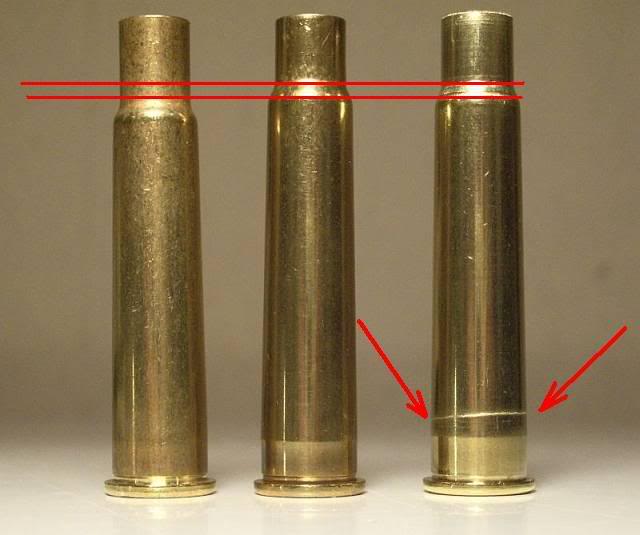
You can tell if your full length die is over sizing the case diameter by measuring a fired case and measuring the case again after sizing. A extreme example of this is full length resizing your .303 British cases fired in a military Enfield rifle. If yo do this you will have case head separations in just a few sizings of the case.

Below the Winchester .303 British case on the right was full length resized twice and almost had a complete case head separation. And this was due to excessive chamber diameter and headspace for a thinner commercial case. Meaning these cases are not made heavy duty and thicker like military brass.

NHlR9jO.jpg


Benchrest shooters use neck turned Lapua brass, have custom minimum dimension chambers and custom dies. And the average shooter/hunter with a factory rifle is better off full length resizing and not worrying about what people with custom rifles and die do. KISS.....Keep it simple stupid

And after over 47 years of reloading and using full length resizing dies the case pictured above is as close to a case head separation as I ever had. And I full length resized this .303 British case intensionally to see how long it would last. And this Enfield rifle had the headspace set below .067 and within SAAMI minimum headspace, and maximum headspace is .074.

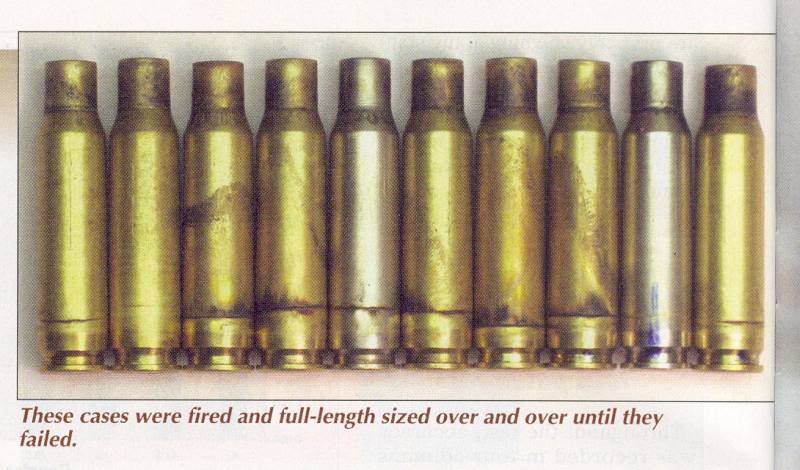
The .308 cases below were full length resized following the dies instructions without setting the die up for minimum shoulder bump. And fired an a brand new Savage .308 rifle, and as you cans see the quality and hardness of the cases played a big part in how long they lasted.

TDwPD1Q.jpg


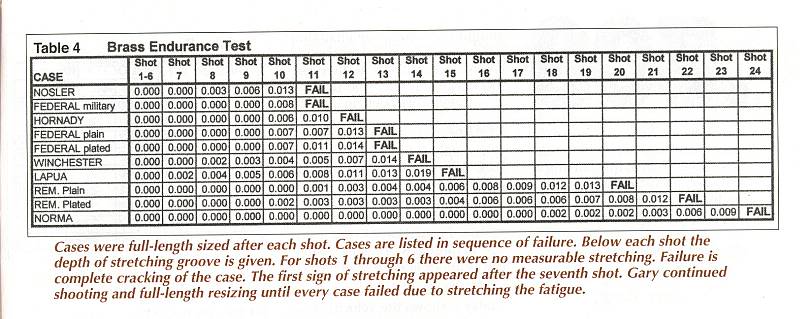
Below be sure to read how much theses cases stretched after each firing and when the case failed. This is why they recommend .001 to .002 shoulder bump when full length resizing. Meaning if you don't give the case room to stretch in the chamber it will last "MUCH" longer.

XEuny9C.jpg


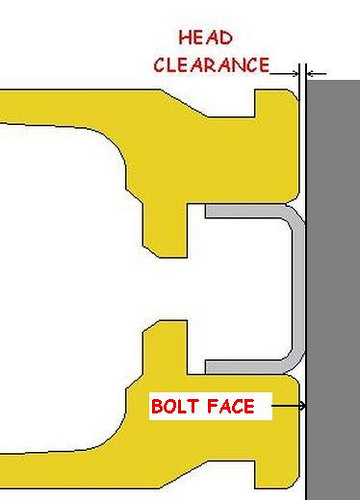
Below your shoulder bump is your head clearance when the cartridge is chambered and .001 to .002 shoulder bump means the case will not stretch beyond its elastic limits. Meaning excessive head clearance is what causes the case to stretch and thin in the base when fired.

HK76WCp.jpg


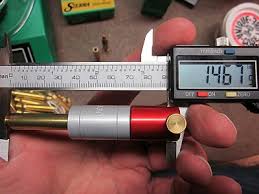
Below measuring a "FIRED" case from my AR15 rifle and then set the full length die for .003 shoulder bump. ;) And you can't do this with a Wilson type case gauge because it doesn't tell you the fired length of the case.
OJqNmQH.jpg


Bottom line, full length resizing is not the end of the world like far too many people think. And if you read the postings at accurateshooter.com and benchrestcentral.com you will see the vast majority of competitive shooters are full length resizing.

So join the "Rat turd in the violin case" club and remember what Kevin Thomas of "Team Lapua USA" said in his posting.

 
These are the references I was talking about from KThomas. Thanks for finding them. Again I was using them for reference for a friend. I'm glad to have got the discussion going though lol.
 
Last edited:
My hunting rifles get full length resized every time.

My varmint and target rifles get neck sized with a lee collet die 3 to 6 times then full length resized because I don't have to mess with cleaning lube off the cases. When I feel some resistance closing the bolt on a full case I full length resize. How soon this happens depends on the batch of brass and how hot. The rifles all shoot very well. My steel banging rifle has shot many half moa 5 shot groups at 6 to 800 yards with neck sized ammo.

I have tools to measure how far I push the shoulder back when I full length resize. I have my dies set for 2 thou on everything. Simply screwing a full length die down to the shell holder is bad for case life, in more than a few of my guns.


 
Back
Top Bottom