












































You are using an out of date browser. It may not display this or other websites correctly.
You should upgrade or use an alternative browser.
You should upgrade or use an alternative browser.
Do you anneal your brass?
- Thread starter Kryogen
- Start date
Never. I have the same bunch of brass (about 1800 Lapua .308) that are on the forth barrel that has been on this rifle. I have only tossed one case because of a split neck and maybe 25-30 because the primer pockets are a little loose (not that the primer pocket has anything to do with annealing).


I anneal to make my brass consistent, not to make it last longer. The lasting longer is a secondary benefit.
I generally anneal after 4-5 firings, you could do it everytime if you had the time for it.
Given the lifetime of AR-15 brass I would not bother annealing it as you will probably lose it before it is fired 5 times.
Since someone has already posted info for an annealing machine from a non-CGN advertiser, I will post my link as well
http://www.canadiangunnutz.com/forum/showthread.php?t=553495&highlight=grizzly
I generally anneal after 4-5 firings, you could do it everytime if you had the time for it.
Given the lifetime of AR-15 brass I would not bother annealing it as you will probably lose it before it is fired 5 times.
Since someone has already posted info for an annealing machine from a non-CGN advertiser, I will post my link as well
http://www.canadiangunnutz.com/forum/showthread.php?t=553495&highlight=grizzly

Rory McCanuck
CGN Regular
- Location
- Middle of Manitoba
I've had good luck so far, doing it every 5th load.
Just roll the case in my fingers with the shoulder
in the tip of flame from a propane torch. Quench
in a cup of water, then mouth end down on a paper
towel in a zip-loc container.
Doesn't take long, and feels a bit like alchemy
Just roll the case in my fingers with the shoulder
in the tip of flame from a propane torch. Quench
in a cup of water, then mouth end down on a paper
towel in a zip-loc container.
Doesn't take long, and feels a bit like alchemy
I neither reload nor anneal for AR15. I have two of them and I buy bulk Federal American Eagle or Remington UMC ammo to feed them. I've 1K of once fired(from my AR15) Federal brass very carefully sorted by weight for my long range rifle in 223 Rem which is still under construction. Once I start shooting it all this brass will be annealed every second time, same like my 308 and 7 SAUM.

I anneal brass on average every 5-6 reloads (I shoot casts-not jacketed bullets)
I use cordless drill fitted with proper size shell holder from Lee trim kit,bowl of water and soldering propane torch from CT-simple,inexpensive and very effective set-up.
Entire operation is done in a room with very dim light (reason why will be explained) and it goes as follows:
1.Case goes into shellholder
2.Bring it up to already lit torch and turn on a drill.
3.Bring rotating case mouth (first 1/8-3/16 only-no more) to the flame.
4. Watch case mouth heat up to dull red color (not bright)
(Here is why dim light is important-you have to be able to see dull red come up on the case)
5.As soon as case mouth is heated dip in the water.
(btw-cases should be de-capped.Water drains a lot faster from cases)
6. Remove case from shell holder and insert next case.
After entire operation check cases and bluing on them-bluing should extend a bit past the shoulder.It's a good idea to compare results with factory cases if they still have bluing on them from annealing.I dry my cases by simply throwing them into tumbler for maybe an hour.
I learned this on 223 cases -I had so many of them I didn't care if some got burned in process of learning.It is a simple process and it doesn't take much time.
BTW-I neck size all my cases-process might be a little different when FL sizing them.
I use cordless drill fitted with proper size shell holder from Lee trim kit,bowl of water and soldering propane torch from CT-simple,inexpensive and very effective set-up.
Entire operation is done in a room with very dim light (reason why will be explained) and it goes as follows:
1.Case goes into shellholder
2.Bring it up to already lit torch and turn on a drill.
3.Bring rotating case mouth (first 1/8-3/16 only-no more) to the flame.
4. Watch case mouth heat up to dull red color (not bright)
(Here is why dim light is important-you have to be able to see dull red come up on the case)
5.As soon as case mouth is heated dip in the water.
(btw-cases should be de-capped.Water drains a lot faster from cases)
6. Remove case from shell holder and insert next case.
After entire operation check cases and bluing on them-bluing should extend a bit past the shoulder.It's a good idea to compare results with factory cases if they still have bluing on them from annealing.I dry my cases by simply throwing them into tumbler for maybe an hour.
I learned this on 223 cases -I had so many of them I didn't care if some got burned in process of learning.It is a simple process and it doesn't take much time.
BTW-I neck size all my cases-process might be a little different when FL sizing them.

maple_leaf_eh
CGN Ultra frequent flyer
@donor - if you were to count the seconds (or steamboats), how long between touching the case to the flame, and quenching it? How fast are you turning the drill, full drilling speed or reduced screwdriving speed?
I have 200x 30-06 cases at the ready to reshoulder to 7.5x53 MAS, and annealing is the next move.
I have 200x 30-06 cases at the ready to reshoulder to 7.5x53 MAS, and annealing is the next move.
Well, you do not need to spend $600 just to anneal, but the question you should ask is why are you doing it?
Prolong brass life, or make your brass uniform?
There are very detailed articles on 6mmbr that discuss the process, the video in the link I posted also discusses and demonstrates some of the principles.
Here are some basic myths, you do not need to toss in water, annealing occurs at 800-900F, once the brass is removed from the heat, the brass will no longer heat up, the warmth will spread to along the body, but the brass will not get any hotter than it was in the flame. The reason why commercial systems use a shell plate, or sleeve is to provide a heat sink to stop heat spreading down the brass during the actual time in the flame, not after.
The color is nice, but looks different and may even be non existent in some types of brass, manufacturers have their own propriety brass formula, they all look different after annealing
Heating brass till it looks dull red?? How dull, whose eyes, how dim a room?
You will be farther ahead spending $20 on a bottle of tempilaq (750 or 800 degree), apply it 1/4 inch below the shoulder and heat your brass in your flame of choice until it melts, then remove it. As long as you repeat this process in a careful manner you will not have to place tempilaq on all the brass you process this way
Brass is rotated in the flame because it is round, and heating only one side (as in a pan) will heat one side more than the other, why would you want a softness gradient around the circumference of your brass?
Summary:
Use a temperature indicator to teach yourself what you are really doing.
Rotate the brass in the flame, use a drill, use a Hornady sleeve system or an expensive rotary annealer, it depends on how much time you have, how much brass you want to anneal, and how reproducible you want the process.
As with everything in life there is no free lunch, just decide which compromises you are willing to make
Prolong brass life, or make your brass uniform?
There are very detailed articles on 6mmbr that discuss the process, the video in the link I posted also discusses and demonstrates some of the principles.
Here are some basic myths, you do not need to toss in water, annealing occurs at 800-900F, once the brass is removed from the heat, the brass will no longer heat up, the warmth will spread to along the body, but the brass will not get any hotter than it was in the flame. The reason why commercial systems use a shell plate, or sleeve is to provide a heat sink to stop heat spreading down the brass during the actual time in the flame, not after.
The color is nice, but looks different and may even be non existent in some types of brass, manufacturers have their own propriety brass formula, they all look different after annealing
Heating brass till it looks dull red?? How dull, whose eyes, how dim a room?
You will be farther ahead spending $20 on a bottle of tempilaq (750 or 800 degree), apply it 1/4 inch below the shoulder and heat your brass in your flame of choice until it melts, then remove it. As long as you repeat this process in a careful manner you will not have to place tempilaq on all the brass you process this way
Brass is rotated in the flame because it is round, and heating only one side (as in a pan) will heat one side more than the other, why would you want a softness gradient around the circumference of your brass?
Summary:
Use a temperature indicator to teach yourself what you are really doing.
Rotate the brass in the flame, use a drill, use a Hornady sleeve system or an expensive rotary annealer, it depends on how much time you have, how much brass you want to anneal, and how reproducible you want the process.
As with everything in life there is no free lunch, just decide which compromises you are willing to make

- Location
- Fort St John BC
but it never gets hard to collet size, does it?
As for 223 rem AR15 brass, how often would you anneal?
Are you saying your using a lee collet die for your ar15 if so how is only neck sizing working for you?
by the way that grizzly annealer looks awesome how much are custom plates for different calibers

ya but forget it im not paying 600$ to anneal.
What about the water pan with hand held torch cowboy anneal while drinking beer technique?
Pan and water definitely work. Issue arise when it comes to consistency.
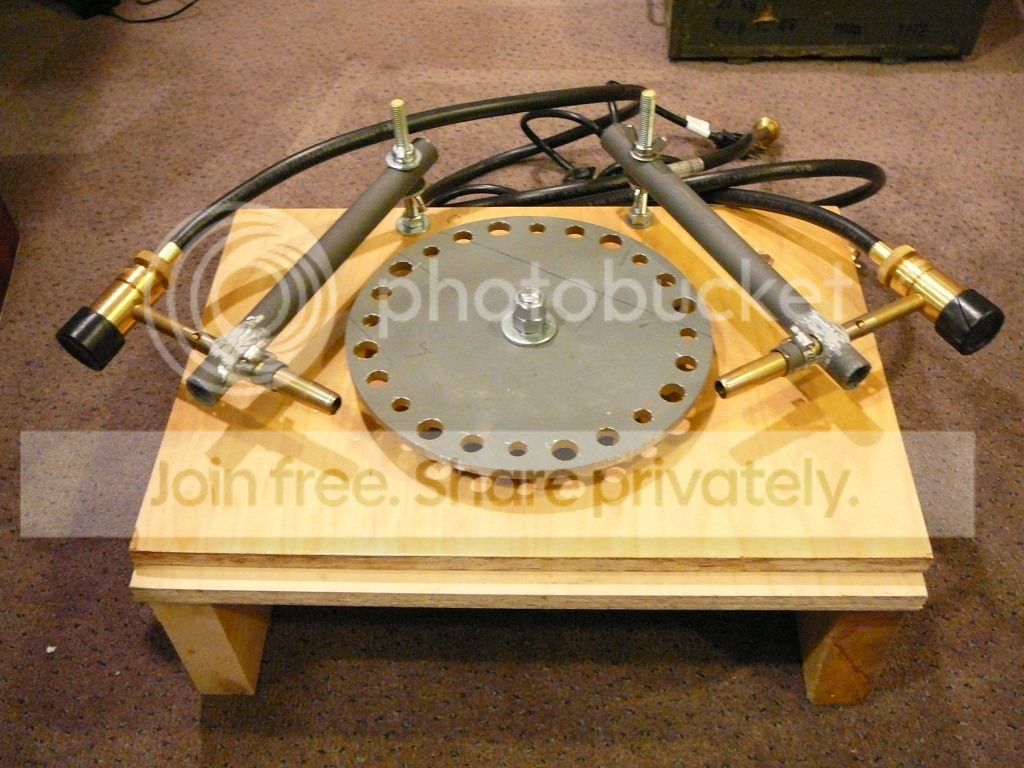
For a cheaper option I built my own annealer.
$120 bucks in for materials and a case of beer to get the plate made by a friend.
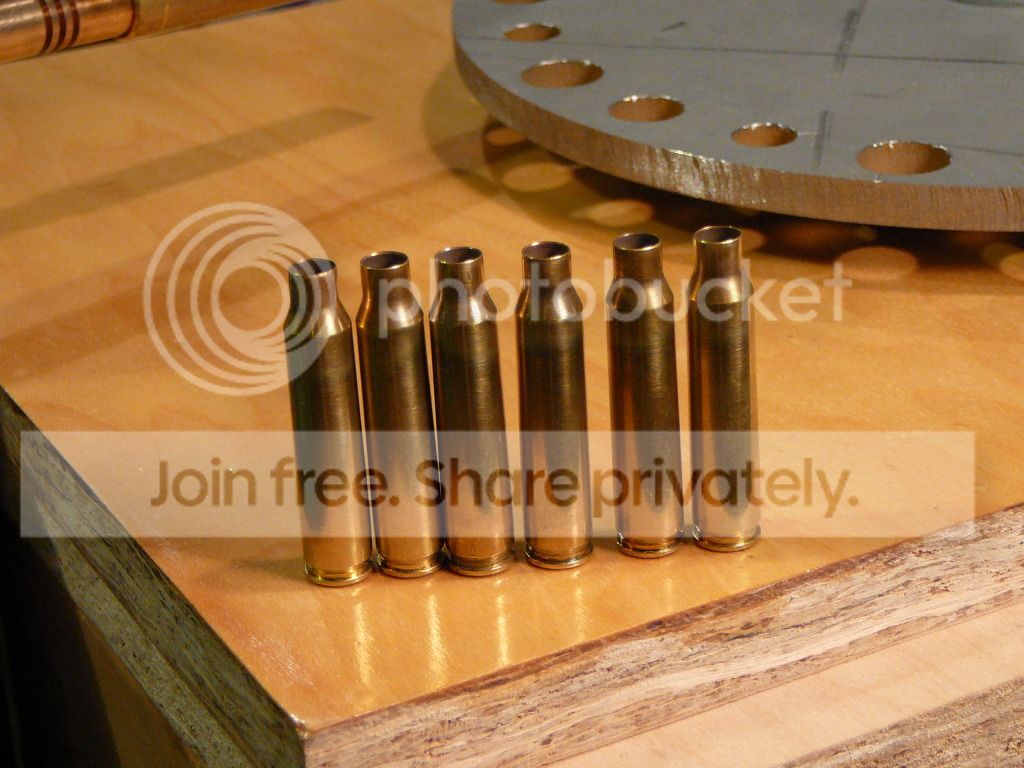
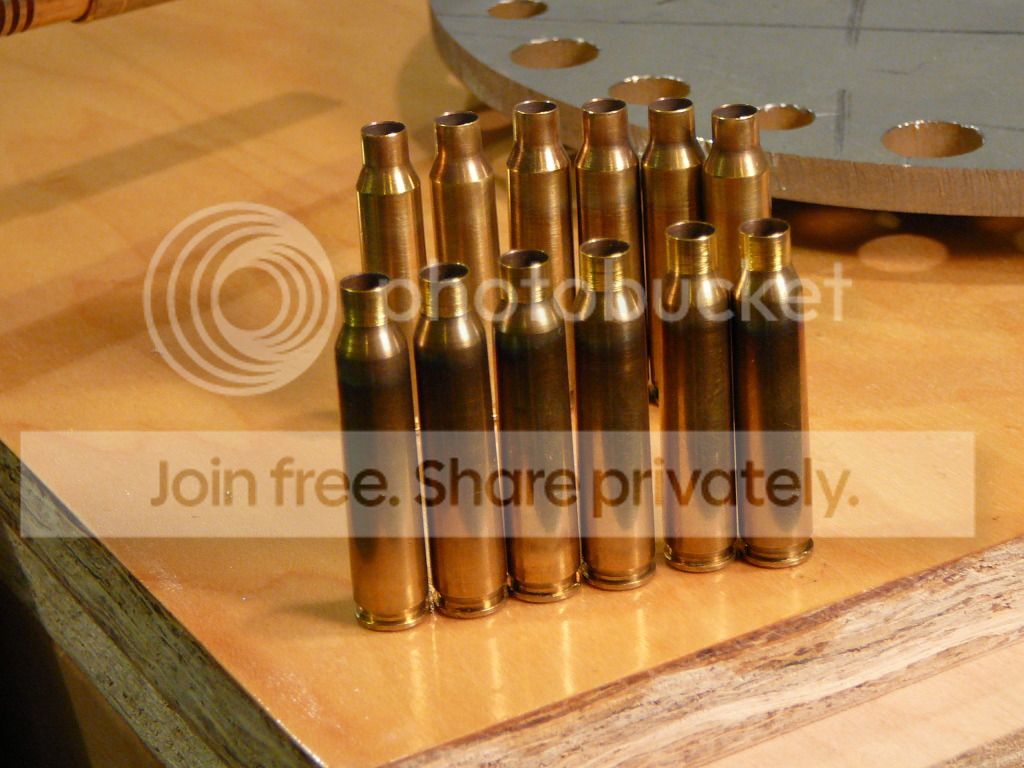
Brass comes turns out OK.
Win brass:
LC brass:
@donor - if you were to count the seconds (or steamboats), how long between touching the case to the flame, and quenching it? How fast are you turning the drill, full drilling speed or reduced screwdriving speed?
I have 200x 30-06 cases at the ready to reshoulder to 7.5x53 MAS, and annealing is the next move.
Time depends on size of the case-smaller case/less time.8x57 (similar size to 30-06 ) takes about 5-10 seconds or so.Intensity(size) of the flame of the torch makes huge difference.I prefer lower flame.
Screwdriver set on the drill works fine.My DeWalt has 3 settings-2nd works best.
I just did my 300 win mag with propane torch, low intensity. approx 18-20 seconds per case, in a socket on a drill.
The gray is 1/4'' below shoulder.
Fine?
Unless you anneal the lower half of the case, I guess you cant really over anneal the neck unless you get it to glow red hot or something?
The gray is 1/4'' below shoulder.
Fine?
Unless you anneal the lower half of the case, I guess you cant really over anneal the neck unless you get it to glow red hot or something?

I just did my 300 win mag with propane torch, low intensity. approx 18-20 seconds per case, in a socket on a drill.
The gray is 1/4'' below shoulder.
Fine?
Unless you anneal the lower half of the case, I guess you cant really over anneal the neck unless you get it to glow red hot or something?
Carefull with the heat Kryro, it's not hard to ruin your cases.
If the neck's ever get red-hot, that case is toast.
Once annealed to dead soft, neck tension is forever gone.(took me 50 ruined .375 H&H to learn that).
What works for me, is a dark room(coldcellar?), rotate the case in the propane torch flame till the fire behind the neck just starts to go yellowish(about 4-5 seconds). Quench.
It's a subtle thing, that flame colour change .... the neck metal looks to glow brighter yellow too, as the flame colour changes.
Practice on a few scrap cases.
Absolutely even ram pressure to seat, is how you'll know you've got it right.

BattleRife
CGN Ultra frequent flyer
- Location
- of No Fixed Address
The torch and cake pan with water method is the worst. Slow. Messy. Lousy consistency. I would buy new brass before I did that.
For my ARs, I am trying to keep my brass sorted well enough to that everything gets annealed every third loading. This is to prolong brass life, as I suffer serious neck splitting issues. For the last 2 years or more I have been annealing in a molten salt bath, and made a little demo video:

For my ARs, I am trying to keep my brass sorted well enough to that everything gets annealed every third loading. This is to prolong brass life, as I suffer serious neck splitting issues. For the last 2 years or more I have been annealing in a molten salt bath, and made a little demo video:
back40sniper
CGN Regular
- Location
- South east Sask.
Battlerifle, tell us more about your salt bath setup. Looks interesting.
Um, did a batch of 50, and I was more like in the 18-20 seconds, and I even did close to 30 sec for the first 5....
I set the tip of the propane torch on the neck, close to shoulder.
First 5, I stopped as soon as I saw the neck start to glow slightly. Not red, more like starting to glow orange. That brought the color change like 1/2'' below shoulder.
Next 45, I stopped as soon as the visible gray color change with the blue line below it was 1/8 below the shoulder. I dont think I actually saw them "glow" or anything.
Approx 10 seconds after you put them in the fire, the neck turns a bit gray. Then you start to see the bluish line go down the neck 12-13, then a bit to the shoulder 18-20, then I stopped.
How do I know if they are ruined anyway? They will collapse during resize, or not hold the bullets or what? I neck resize only.
I set the tip of the propane torch on the neck, close to shoulder.
First 5, I stopped as soon as I saw the neck start to glow slightly. Not red, more like starting to glow orange. That brought the color change like 1/2'' below shoulder.
Next 45, I stopped as soon as the visible gray color change with the blue line below it was 1/8 below the shoulder. I dont think I actually saw them "glow" or anything.
Approx 10 seconds after you put them in the fire, the neck turns a bit gray. Then you start to see the bluish line go down the neck 12-13, then a bit to the shoulder 18-20, then I stopped.
How do I know if they are ruined anyway? They will collapse during resize, or not hold the bullets or what? I neck resize only.






















