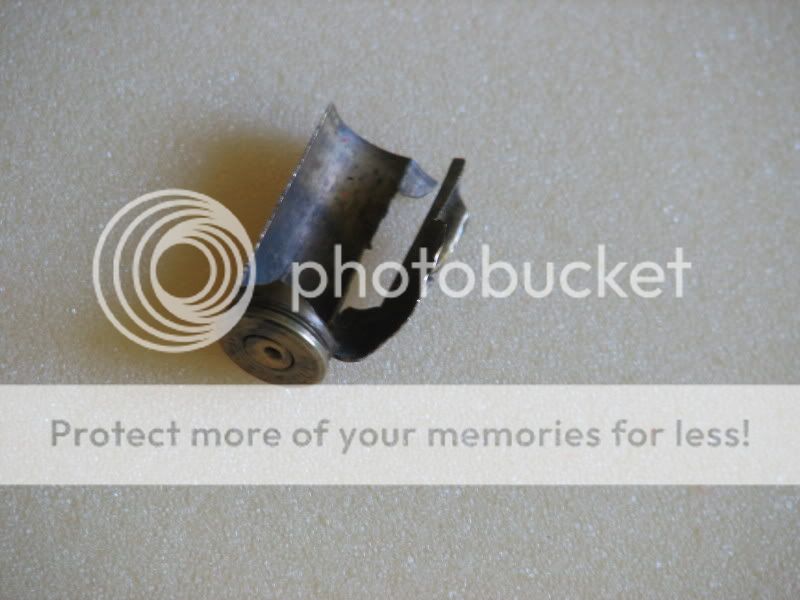
Do you shoot your antiques?

I only use real black powder, I tried the subs and I dislike them, I have never tried smokeless in any of my antiques.....Nor will I ever.

I like black powder fouling,smoke and fire.

Cleaning them up afterwards is fun aswell.
 
I'm surprised so many say they us only smokeless in their old guns, from other threads it seemed like a very rare breed of shooter who did that and a little taboo.

I like BP in my revolvers because of this. :D

288c96t.jpg

34dpe6o.jpg

13yp5wk.jpg

35mnout.jpg


Never use petroleum based oil in a BP gun! That is what turns the fouling hard.

What about the oil used to keep the gun lubed and to prevent rust while in storage? I use Outers gun oil for that.
 
I'm surprised so many say they us only smokeless in their old guns, from other threads it seemed like a very rare breed of shooter who did that and a little taboo.

I like BP in my revolvers because of this. :D

13yp5wk.jpg


What about the oil used to keep the gun lubed and to prevent rust while in storage? I use Outers gun oil for that.

Hey, I'm a little (and I mean VERY) confused by those pics you posted. They are very cool, but at the same time seem a bit... unreal. How is it possible to capture the muzzle blast and fire coming from the front of the cylinder of a single action SAA with the hammer still in the cocked position? Does this fire from an "open bolt" like an UZI or are you just THAT fast, lol? Impressive...

:D


As far as the smokeless powder is concerned, I don't mind the lesser pyrotechnics if it means longer gun life. Let's not forget that these guns are well over 100 years old and, in many cases, are nearing the end of their useful lives... therefore a mild dose of a mild smokeless powder is what they should be getting instead of hand-cannon BP loads (kind of like the above pic, lol). Some very insightful members on these boards have actually compared the pressures of smokeless vs BP for standard velocities (fps) of a given cartridge and determined that smokeless pressures were actually lesser and therefore safer. The key is not to load too much, the margin of error being also very small (as 1 extra grain too much could put it in the red zone).

As far as the jacketed bullets and BP go, I meant one OR the other, not both (although that would be twice as bad, I guess). What I meant to say is that a person shouldn't be using BP or jacketed bullets in their antiques. BP creates fouling/pitting/corrosion and jacketed bullets wear off the rifling, even on modern iron (it even says so in my latest Lyman pistol reloading manual). A lead cast bullet will never wear out a bore... that's exactly why you see so many old/antique .22LR rifles still with such great bores (because they've been used with lead bullets only).
 
Hey, I'm a little (and I mean VERY) confused by those pics you posted. They are very cool, but at the same time seem a bit... unreal. How is it possible to capture the muzzle blast and fire coming from the front of the cylinder of a single action SAA with the hammer still in the cocked position? Does this fire from an "open bolt" like an UZI or are you just THAT fast, lol? Impressive...

This came up when I originally posted the photos. I am as confused as you. I used a high speed setting on my camera that takes about 2.5 frames per second. I honestly don't know why the hammer is still cocked. One idea I had was the recoil causing the case to slam back against the recoil plate perhaps knocks the hammer back? I'd really like to know.
 
This came up when I originally posted the photos. I am as confused as you. I used a high speed setting on my camera that takes about 2.5 frames per second. I honestly don't know why the hammer is still cocked. One idea I had was the recoil causing the case to slam back against the recoil plate perhaps knocks the hammer back? I'd really like to know.

So.. theoretically, if you were to use a tiny bit stronger loads (or maybe not even) and keep the trigger pressed down, would it go FA? Holy crap, I bet Sam Colt never though of that one, haha... Your SAA beats the Webley-Fosbery design hands down!

:D

Amazing pictures... I'd keep the gun if I were you... if only for those pictures, lol! By the way, what kind of camera are you using? It's awesome!
 
So.. theoretically, if you were to use a tiny bit stronger loads (or maybe not even) and keep the trigger pressed down, would it go FA? Holy crap, I bet Sam Colt never though of that one, haha... Your SAA beats the Webley-Fosbery design hands down!

:D

Amazing pictures... I'd keep the gun if I were you... if only for those pictures, lol! By the way, what kind of camera are you using? It's awesome!

If the hammer acted on the cylinder and not the trigger, then maybe? :)

Imagine if he had accidentally designed it that way.... the first trigger pull would be a pants stainer for sure:p
 
So.. theoretically, if you were to use a tiny bit stronger loads (or maybe not even) and keep the trigger pressed down, would it go FA? Holy crap, I bet Sam Colt never though of that one, haha... Your SAA beats the Webley-Fosbery design hands down!

I'm probably way off on my theory then. :D

I asked in the OT, I'm hoping some photography experts can chime in. It may have something to do with the shutter speed.
 
From the looks of the sparks in the pic by the fact that they look like a streek meens that the shutter was open longer perhaps it was a dull day the shutter would stay open longer to gather more light catching the hammer before it dropped and the flash as well I have taken pics like this with my old 35mm cannon camera and set a slow shutter speed.
 
A freind was telling me some colts with week main springs would sometimes go FA :D
As long as you held the trigger down but it was a rare thing to happen.
I honestly dont know if its true that it ever happened.
He is a good gunsmith so i take his word on it.
Only under certin conditions he said.
id like to see it myself....

I know thats not whats happening with Colt 41s pics just thought i would mention i had heard of such a thing happening..
 
A freind was telling me some colts with week main springs would sometimes go FA :D
As long as you held the trigger down but it was a rare thing to happen.
I honestly dont know if its true that it ever happened.
He is a good gunsmith so i take his word on it.
Only under certin conditions he said.
id like to see it myself....

I know thats not whats happening with Colt 41s pics just thought i would mention i had heard of such a thing happening..

Nice.. so it is theoretically (and practically, it would seem) possible. I would hate to see an antique sixgun go FA on me... I don't know if it wouldn't freak me out enough to just drop it & run before it kabooms my hand & face away!

:eek:

Scary stuff... but yeah, the shutter theory makes sense too, although it's still a bit weird (as there is no "ghosting" effect - the trigger is solid in every pic, even though the rest of the image changes). I once heard from one fellow (who used to collect a lot of milsurp) that underloaded 7.62x39 ammo can make a semi-auto SKS cycle in full auto quite easily. Supposedly if you get the powder just right, the ammo doesn't have the momentum to fully cycle the action into semi-auto mode and fires round after round all by itself. I just don't know if there is any truth to that... supposedly it used to be a popular trick to do if you wanted to impress people at the range in the old days. I tried to see if it's possible with my 3 SKS's by manually cycling the bolt slowly and seeing if the mechanism engages and it seems that it does... so the fellow wasn't telling the truth, unless there's something I missed (maybe the rifle behaves differently when actually fired, as opposed to being cycled manually).

:)
 
I'd suspect you might have some interesting combinations of shutter speed, Aperture, and ISO that when combined with the moderate ambient light and the high intensity flash of the muzzle flash mimics a shutter sync technique commonly used to make taillight streaks on night shots of moving cars.

You're using a shutter speed that allows light from the gun to be recorded, but the hammer moves so fast, that the shutter closes before small amount of light from the hammer shows a blur or de-cocked hammer, however the over powering light from the explosion of the blast overwhelms the photo sensor just before the shutter closes.

From my OT thread, this makes sense.

Okay, back on topic. :D

As far as the smokeless powder is concerned, I don't mind the lesser pyrotechnics if it means longer gun life. Let's not forget that these guns are well over 100 years old and, in many cases, are nearing the end of their useful lives... therefore a mild dose of a mild smokeless powder is what they should be getting instead of hand-cannon BP loads (kind of like the above pic, lol). Some very insightful members on these boards have actually compared the pressures of smokeless vs BP for standard velocities (fps) of a given cartridge and determined that smokeless pressures were actually lesser and therefore safer. The key is not to load too much, the margin of error being also very small (as 1 extra grain too much could put it in the red zone).

Another thing to consider is pressure curve speed. One member here has determined that a powder called 2400 IIRC has about the same pressure curve as BP. This is a somewhat slow powder compared to all other powders I have personally heard of being used in antiques.

I use Unique, just like others have posted, in my .41 Colt smokeless loads. It's fairly fast, number 23 I think on the list of powder speeds. Universal is another I tried, right next to Unique. Bullseye is also listed for .41 Colt but it is number 5 or so on the list. Trailboss is another that is quite fast.

The main thing I have learned with using modern smokeless, especially faster powders is to stay about 100fps under the listed BP velocity in order to keep pressure levels safe. This can however lead to slow, under performing bullets.
 
The main thing I have learned with using modern smokeless, especially faster powders is to stay about 100fps under the listed BP velocity in order to keep pressure levels safe. This can however lead to slow, under performing bullets.

Thanks for sharing this info. I usually go for slightly less than the minimum load listed in the reloading manual (about 0.1 to 0.5 grain), because going any lower is said to create other safety concerns as well. I never actually figured a rule of thumb for this, but figured that staying slightly below recommended minimum loads can't lead to a fatal mistake. Other members are actually slightly more adventurous than I am when it comes to smokeless in their antique iron... and get great results too, without any issues.

Anyway, I am still a novice at this, but trying to learn as much as I can. I got into reloading less than a year ago, but already managed to research and build various smokeless ammo for my antiques. I guess that feeding antiques with commercially unavailable ammo is the main reason I decided to get into reloading in the first place (I used to just buy commercial ammo for my modern collection)... and I'm very glad I did! It really takes the hobby to a whole new level, especially when you start researching and building custom ammo with custom loads.

:dancingbanana:
 
I usually go for slightly less than the minimum load listed in the reloading manual (about 0.1 to 0.5 grain), because going any lower is said to create other safety concerns as well.

I've heard of this, a low pressure spike or something?? Almost like leaving an air space in a BP loaded cartridge?
 
I've heard of this, a low pressure spike or something?? Almost like leaving an air space in a BP loaded cartridge?

Yes... I've read it in my Lyman pistol reloading manual that actually covers a lot of "cowboy" ammo, since they claim that the cowboy action/antique gun shooting is regaining a lot of popularity lately (maybe due to the UN world-domination/gun confiscation agenda that the Democrats are applauding so much?). It's a special manual dedicated to some cowboy/antique calibers, such as .44 Russian for example.

Anyway, the manual says that underloaded ammo can create pressure issues too, which can lead to serious accidents or damages to the gun. Supposedly the casing can generate too much pressure if the explosion isn't powerful enough to evacuate the bullet in a timely manner, or something like that. The way they explain it is a bit ambiguous and they don't seem to go into much detail... they just basically say to avoid underloading your ammo and to respect minimum loads the same as you would respect maximum loads.

And here it is (my main reloading Bible):

277752.jpg
 
In my antique pistols I use Blue dot you need a crony it gives about the same pressure as 3f for the same velocity I load about 100 fps under black loads aswell it needs a good crimp and in bigger cases a magnum primer as its hard to get going in my 44 Russian I use a 240 grain bullet and 6 grains and a mag primer for around 650 fps
 
As I understand things, there is considerable resistance when the bullet first enters the barrel. If the load is not strong enough to overcome that resistance, the pressure builds up and can blow the cylinder. This can happen to rifles, as well, and the problem only began to be seriously investigated after a number of C.A.S. guns blew up shooting mild smokeless loads. People are always saying to shoot smokeless in old guns, it's perfectly safe, blablabla..... As I've said before, there is little margin of safety in these old guns. Bugger up a load by using a magnum primer instead of a standard primer, or have a slight overcharge due to a sticking powder measure, and you could bulge the cylinder on your fine old Colt, or worse. These guns are irreplaceable, and are more than just a fun gun to shoot. They are part of our history, and we are the custodians of that history. There is no worse feeling than causing damage to something that has survived intact for 130+ years! I nearly killed my friend after he gouged the stock on my old Martini-Henry. Anyway, I keep hearing about how BP is "corrosive", it will "pit your gun", "damage the bore" etc. etc. If it really was as bad as these guys claim, there WOULDN'T BE shootable antiques around today! Many antiques do have dark, pitted bores, but these were smokeless era guns, damaged from mercuric, corrosive primers. As for the full auto SAA, that happens when the recoil plate around the firing pin is missing. When the first round is fired, the primer flies out, cocking the hammer. The whole cylinder will go before the shooter can react and release the trigger! A fellow in the US got in trouble, decades ago, when he fired a shot into the ground in front of a trespasser. The gun went F/A and stitched the trespasser, killing him, as the gun climbed under recoil. On testing at the crime lab, it was proven that the gun did indeed fire full auto, just as its owner claimed it had. This could also happen with early .357 magnum SAA's, too, I believe, as they used the same firing pin as the .45's. It could also happen with the .38-40, which is, I believe, the reason factory primers are crimped in now.

 
I think there is a lot of urban legend in the above posting. Semiautos will go full auto because they are dirty and "slam fire" from the firing pin being stuck forward but I have never heard of a revolver firing full auto. The guns being blown up from light smokeless charges that I have heard of, have involved small charges of slow burning powders in large volume cases. These blow ups are not replicable and are usually attributed to the powder being slow to combust and all powder grains igniting within the shell before the slug leaves and leading to a sudden pressure peak in the chamber.

I strongly suspect that handguns that blow up with smokeless are a result of either double charges or poor loading practices using loads outside the published tables
I also suspect that the photo of the SAA with the hammer at full #### and the muzzle flame is a result of a long shutter opening and a double flash or a double shutter opening. I have had photos, taken in poor light with double images; one of the gun level and one superimposed under recoil with flames out the muzzle.

cheers mooncoon
 
Back
Top Bottom