Does accuracy matter?

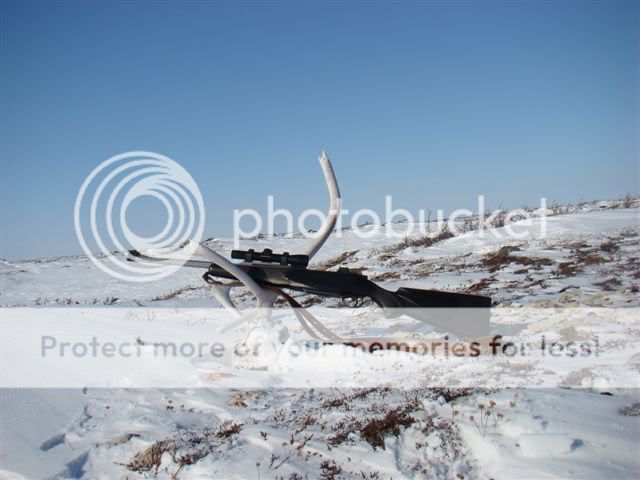
You gonna shoot that thing, or wait 'til the antlers fall off on their own?;)

:)
DSC03745.jpg
 
Totally agree with you Boomer, but I am also willing to bet your rifles also shoot very well! :D
Though you may not be as obsessed with accuracy as Dog and I are, I also bet your CCB shot is right on the money every time for every rifle you seriously hunt? :)

There is something very satisfying and confidence inspiring about a very accurate rifle that (I readily admit) has little or nothing to do with hunting.
Strangely enough that works for me!

You are of course right Dogleg, but as long as I have a little extra money in the bank my rifles will shoot A LOT better than they need to. :p
I suspect yours will as well.

Now we come to the crux of the matter. We have developed a preoccupation with accuracy because we haven't thought of challenging ourselves in other ways. IMHO this preoccupation with accuracy has led to more than one hunter making poor choices as it pertains to his choice of rifle and ammunition, and has resulted in hunters being ignorant of the more practical aspects of marksmanship.

How many times have we seen folks post that they want a heavy barrel .308 bolt gun as their hunting rifle. To what advantage? Chances are the cold bore shot from that target/varmint rifle will be no more accurate than the cold bore shot from the same rifle with a light barrel.

The stocks that come as standard equipment on these rifles do not have a shape that makes handling or shooting either quick or natural. More often than not, these things have too much scope on them, and while they might be able to count the veins in a fly's wing at 1000 yards, being able to find a deer standing just inside a tree line is all but impossible, and tracking a moving animal at normal hunting ranges is impossible.

Match bullets are more accurate than their game specific counterparts, but hitting the animal is only one part of the problem, the bullet must produce sufficient terminal performance to produce a quick humane kill. A match bullet fired over normal hunting ranges which either fails to open up and pencils through or that simply goes to pieces and results in a large but shallow wound is a failure. Choosing the wrong bullet, will almost certainly result in wounded game.

As hunters we need to challenge ourselves beyond the mandatory 5 shot group from the bench or prone. Work on the shooting positions and scenarios that give you trouble, rather than shooting the same old drills that you aced when you were 12.

Your rifle might very well shoot MOA, but how fast can you get your rifle on target and hit it with a pair of off hand shots? At what range? Can you do it left handed? "Left handed?" you ask, Thats right, when I was in Africa I shot my warthog quartering away from me, on the run, with a left hand shot, because I trained myself that an animal that runs to the right is engaged more quickly and easily with a left hand hold, then by pivoting my entire body position. When the rifle came down out of recoil, I had already cycled the action by rotating the piece to the left, which brings the bolt handle to the top, without removing it from my shoulder, working the action with my left hand, then rotating back to its normal position for a follow-up shot, which proved unnecessary. How many shooters work a manual action at the shoulder? More often than not I see folks drop the piece to waist height, work the action and return it to the shoulder. By the time you've done that, the critter you were shooting at is in another province.

While we prefer to shoot from a low rested position, obstacles that prevent the target from being seen, or a quickly changing situation that does not always allow you the time to acquire a better position, means that an off hand shot is all you have. Set up obstacles you have to shoot over or around.

One of the most difficult challenges for a rifleman is to shoot a target coming straight on, and the closer the target gets the more difficult the problem is to solve. The tendency is to shoot where the target was. There are two ways to solve this. One is to allow the proper lead and the other is to drop to a low position that puts the bullet's trajectory on a path which coincides with the length of the target. But unless you try it you won't know how to go about solving it.

A good drill is shooting while winded. Pace off 50 yards from your firing line, then make a hard run across that 50 yards, drop into whatever position seems appropriate, and engage the target as quickly as you can with a pair of shots. No matter how quickly you shoot, you must retain the basic principles of marksmanship; breath, relax, look, press.

Practice getting your shot off quickly. In the filed a game animal might remain motionless for as long as you need to make your shot, but don't count on it. As soon as your sight is on target you should have pressure on the trigger.

Practice acquiring and checking your natural point of aim. In the field this will make achieving a good position instinctive.

Don't score your targets by the group size, score them by the length of the shot string. That is measure the distance from each bullet hole to the aiming point and divide by the number of shots to determine a score; low score wins. Figure out a way to reduce the score for taking too long to make a shot.

These simple drills are a good test of your practical marksmanship. They will also let you know if your rifle is suitable for the job at hand. But don't limit yourself to just these. Any shooting problem you can imagine is worth trying to solve.
 
Its called "tolerance stack up"

Suppose you have the most accurate gun in the world and it shoots right were you aim it. From a standing position, you may shoot a 10 inch group at 100 yards. Does this mean that you might just as well have a gun that shoots 10 inch groups at 100 yards from a bench?

No, because that would mean you would shoot 20 inch groups at 100 yards from a standing position.

These things add up.

As you move to extended range, what is your wobble area? how accurate is your range estimate? How accurate is your wind estimate? What is the affect from altitude or temperature? etc.

Then there's the ever unknown real world moving target hunting adrenalin and panic factor.

Does it all add up within the size of the kill zone?

Maybe when some guys add it up, its 6 inches at 30 yards. Ok well think like a bow hunter and go hunt at 30 yards.

Other guys (with the right gear) add it all up and it's 6 inches at 300 yards. Ok fine, go hunt the clover field.

Now, the 30 yard guy will probably criticize the 300 yard guy as reckless, because for the 30 yard guy it is.
 
Last edited:
Don't score your targets by the group size, score them by the length of the shot string. That is measure the distance from each bullet hole to the aiming point and divide by the number of shots to determine a score; low score wins.

That's a good way of determineing accuracy, since it keeps in mind the old fashioned idea that it might matter if you hit what you're aiming at. Laying a first cold bore shot where it belongs is another.
I get a kick out of watching shooters with a nice tight group three inches high that they can cover with the appropriate coin, and a notation marking the first shot somewhere other than in the group. (Not that they sight in for it, but apparently they know about it) They seem to have covering a group with a dime confused with being able to hit a dime. It's a little hard to hit that tiny target at say, 200 yards from a bench while trying to aim 4 inches below it. That's OK, they will explain, since 4 inches is SFA on a big-game animal. Hmmm.............. a 4 MOA rifle will keep the worst shots within 4 inches of point of aim too at that distance, provided it was zeroed for that range. Come to think of it, unless the dime shooter is putting them all in the same hole, MR 4 MOA is going to be closer over half of the time.
 
You are preaching to the choir Boomer. :)

From what I see at the local range most hunters don't have enough ability to shoot a group from the bench never mind an improvised field position...I do my bit to help, but most guys really don't seem interested in learning.
Not that it isn't appreciated, but what you are suggesting is beyond the average hunters comprehension.

Most hunters have a hard time buying more than one box of ammunition per years and just think I am insane when they find out what I spend every year on components alone....Just the way it is I guess. :(
 
In the recent Sporting Shooter, Nick Harvery talks about this very topic.
Sorry i havnt read the whole thread.

He claims too many people worry too much about thier "Hunting Rifle's" accuracy.

It was quite a good read and i believe there is too much Hype about MOA rifles for hunting.

as its been said when your in the field * puffed from the steep face you walked *the animals on the move slowly * the tree branch your leaned up against.. it matters not that your rifle can hit a Dollar coin at 100m.

this has proberly been said in this thread, il shutup now.

WL
 
Why would you want to shoot a tight group on a big game animal anyway? Putting them all in the same hole is the same as shooting it once.;) Scatter the damage around some, then you're getting somewhere.
 
Now we come to the crux of the matter. We have developed a preoccupation with accuracy because we haven't thought of challenging ourselves in other ways. IMHO this preoccupation with accuracy has led to more than one hunter making poor choices as it pertains to his choice of rifle and ammunition, and has resulted in hunters being ignorant of the more practical aspects of marksmanship.

How many times have we seen folks post that they want a heavy barrel .308 bolt gun as their hunting rifle. To what advantage? Chances are the cold bore shot from that target/varmint rifle will be no more accurate than the cold bore shot from the same rifle with a light barrel.

The stocks that come as standard equipment on these rifles do not have a shape that makes handling or shooting either quick or natural. More often than not, these things have too much scope on them, and while they might be able to count the veins in a fly's wing at 1000 yards, being able to find a deer standing just inside a tree line is all but impossible, and tracking a moving animal at normal hunting ranges is impossible.

Match bullets are more accurate than their game specific counterparts, but hitting the animal is only one part of the problem, the bullet must produce sufficient terminal performance to produce a quick humane kill. A match bullet fired over normal hunting ranges which either fails to open up and pencils through or that simply goes to pieces and results in a large but shallow wound is a failure. Choosing the wrong bullet, will almost certainly result in wounded game.

As hunters we need to challenge ourselves beyond the mandatory 5 shot group from the bench or prone. Work on the shooting positions and scenarios that give you trouble, rather than shooting the same old drills that you aced when you were 12.

Your rifle might very well shoot MOA, but how fast can you get your rifle on target and hit it with a pair of off hand shots? At what range? Can you do it left handed? "Left handed?" you ask, Thats right, when I was in Africa I shot my warthog quartering away from me, on the run, with a left hand shot, because I trained myself that an animal that runs to the right is engaged more quickly and easily with a left hand hold, then by pivoting my entire body position. When the rifle came down out of recoil, I had already cycled the action by rotating the piece to the left, which brings the bolt handle to the top, without removing it from my shoulder, working the action with my left hand, then rotating back to its normal position for a follow-up shot, which proved unnecessary. How many shooters work a manual action at the shoulder? More often than not I see folks drop the piece to waist height, work the action and return it to the shoulder. By the time you've done that, the critter you were shooting at is in another province.

While we prefer to shoot from a low rested position, obstacles that prevent the target from being seen, or a quickly changing situation that does not always allow you the time to acquire a better position, means that an off hand shot is all you have. Set up obstacles you have to shoot over or around.

One of the most difficult challenges for a rifleman is to shoot a target coming straight on, and the closer the target gets the more difficult the problem is to solve. The tendency is to shoot where the target was. There are two ways to solve this. One is to allow the proper lead and the other is to drop to a low position that puts the bullet's trajectory on a path which coincides with the length of the target. But unless you try it you won't know how to go about solving it.

A good drill is shooting while winded. Pace off 50 yards from your firing line, then make a hard run across that 50 yards, drop into whatever position seems appropriate, and engage the target as quickly as you can with a pair of shots. No matter how quickly you shoot, you must retain the basic principles of marksmanship; breath, relax, look, press.

Practice getting your shot off quickly. In the filed a game animal might remain motionless for as long as you need to make your shot, but don't count on it. As soon as your sight is on target you should have pressure on the trigger.

Practice acquiring and checking your natural point of aim. In the field this will make achieving a good position instinctive.

Don't score your targets by the group size, score them by the length of the shot string. That is measure the distance from each bullet hole to the aiming point and divide by the number of shots to determine a score; low score wins. Figure out a way to reduce the score for taking too long to make a shot.

These simple drills are a good test of your practical marksmanship. They will also let you know if your rifle is suitable for the job at hand. But don't limit yourself to just these. Any shooting problem you can imagine is worth trying to solve.
A heavier barrel wobbles les than a light one. I built a gun for silhouete and weight is a big deal on these things and I wanted to hunt with this same gun. sux 2 be me I wobble 2 much anyway so I gotta use a rest. A better shooter can for sure take advatage of the PMI of a heavier barrel.


 
Back
Top Bottom

































































