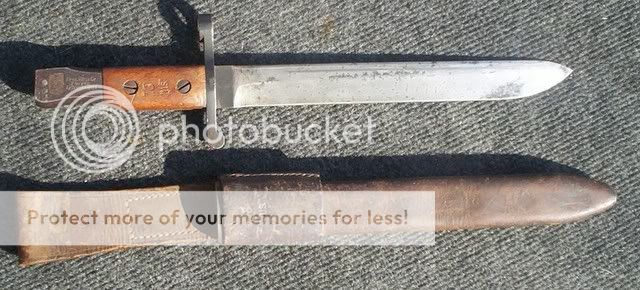
Does anyone know why the Ross bayonet was shaped like a butcher knife with no point?

Unsub

CGN Ultra frequent flyer
EE Expired
Rating - 98.7%
75   1   0
I bought a couple beat up Ross bayonets recently and one has had the point altered and the other has the original shape. It is the strangest bayonet I have ever seen:eek:. It has a hollow ground single edge blade with no point!

It makes perfect sense why they reshaped the point in the trenches but why on earth have a bayonet like that in the first place?

It actually looked like a much better using knife than most bayonets. It is one of the only bayonets with decent blade geometry as far as being able to slice with the blade. It would make an excellent butcher knife.

The only thing I could come up with was the designers thought the long range accuracy of the Ross was so good the only thing they would need the bayonets for is cooking dinner?
 
The one with the rounded butcher knife end is NOT sharpened. That is how they came from the factory. The point would not penetrate webbing, leather belts and Great coats so the point was modified to what you see now....almost like a scimitar....upside down.
 
The one with the rounded butcher knife end is NOT sharpened. That is how they came from the factory. The point would not penetrate webbing, leather belts and Great coats so the point was modified to what you see now....almost like a scimitar....upside down.

Well, that's what the British Generals said.... Would it penetrate the large jackets??? Anyone try?
 
But why did they make it like that in the first place? Is not the whole "point"(no pun intended) of a bayonet to put a point through the guts of the enemy?

I understand why they got rid of the rounded end but why was it like that in the first place?
 
The general idea in bayonet fighting is NOT to SLICE a hole in the other guy, it is to SMASH a hole in the other guy.

Great War vets I have known didn't keep the things too sharp in case they went IN and then they had trouble getting them OUT. Absolutely ruin your day if you've got your sticker stuck in Fritz and his buddy comes along and blows you away.

Wounds made by a dull blade would crush their way in, destroying enoughn ribcage etc material that the thing would slide out easily.

'Nuff said!
 
Like many of his other inventions, not a lot of practical thought went into it. They're rounded, well, because that's what he thought was good. It's part of the magic of the ross and why it's so interesting.
 
The general idea in bayonet fighting is NOT to SLICE a hole in the other guy, it is to SMASH a hole in the other guy.

Great War vets I have known didn't keep the things too sharp in case they went IN and then they had trouble getting them OUT. Absolutely ruin your day if you've got your sticker stuck in Fritz and his buddy comes along and blows you away.

Wounds made by a dull blade would crush their way in, destroying enoughn ribcage etc material that the thing would slide out easily.

'Nuff said!

Sounds like another army myth. I have never found dull knives that did anything better than sharp ones. If a blade was big enough, it could smash bones etc, but bayonets are really not that big.
 
Sounds like another army myth. I have never found dull knives that did anything better than sharp ones. If a blade was big enough, it could smash bones etc, but bayonets are really not that big.

The idea was actually that a sharp blade could cut itself into a rib or bone and make pulling it out difficult. A dull blade would not do this. At least that's what I've read.
 
Do any of you for one wild minute think that anyone at the Ross Plant actually "designed" the MkI/MkII bayonets? Initial designs/concepts would have been submitted to Gummint Committees(SSAC), then likely following multi revisions, gummint "approval" would have been granted, then production began.....Same story with all the whining about the various changes on the military rifles.....changes had to be made to satisfy/pacify gummint drones, then production could begin until another 'change' was viewed as necessary.....Strange indeed that the commercial production line just rolled smoothly along with rifles of exceptionally high quality and outstanding accuracy were delivered to anxious customers.
 
I did not do anything with the modified mark 2 Ross but the one I got from You Englishman has started to clean up beautifully.
Usually I don't believe in doing any more than a cleaning and oiling but that old Ross was in such poor shape I decided to give it some quality time with the dremel. It was pretty cool seeing the markings appear as if by magic from under the rust.

It was in seeing this knife come out that got me to start this thread. Whether sharp or blunt all bayonets I have ever seen had a point but not this one?
They also usually had very little concern with a blade(as opposed to a point)
The Ross is the only bayonet I have ever seen with a hollow ground blade.

For those of you who are not knife nerds a hollow ground blade is the sharpest but also the weakest type of blade. It is the type of blade on a straight razor or that you might find on a butcher knife.

It would be much more useful for camp use then almost any other bayonet but not much use as a bayonet.

I thought maybe Sam Hughes might have had some crackpot theory behind this very strange bayonet.
 
Probably pretty hard now, to establish how much of the continual change in the Ross design was Sir Charles' doing and how much was military change orders. I wish they had gone to a design that had a conventional double stack magazine without the long lever to depress the spring and follower of the MkII. The MkIII single stack magazine spoils the look of the rifle. While they were at it, they should have stopped at the shorter barrel length. Even 28" was too long. but Hey, it is easy to redesign a rile after 100 years. I wonder if the 10 round capacity of the Lee-Enfield was a significant factor in the Cdn. soldiers picking them up from casualties.
 
I wonder if the 10 round capacity of the Lee-Enfield was a significant factor in the Cdn. soldiers picking them up from casualties.

Could very well be part of the reason , but nevertheless , our soldiers obviously thought the LeeEnfield was a much better battle rifle ...through experience.

ross6.jpg
 
My theory is it was mostly the issues with the Brit ammo not working properly.

I finally got some photos of my new Ross bayonet which I am in the process of
restoring. It is a work in progress so don't judge me to harshly. There is still a lot of hand sanding to do to work out all the dremel scratches.
There is also the other Ross in the photo. I tried to take some photos of the markings but when I get close they get very blurry. The rusty one is a 1909 model and the modded one is a 1912. I believe that the rusty one is a Mark 1 and the modded one is a Mark2.


As I am still getting the hang of the Picasa system it is a link but a quick easy one.
http://picasaweb.google.com/Lance.G.Davis/Bayonets/photo#5183308980465314130

Here is the before photo. In a way I still like the rusty look a bit better but I think the finished product will be excellent.
http://picasaweb.google.com/Lance.G.Davis/Bayonets/photo#5179856814601808162

Here is a photo of both Ross's a 1888 and a period butcher knife.
http://picasaweb.google.com/Lance.G.Davis/Bayonets/photo#5183308997645183346
 
I would imagine if today's Liebrals were to design a bayonet blade it would be shaped much like the early Ross. It greatly lessens the chance that you might really hurt someone with it. The only change they might make is to make the blade from foam rubber. :dancingbanana:
 
Probably pretty hard now, to establish how much of the continual change in the Ross design was Sir Charles' doing and how much was military change orders. I wish they had gone to a design that had a conventional double stack magazine without the long lever to depress the spring and follower of the MkII. The MkIII single stack magazine spoils the look of the rifle. While they were at it, they should have stopped at the shorter barrel length. Even 28" was too long. but Hey, it is easy to redesign a rile after 100 years. I wonder if the 10 round capacity of the Lee-Enfield was a significant factor in the Cdn. soldiers picking them up from casualties.

The smellie was king because it could fire hot and dirty and fast.
 
Back
Top Bottom