Don't Think I am Understanding The Big Picture

Wayne9

New member
EE Expired
Rating - 0%
0   0   0
Location
Nelson Area, BC
After researching and asking questions here (and elsewhere), I figured out what handloading equipment I would like to get.
But I now have several very puzzling questions (well, puzzling to me :confused:

First off, some numbers I put together from the net that I will refer to later in this post:

The following is from the Custom Reloading Service price list.
<QUOTE>
•9 mm 115 GR/ 124 GR/ 147GR ---: $ 110.00 PER 500 / $ 11.00 PER BOX

Cleaned and sorted brass •9mm-----------: $ 25.00 PER 1000
FEDRAL#100 SMALL PISTOL PRIMERS---$35.00 PER 1000
•9mm 124GR TMJRN (CAMPRO)----$95.00 per 1000
•9MM 124GR FMJRN (BDX)---$115.00 per 1000
•9mm 124GR TMJRN (BERRY)---$77.00 PER 1000
<END OF QUOTE>
Powder is around $35.00

From the above mentioned, the following conclusions and questions:
1000 9mm 124gr ammo costs ~$220.00
1000 primers, bullets, casings and powder ~$200.00
Making 1000 bullets= a lot of time on an SS loading press.

Partial conclusion: either I have misinterpreted costs or reloading doesn't save a lot of money.

Questions:
1. I understand the "hobby" part of handloading (feeling of accomplishment, etc). But, for me one of these 2 things should be present (either or both is good enough for me) 1. trade off time spent for money saved. or 2. trade off time spent for quality of product
2. I listed 3 bullet types and their prices. Would someone please briefly summarise why I would choose one bullet over another? There seems to be many variations. Is this strictly related to cost? accuracy? Does a TMJRN (BERRY) cost less because it is less accurate or is less quality(maybe causing extra wear on my pistol) than a TMJRN (CAMPRO)?

All info appreciated, even if its just a link to somewhere I can find this info. Many thanks in advance.
 
Comparing remanufactured 9mm like Custom or Wolf there isn't as much savings. This is the cheapest centrefire pistol calibre even to buy new ammo.

When you look at most rifle loading, less common calibres of pistol or rifle, and ability to make custom types of ammo not available (bullet choice, velocity) and more accurate ammo for your specific firearm along with the ability to supply your own ammo when the store is low or out of one type this is where reloading really shines and can save.

Cheap .308 is $20 a box of 20. I can reload a premium bullet and load for a bit less than this. A premium factory box might be $40-$50 for 20.
.45-70 is around $2 or so a shot now I think, I can reload mine for about 20 cents each.
.300 Wthby Mag is $84 for 20, can do those for about $20
Casting your own lead bullets can also reduce costs in most cases.

With pistol .45ACP to .357, .44mag, .500 S&W etc will see more variety in loading and also savings over factory ammo compared to round nose 9mm.

I have not used the bullet you mention, but either one could shoot well in YOUR pistol, or one could be far more accurate than the other for YOU but not the next guys gun. Neither should put any signifigant wear on your pistol.
 
Reduce the cost of the second batch, by the re-use of your cases.

As was pointed out, you are looking at trying to save at the thinnest point of the scale as far as available savings goes.

Price out a box of any of the big boomer rifles that are seeing a resurgence. Several calibers are running way over $100 a box of 20. Reloads are a wee fraction of that, with premium bullets. Light loads and cast bullets, even cheaper still. Trigger time is trigger time. You don't always have to beat yourself with your loads.

And you get the loads that work for you, without having to accept whatever is in stock, if it even is in stock. Those two things are the real benefit of reloading, IMO.

And hey. Cheaper is still cheaper. Unless you were planning on doing something that would be making you money, with that time... I enjoy the time spent loading.


Cheers
Trev
 
depending on what your loading the savings will vary, get into the big stuff, .338lm, 45-70, .338wm, .50ae and the savings really start to show, i can load 100 .338wm for about $150 or i can buy 100 rounds for 270 (thats for the cheap stuff) get the good stuff and your looking at 400bucks for 100rds.

ontop of that if your into accurate shooting, especially at long range hand loads will be much more consistand and predictable, get the right load developed and it will literally cut your groups in 1/2 of not down to 1/3rd of factory ammo

you said "Making 1000 bullets= a lot of time on an SS loading press." im guessing by SS you mean single stage... any one who plans on loading 1000rds a weekend wont be useing a single stage, youd need a progreiive or turret press for that. single stage is best left for the guys with the big boomers who fire off less then 100rds a weekend

as far as bullets go , quality is useusally the deciding factor, one bullet wont wear out you barrel faster then another but a match grade bullet will be much close in size/shape and weight then just a regular box of bullets, but your goin to pay for the quality, every gun will like somthing slightyly differnt (Even if they are the exact same brand and modle) so you wll need to try a little bit of every thing befor u make a huge bulk purchase, if your just plinking away then it wont really matter, but if accuracy is the name of your game, take the time to load develope
 
And you get the loads that work for you, without having to accept whatever is in stock, if it even is in stock. Those two things are the real benefit of reloading, IMO.

Not being a slave to factory loads and supply/demand cycles are huge parts of why reloading is better.

OP, I reload premium .338 Win Mag for around $1.50/round, where commercial ammo is around $4/round. .44 Mag is a tremendously versatile round for the handloader and I reload light loads for $0.20/round and max loads for $0.25/round. Commercial ammo offers none of the versatility and is $0.80/round or more.

I don't reload bulk 9mm because of the price I have bought it at in the past, but if supply dries up tomorrow, I will simply start loading my own and carry on shooting. I do reload specialty rounds, though. I can load lead bullet 9mm for steel shoots where none is available commercially for my use.

Saving money is a nice bonus but, to me, having absolute control over my ammo supply is the real advantage to reloading.

Mark
 
Looking at what I have on my shelf and current pricing here are my stats: winchester primers, unique powder, used brass, cast tumble lube boolits

If you look enough on the EE you can obtain 1000 brass for $30 shipped. My cost to reload 1K is $100

Reusing the brass: 1K is $70

Cheapest I can buy a 50 pack locally is 18+tx.
 
After researching and asking questions here (and elsewhere), I figured out what handloading equipment I would like to get.
But I now have several very puzzling questions (well, puzzling to me :confused:

First off, some numbers I put together from the net that I will refer to later in this post:

The following is from the Custom Reloading Service price list.
<QUOTE>
•9 mm 115 GR/ 124 GR/ 147GR ---: $ 110.00 PER 500 / $ 11.00 PER BOX

Cleaned and sorted brass •9mm-----------: $ 25.00 PER 1000
FEDRAL#100 SMALL PISTOL PRIMERS---$35.00 PER 1000
•9mm 124GR TMJRN (CAMPRO)----$95.00 per 1000
•9MM 124GR FMJRN (BDX)---$115.00 per 1000
•9mm 124GR TMJRN (BERRY)---$77.00 PER 1000
<END OF QUOTE>
Powder is around $35.00

From the above mentioned, the following conclusions and questions:
1000 9mm 124gr ammo costs ~$220.00
1000 primers, bullets, casings and powder ~$200.00
Making 1000 bullets= a lot of time on an SS loading press.

Partial conclusion: either I have misinterpreted costs or reloading doesn't save a lot of money.

Questions:
1. I understand the "hobby" part of handloading (feeling of accomplishment, etc). But, for me one of these 2 things should be present (either or both is good enough for me) 1. trade off time spent for money saved. or 2. trade off time spent for quality of product
2. I listed 3 bullet types and their prices. Would someone please briefly summarise why I would choose one bullet over another? There seems to be many variations. Is this strictly related to cost? accuracy? Does a TMJRN (BERRY) cost less because it is less accurate or is less quality(maybe causing extra wear on my pistol) than a TMJRN (CAMPRO)?

All info appreciated, even if its just a link to somewhere I can find this info. Many thanks in advance.
I go to the club once a week and shoot on average 300 rounds of .45 ACP.
If I were to be paying factory ammo prices I would only be shooting 100 rounds.


Your bullet and primer prices are not too bad but your powder price is out to lunch unless you're using Vihtavuori.
At a max load of 4.5gr of W231 you will use only .65lbs to make 1000 rounds which comes out to $15.00/1000.

This is what I came up with for loading 9mm.
Cam-Pro 124gr @ $95.00/1000
Federal 100 SPP @ $35.00/1000
Win 231 @ $23.00/Lb. or $15.00/1000 rounds.
9mm brass $25.00/1000 You can load the brass a minimum of 10 times if not more so that's only $2.50 per relaod for brass.

My total comes out to $147.50 + tax.

147.50 x 1.05 = $154.87 x 1.085 = $168.03

If you purchase the pre made rounds at $220.00/1000 and you add the same taxes you come to $250.63

There is still a savings of $82.60/1000 or 33%

If I do the same calculations with my premium .45 loads you'll see what we're talking about.
With a max load of 5.2gr of Vhitavuori N320 over a 230gr bullet I need .75Lb. of powder per 1000 rounds.

Zero Brand 230gr JHP $146.00/1000
Win LPP $38.00/1000
Vhitavuori N320 $46.00/lb or $34.50/1000
.45 ACP Brass $120/1000 You can load the brass a minimum of 10 times if not more so that's only $12.00 per relaod for the brass.

The total is $230.50/1000 rounds + taxes = $262.60 after taxes.

Brass cased factory loaded .45 ACP costs a minimum of $25.00/50 or $500/1000 + taxes = $569.62

That's a savings of 54%

If I take my favorite .45 ACP practice load the numbers come out much better especially since I never calculate brass because I pick it up at the range for free.

Cam-Pro 230gr RN $109.00/1000 (on special after Christmas)
Win LPP $38.00/1000
Win 231 $82.00/4 lb or $13.75/1000

The total is $160.75/1000 + taxes = 183.13/1000 after taxes for a savings of 68%:eek:

As you can see for many people reloading can and does save a substantial amount of money or allows them to shoot a lot more.
 
Your price per round based on the most expensive bullet will be about 17 cents,or $17.00/thousand, give or take a tiny bit to account for different powder charge recipes. If you reload your brass more than once you can amortize the cost out over the number of loadings, so it gets cheaper.

After researching and asking questions here (and elsewhere), I figured out what handloading equipment I would like to get.
But I now have several very puzzling questions (well, puzzling to me :confused:

First off, some numbers I put together from the net that I will refer to later in this post:

The following is from the Custom Reloading Service price list.
<QUOTE>
•9 mm 115 GR/ 124 GR/ 147GR ---: $ 110.00 PER 500 / $ 11.00 PER BOX

Cleaned and sorted brass •9mm-----------: $ 25.00 PER 1000
FEDRAL#100 SMALL PISTOL PRIMERS---$35.00 PER 1000
•9mm 124GR TMJRN (CAMPRO)----$95.00 per 1000
•9MM 124GR FMJRN (BDX)---$115.00 per 1000
•9mm 124GR TMJRN (BERRY)---$77.00 PER 1000
<END OF QUOTE>
Powder is around $35.00

From the above mentioned, the following conclusions and questions:
1000 9mm 124gr ammo costs ~$220.00
1000 primers, bullets, casings and powder ~$200.00
Making 1000 bullets= a lot of time on an SS loading press.

Partial conclusion: either I have misinterpreted costs or reloading doesn't save a lot of money.

Questions:
1. I understand the "hobby" part of handloading (feeling of accomplishment, etc). But, for me one of these 2 things should be present (either or both is good enough for me) 1. trade off time spent for money saved. or 2. trade off time spent for quality of product
2. I listed 3 bullet types and their prices. Would someone please briefly summarise why I would choose one bullet over another? There seems to be many variations. Is this strictly related to cost? accuracy? Does a TMJRN (BERRY) cost less because it is less accurate or is less quality(maybe causing extra wear on my pistol) than a TMJRN (CAMPRO)?

All info appreciated, even if its just a link to somewhere I can find this info. Many thanks in advance.
 
Huge thanks for the replies. I now see the bigger picture.
I appologise for my lack of knowledge on how much powder=1000rounds (assumed 1 can=1000 because all other other items are sold to the tune of 1k) and had no idea how many times brass could be reused.
Issues pointed out that I had not even considered were 1. control over availability(hate waiting for stores to restock) 2.Savings on other calibers.
And in answer to my question, it appears that quality pokes its head up. By this I mean "matching bullets to a specific gun".
Thanks all!!
 
After researching and asking questions here (and elsewhere), I figured out what handloading equipment I would like to get.
But I now have several very puzzling questions (well, puzzling to me :confused:

First off, some numbers I put together from the net that I will refer to later in this post:

The following is from the Custom Reloading Service price list.
<QUOTE>
•9 mm 115 GR/ 124 GR/ 147GR ---: $ 110.00 PER 500 / $ 11.00 PER BOX

Cleaned and sorted brass •9mm-----------: $ 25.00 PER 1000
FEDRAL#100 SMALL PISTOL PRIMERS---$35.00 PER 1000
•9mm 124GR TMJRN (CAMPRO)----$95.00 per 1000
•9MM 124GR FMJRN (BDX)---$115.00 per 1000
•9mm 124GR TMJRN (BERRY)---$77.00 PER 1000
<END OF QUOTE>
Powder is around $35.00

From the above mentioned, the following conclusions and questions:
1000 9mm 124gr ammo costs ~$220.00
1000 primers, bullets, casings and powder ~$200.00
Making 1000 bullets= a lot of time on an SS loading press.

Partial conclusion: either I have misinterpreted costs or reloading doesn't save a lot of money.

Questions:
1. I understand the "hobby" part of handloading (feeling of accomplishment, etc). But, for me one of these 2 things should be present (either or both is good enough for me) 1. trade off time spent for money saved. or 2. trade off time spent for quality of product
2. I listed 3 bullet types and their prices. Would someone please briefly summarise why I would choose one bullet over another? There seems to be many variations. Is this strictly related to cost? accuracy? Does a TMJRN (BERRY) cost less because it is less accurate or is less quality(maybe causing extra wear on my pistol) than a TMJRN (CAMPRO)?

All info appreciated, even if its just a link to somewhere I can find this info. Many thanks in advance.

I don't believe your would run into any corrosive ammunition from a modern commercial manufacturer, so unless you come across stores of old milsurp ammo with corrosive priming, concerns about additional wear and tear to your pistol are groundless. The cost of commercial ammunition is tied to a number of factors that may or may not be representative by the components that make up that ammo. Clearly, a commercial loader who can produce a million rounds a day has lower costs per thousand than a competitor who can only produce 1000 rounds per day, yet while the ammunition might be identical for all practical purposes, there will be a disconnect in price.

Although I load little in the way of auto pistol ammo, compared to other types, for me the real benefit of handloading is not so much the saving over purchasing commercial ammunition, but the broad range of ammo I can make, which in turn makes each of my guns more versatile; so because I can do more with each, I need fewer . . . in theory anyway.

Savings realized by the handloader over purchasing commercial ammunition can be significant. Lets say you need 1000 rounds. You only need to purchase 100 pieces of brass and recycle it 10 times to have your 1000 rounds, thus you save the cost of purchasing 900 pieces of brass which must be included with the cost of purchasing 1000 rounds of commercial ammo. The brass case represents the highest cost of you ammunition. Further savings can be achieved by purchasing larger quantities of components and powder, particularly if you must have it shipped to you. But it is the bullet that represents the highest cost over the brass case. Choosing a lighter bullet, and/or a cast or swaged bullet, and choosing a powder that requires a smaller charge will also reduce cost, if monetary savings are your primary focus. Once you have saved enough money, you can upgrade your single stage press to an automatic press in order to reduce the amount of time you need to invest at the loading bench; so now you have reduced the cost of your ammo to the minimum, and you have reduced your time investment to a minimum as well.

I can sometimes improve on quality of the commercial ammo I might buy, but that depends on how you measure quality. If for example, you participate in practical shooting with an auto pistol, reliable feeding trumps match accuracy. If commercial ammo is more accurate than your handloads, you probably can't realize the advantage. The advantage you can't realize is pointless particularly if the bullet they load doesn't cycle properly in your gun, thus you don't have the reliability that you must realize in order to be competitive.

With respect to the cost of particular bullets, you must first define what your gun is used for. If it is to shoot paper targets or steel plates, the cheapest bullet will probably provide competitive accuracy over the most expensive. But if your pistol was to be used as a life saving tool, the choice of bullet is far more complicated. You need to be concerned with not only the reliable cycling of your action, but you must also be concerned with the terminal performance of the bullet and its ability to end a threat, and you are concerned with the danger from over-penetration in a populated area. If to resolve these problems you choose a bullet with a complex construction, its cost will be higher, regardless of how much metal goes into it.
 
i don,t reload for hand guns but i do for rifles and i can tell you that it can be much cheaper.
specially if you can get free WW and cast your own.
Ex. i have a very accurate load for my .308 win with cb's , brass i get them from the range so its also free, so i buy powder , gc,s , primers .
powder i use 13.5 gr of unique at $17lb, gc,s $30 for 1000, primers $25 for 1000, now i need 2 lb of powder to load 1000 rounds so its $34 ,now if i ad the taxes on the components my total will be $100.57 , i think its worth it.
 
There are other benafits as well. When you need a little quite time, off to the man cave to reload a few hun. It is a hobby, it is relaxing. with a feeling of accomplishment.
When you find that sweet spot for your rifle, you've done it!! Pride!!
 
The real secret to reloading is not saving money with cheaper centerfire calibers (9mm and .223 being the two big ones), but having ammo that works everytime and is far more accurate in your firearms.

Saving money is a convinient side effect for any caliber other then 9mm/.223.

45ACP, 30-06, and .338 Lapua. That is where my savings are.

I still load my own .223 and 9mm though because I know what loads work in my firearms. Cost is slightly cheaper, but thats fine because of the benifits it gives me.
 
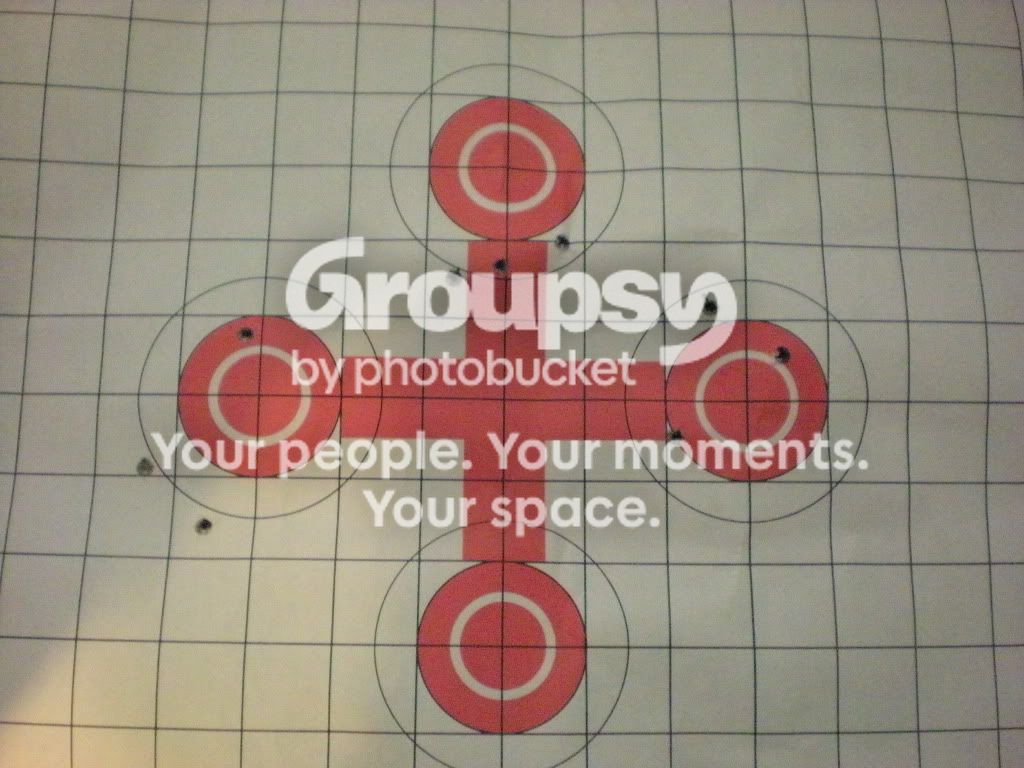
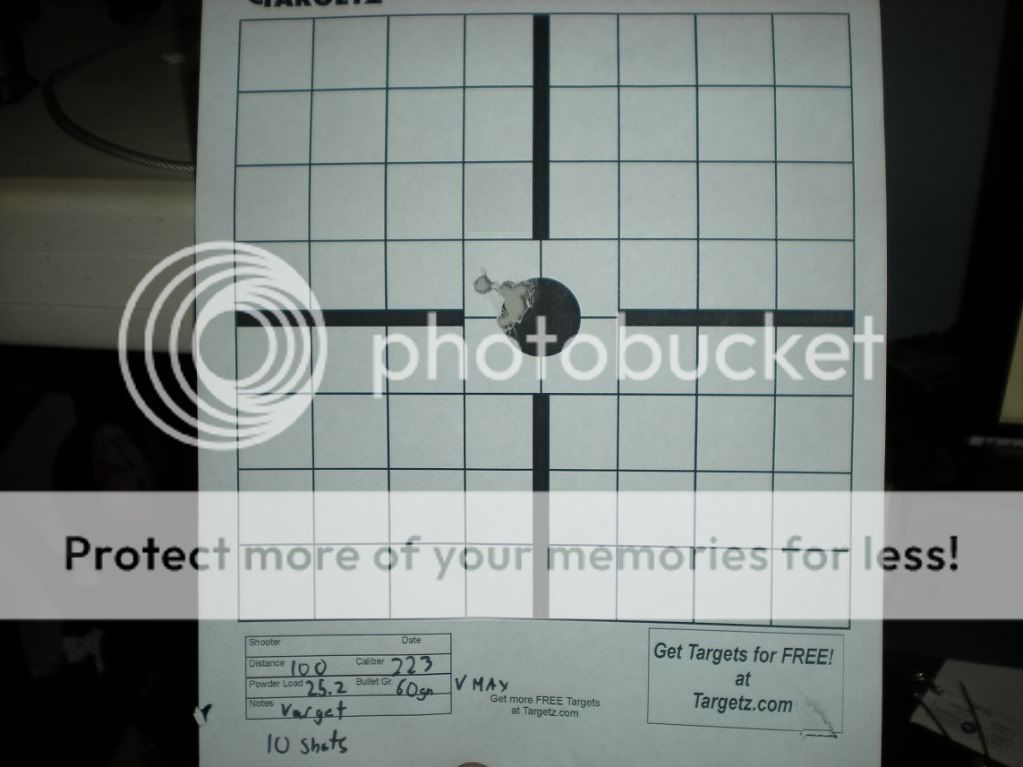
here is a nice side by side comparison for the "quality " aspect.. tell me which one you would rather be shooting

same rifle, same shooting position, weather conditions the same, and same number of "fouling" shots previous to groups

here is factory ammo - winchester 64gn fmj

DSCN0655.jpg


and here is, 60gn vmax, over varget powder.

DSCN0642-1.jpg
 
Back
Top Bottom